


The world doesn’t just need more tech startups—it needs the exact solutions sitting inside your mind right now. For women in STEM, the transition from analyzing complex data points to scaling a high-profit business isn’t just possible; it’s your distinct competitive advantage. You already possess the analytical thinking and problem-solving grit required to build disruptive software, biotech, or AI solutions. Yet, a massive gap remains between brilliant scientific concepts and commercial market success.
How do you bridge it?
Whether you are looking to secure non-dilutive government grants, build a lean MVP (Minimum Viable Product), or pitch to venture capitalists as a first-time founder, you need a repeatable blueprint. This comprehensive guide breaks down exactly how female scientists, engineers, and researchers can transition from the lab to the boardroom, monetize their intellectual property, and turn innovative STEM ideas into profitable tech startups.
Let’s unpack the exact framework to scale your tech innovation from a proof-of-concept into a market-leading business.
Why Women in STEM Excel at Building Tech Startups
The tech ecosystem moves fast, but it moves smartest when driven by data. While the traditional startup narrative often celebrates the “move fast and break things” ethos, modern tech ventures require a more calculated, precise approach to survive. This is where women in STEM hold an unfair advantage. With a foundational background in hypothesis testing, data architecture, and systemic problem-solving, female scientists, engineers, and researchers are naturally wired to build resilient, product-led companies. You don’t just stumble onto market solutions; you engineer them.
Bridging Analytical Thinking and Market Innovation
At its core, a successful tech startup is simply a validated hypothesis. The exact same rigorous training used to isolate variables in a laboratory or debug complex code applies directly to achieving product-market fit.
- Data-Driven Decision Making: Where traditional founders rely on gut feeling, a STEM-trained founder looks at user analytics, churn rates, and cohort data. This minimizes costly pivots and ensures development resources are allocated efficiently.
- First-Principles Thinking: Breakthrough innovations—whether in SaaS, DeepTech, or biotech—happen when you break a problem down to its most fundamental truths and construct a solution from there.
- The Feedback Loop: In scientific research, a failed experiment is simply a data point. In the startup world, this mentality translates to rapid iteration. When a feature fails, a STEM founder analyzes the telemetry rather than taking the loss personally.
Case Studies: Female Founders From Lab to Boardroom
True authority isn’t just theoretical; it’s proven. Across the global tech landscape, women are leveraging their specialized technical expertise to build high-valuation enterprises.
- Dr. Özlem Türeci (BioNTech): Moving from intensive clinical research to co-founding BioNTech, she utilized her deep understanding of mRNA technology to navigate complex clinical trials and scale a global biotechnology powerhouse.
- Gwynne Shotwell (SpaceX): With a mechanical engineering and applied mathematics background, Shotwell bridged the gap between complex aerospace engineering and commercial business strategy, scaling SpaceX into a massive market leader.
- Dr. Iman Abuzeid (Incredible Health): Combining her medical degree with an understanding of healthcare systems, she engineered a data-driven career marketplace for healthcare workers, turning a systemic labor shortage into a highly profitable, venture-backed marketplace.
Overcoming Biases in Male-Dominated Tech Sectors
Let’s address the elephant in the room: the tech and venture capital landscape still carries systemic biases. Statistically, female founders receive a fraction of traditional venture capital, and entering a boardroom as a technical woman often means facing unstated skepticism. However, this environment has forged an incredibly resilient class of entrepreneurs.
The STEM Advantage: When pitching to investors or negotiating enterprise contracts, your technical depth is your shield. It is exceptionally difficult to dismiss a founder who answers subjective skepticism with objective, undeniable data and tight technical architecture.
To bypass traditional bottlenecks, successful female founders are increasingly relying on objective metrics, securing non-dilutive government grants (like SBIR/STTR programs), and leveraging highly specialized incubators. By focusing on capital efficiency and building robust intellectual property (IP), women in STEM are redefining what an investable, high-growth startup looks like.
How to Turn Your STEM Concept into a Viable Product
Great ideas are a dime a dozen; validated commercial products are rare. For a technical founder, the biggest trap isn’t a lack of innovation—it’s falling in love with the technology rather than the problem it solves. To build a highly profitable startup, you must transition your concept from an academic or technical breakthrough into a viable market solution. This requires a systematic framework to ensure that what you are building has a eager, paying customer base waiting for it on day one.
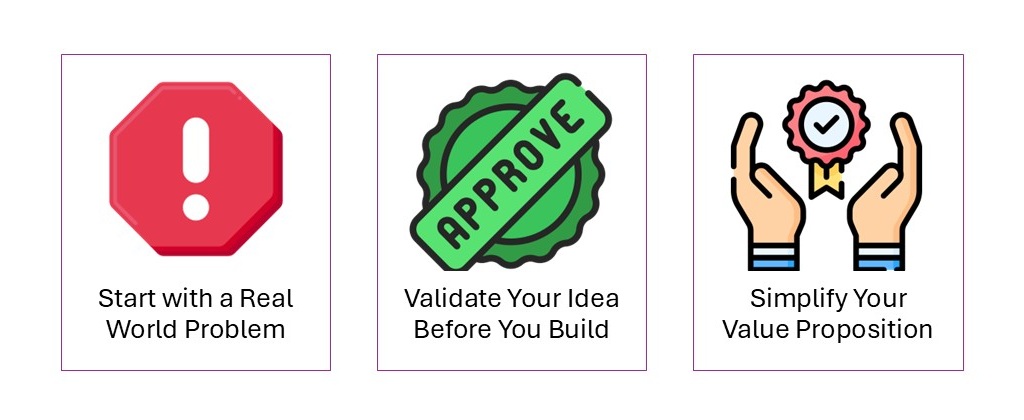
Identify High-Value Problems in AI and Biotech
The most lucrative startups don’t solve minor inconveniences; they solve bleeding-neck problems. In high-growth sectors like Artificial Intelligence (AI) and Biotechnology, profitability is directly tied to the scale of the inefficiency you are fixing.
- Look for High-Cost Inefficiencies: Target industries where manual errors cost millions or where legacy systems slow down progress (e.g., automated data pipeline cleaning in SaaS, or predictive analytics in healthcare logistics).
- The “Must-Have” vs. “Nice-to-Have” Test: A high-value problem is a “must-have” solution. If your AI model or bio-tech process reduces operational costs by 40% or cuts drug discovery timelines in half, it becomes an undeniable line-item expenditure for enterprise buyers.
- Assess Market Size & Velocity: Ensure the problem is growing, not shrinking. Focus on sectors with strong regulatory or economic tailwinds, such as ethical AI compliance, bioinformatics, or decentralized clinical trials.
Test Your Hypotheses Before Investing Heavy Capital
One of the costliest mistakes a technical founder can make is writing a single line of code or purchasing lab equipment before validating demand. Treat your startup ideas exactly like a scientific experiment: construct a hypothesis, define your metrics, and test it with the least amount of resources possible.
- Smoke Testing: Build a simple, high-converting landing page detailing your proposed tech solution and track the click-through rates on your “Request Early Access” button. This measures actual market interest, not just polite compliments.
- Conduct Discovery Interviews: Talk to at least 30 potential B2B clients or end-users. Don’t ask them if they like your idea; ask them how much they currently spend to solve the problem and what their exact pain points are with current workarounds.
- Define Your Minimum Viable Metric (MVM): Before building a full-scale platform, what is the smallest indicator of success? If you’re building an AI SaaS tool, can you manually run the backend algorithm for 5 initial clients to prove the output provides real, measurable value?
Translate Complex Tech into Simple Value Statements
As a scientist, researcher, or engineer, you understand the intricate architecture of your solution. However, investors and early customers rarely care about the underlying neural network or chemical synthesis process—they care about the outcome.
- Focus on the ROI, Not the Features: Your homepage copy and pitch deck should clearly state how much time, money, or stress your product saves. Speak in business metrics (e.g., ROI, efficiency gains, risk mitigation).
- Ditch the Hyper-Technical Jargon: If a non-technical director or angel investor cannot understand what your product does within 5 seconds of reading your headline, your value proposition is too complex.
- The “So What?” Framework: For every technical feature you are proud of, ask yourself “so what?” until you reach the emotional or financial benefit. (e.g., Our database has 99.999% uptime. So what? Your e-commerce clients never lose a sale due to server crashes.)
From Proof of Concept to a Scalable Startup Model
Moving from a validated technical concept to a scalable commercial business requires a complete shift in operations. In the startup world, brilliant code or an advanced laboratory breakthrough is only half the equation; the other half is engineering a predictable, repeatable business machine. To scale without burning through your seed capital, you must implement frameworks that allow your operational model to adapt just as quickly as your technology.
Write an Agile Business Plan for DeepTech Ventures
Traditional, 50-page business plans are dead—especially for DeepTech, AI, and biotech ventures where market dynamics and underlying technologies change weekly. Instead, successful technical founders use an agile business framework built around living documents and continuous de-risking.

- Ditch Projections for Milestones: Instead of fabricating 5-year revenue streams, tie your agile business plan to Technical Readiness Levels (TRLs) and commercial milestones (e.g., Phase 1: Secure IP patent $\rightarrow$ Phase 2: Complete beta telemetry test $\rightarrow$ Phase 3: Land 3 enterprise pilots).
- The DeepTech Canvas Focus: Shift focus toward your defensibility layer. Your business plan must explicitly define your intellectual property (IP) strategy, regulatory hurdles (FDA, GDPR, or compliance laws), and data network effects.
- Build in Weekly Sprints: Treat business operations like software development. Review your go-to-market assumptions, customer feedback metrics, and burn rate every single week to adjust your positioning before running out of runway.
Select the Best Monetization and Software Models
Your pricing structure dictates your technical architecture and your sales cycle. For a tech startup, choosing the wrong business model can kill a product before it launches. You must align your technical delivery with how your target market prefers to buy.
| Model Type | Best For | Monetization Strategy | Scale Trigger |
|---|---|---|---|
| SaaS (Software as a Service) | AI platforms, workflow automation, B2B software | Tiered monthly/annual recurring subscription fees | Expansion revenue (upselling user seats or premium features) |
| Usage-Based / API Pricing | Developer tools, data infrastructure, heavy compute AI | Pay-per-call, per gigabyte, or per compute token consumed | Increased product utilization and deep workflow integration |
| Hybrid Enterprise Licensing | DeepTech, biotech, on-premise security software | Annual base license + dedicated implementation & support fees | Contract value growth via multi-department rollouts |
Top Low-Code Tools to Build a Cost-Effective MVP
You do not need to hire a massive engineering team or spend six figures to get a working version of your product into the hands of users. Modern visual builders and AI-native scaffolding tools allow technical founders to deploy highly functional Minimum Viable Products (MVPs) in a matter of days.
- Lovable & Bolt.new (AI-Native Full-Stack): Leading options for rapid software prototyping. By simply describing your application in plain English, these tools generate clean React frontends connected to robust Supabase or Postgres backends—and the code remains fully exportable.
- Bubble (Complex Business Logic): The undisputed gold standard for web-based SaaS MVPs. Bubble provides custom database structures, visual workflows, and thousands of API connectors, making it ideal for building complex dashboards or two-sided marketplaces without writing raw code.
- FlutterFlow (Mobile-First MVPs): If your startup requires a native mobile app to utilize device hardware (like cameras, GPS, or biometric security), FlutterFlow allows you to visually design your application while compiling native Flutter and Dart code under the hood.
Top Grants, Funding, and Capital for Female Founders
Securing capital is often the most challenging hurdle for any early-stage founder, but the funding strategy for a STEM startup requires a unique blueprint. Because technical or deep-tech concepts often require significant R&D before generating revenue, relying solely on traditional venture capital early on can lead to excessive equity dilution. Maximizing your runway means blending equity-free funding with strategic investment networks that value scientific and technical innovation.
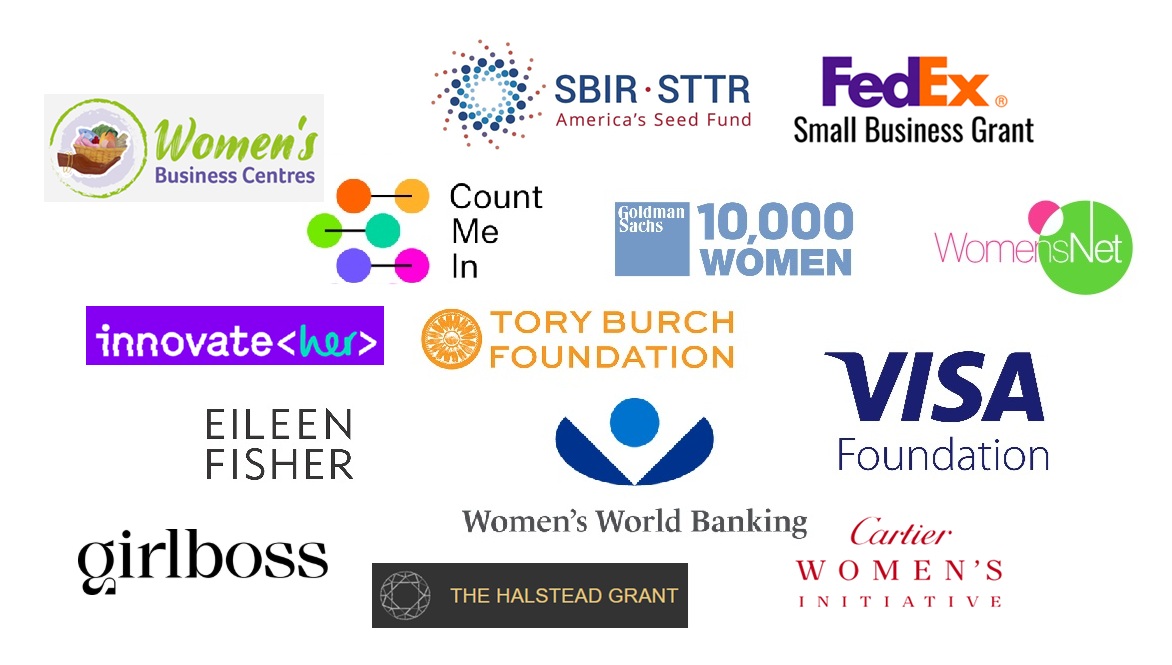
Government Grants and Elite Women-Only Accelerators
The gold standard for early-stage technical funding is non-dilutive capital—money that allows you to advance your technology without giving up ownership of your company.
- Government Innovation Grants: Programs like the SBIR (Small Business Innovation Research) and STTR in the US, or the massive Women TechEU initiative in Europe, provide substantial equity-free grants specifically for deep-tech, AI, and biotech ventures. These programs prioritize technical merit and commercial viability over current revenue.
- Elite Specialized Accelerators: Programs specifically structured around female technical founders—such as Village Capital’s Women in Tech Accelerator, She Loves Tech, and the Morgan Stanley Inclusive Ventures Lab—provide a combination of equity-free cash, intensive corporate infrastructure, and direct pathways to institutional funding.
- The Grant Advantage: Securing a competitive government or institutional grant serves as a major validation stamp. When you later pitch to private investors, having a trusted regulatory or scientific body already verify your technology drastically lowers their perceived risk.
Venture Capital, Angel Investors, and Crowdfunding
Once you have established a working proof of concept, scaling your operations usually requires private capital injections. The key is finding investors whose portfolios match your specific technical horizon.
- Targeting Venture Capital (VC): Avoid casting too wide a net. Target early-stage VC firms like Harlem Capital or specialized deep-tech micro-VCs that explicitly invest in pre-seed and seed-stage software or biotech. Look for funds where at least one general partner has a technical background.
- Tech-Focused Angel Networks: Look for specialized angel syndicates like Plum Alley Investments or Arya Women’s Investment Platform, which actively focus on investing in advanced technology, healthcare, and STEM ventures led by female executives..
- Equity Crowdfunding vs. Rewards: For consumer-facing tech or hardware, platforms like Republic or Wefunder allow you to raise capital directly from your future user base. This not only funds your initial production but simultaneously builds a built-in community of brand evangelists.
Master the Pitch Deck as a First-Time Tech Founder
A winning pitch deck for a STEM startup must strike a perfect balance between technical breakthrough and massive market potential. Investors don’t just invest in smart technology; they invest in massive business opportunities.
- The Problem-Solution Match: Dedicate your opening slides to the undeniable pain point in the market. Use clear financial or operational metrics to show exactly why the current legacy options are failing.
- The Defensibility Slide (Moat): This is crucial for STEM startups. Clearly explain your intellectual property (IP) status, proprietary datasets, or algorithmic advantages without giving away trade secrets. You need to answer the question: What stops a massive tech giant from copying this tomorrow?
- The Financial Runway and Milestones: Clearly state how much capital you are raising and exactly how far it will take you. Instead of generic line items, tie the use of funds to clear technical milestones (e.g., 70% toward engineering to reach Beta 2.0; 30% toward enterprise pilot acquisition).
How to Find the Right STEM Networks and Mentorship
Isolated brilliance will only take a startup so far; strategic hyper-connectivity is what scales it. For women transitioning from technical, academic, or corporate STEM roles into entrepreneurship, your network is your ultimate growth lever. Navigating founder-market fit, raising capital, and building infrastructure requires a specialized support ecosystem. By tapping into elite tech networks and mentorship pipelines tailored for technical women, you actively compress your learning curve and gain warm introductions to institutional investors and enterprise buyers.
Top Tech Startup Communities to Join Online and Locally
Belonging to general business groups is helpful, but engineering-led startups require communities that understand technical debt, product sprints, and data architecture.
- Women in AI (WAI) & Women in CyberSecurity (WiCyS): Global, highly active community networks providing localized chapters, technical peer reviews, and closed Slack channels dedicated to sharing resources, job opportunities, and startup advice.
- Elpha and Women Who Code Networks: Dubbed the “LinkedIn for women in tech,” Elpha offers an unvarnished space to discuss fundraising strategies, technical hiring, and co-founder agreements with thousands of technical female executives worldwide.
- Local Innovation Hubs & Research Parks: Do not overlook geographic advantages. Major research universities and local tech incubators often host regular, free-to-attend pitch nights, hacker spaces, and regional developer meetups where you can sync with local ecosystem builders.
Mentorship Programs for Female Entrepreneurs
A great mentor doesn’t just offer generic encouragement; they offer high-level tactical advice and open doors that are otherwise locked. For a technical founder, finding mentors who have successfully commercialized complex research is essential.
- Million Women Mentors (MWM) & AWIS: The Association for Women in Science (AWIS) and MWM provide structured mentorship tracks designed specifically to pair technical researchers and scientists with executive-level leaders who understand the commercialization of intellectual property.
- Techstars & Y Combinator Mentorship Networks: If you are targeting rapid venture scale, engaging with the mentor pools of top-tier accelerators provides access to veteran product managers, CTOs, and growth hackers who can audit your product roadmap in real time.
- The “Micro-Mentorship” Strategy: Don’t rely solely on formal, year-long programs. Reach out to mid-to-late stage tech founders via LinkedIn for specific, single-topic advice (e.g., “I love how you scaled your data pipelines at Company X. Can I buy 15 minutes of your time to ask how you structured your early enterprise pilots?”).
Find a Technical Co-Founder and Build a Core Team
If your background is deeply academic or research-focused, you may need a co-founder who excels at commercial execution—or vice versa. Building a balanced founding team is the number one signal of operational health to early-stage investors.
- Utilize Co-Founder Matching Platforms: Platforms like Y Combinator’s Co-Founder Matching tool and Founderio allow you to filter potential partners by technical stack, geographic location, interests, and equity expectations.
- The Complementary Skillset Matrix: Avoid hiring a mirror image of yourself. If you are an expert in deep learning algorithms (CTO track), your ideal co-founder should be an expert in B2B enterprise sales, product management, or growth marketing (CEO/Coo track).
- Implement a Vesting Schedule: Never hand over flat equity upfront. Protect your startup’s core assets by structuring all co-founder agreements with a standard 4-year vesting schedule and a 1-year cliff. This ensures that everyone remains fully incentivized and aligned on long-term execution.
Avoid These Crucial Mistakes in Your Startup Journey
Building a tech startup is an exercise in resource allocation. For founders with a background in science, engineering, or research, the biggest threats to your company rarely come from external competitors; they come from internal operational blind spots. Because your comfort zone lies in solving complex technical problems, it is easy to over-index on product development while neglecting market realities and legal protections. Recognizing these specialized structural traps early is the difference between a high-growth enterprise and a costly research project.
Beware of Over-Engineering the Product Too Early
Technical founders often fall victim to “feature creep”—the urge to build a flawless, fully optimized, enterprise-ready system before getting real feedback from the market. In the startup ecosystem, perfectionism is a liability.
- The Danger of the Perfect Monolith: Spending six to twelve months building complex backend architectures, scaling data pipelines for millions of hypothetical users, or fine-tuning AI models to 99.9% accuracy before launch wastes precious capital. You run the risk of building a beautifully engineered product that nobody actually wants to buy.
- Embrace the “Good Enough” Architecture: Your initial Minimum Viable Product (MVP) should be built for validation, not infinite scalability. Use modular code, leverage third-party APIs, and build just enough functionality to solve the core problem for your first 10 to 50 users.
- Prioritize Feedback Over Telemetry: No amount of automated testing can replicate a real human trying to navigate your user interface. Launch early so you can observe where users get confused, what features they actually use, and what parts of your technical stack need to be rebuilt based on real-world demand.
Protecting Intellectual Property and Patent Laws
For a STEM startup, your intellectual property (IP) is often your most valuable asset and your primary competitive moat. However, mishandling your legal protections early on can permanently destroy your company’s long-term valuation and scare off institutional investors.
- Understand the Public Disclosure Trap: This is the single most common mistake made by academic researchers and scientists. If you publish your core algorithms, present your findings at a public conference, or open-source your proprietary code before filing for protection, you can inadvertently destroy your ability to secure a patent.
- File a Provisional Patent Early: You do not need to wait for a finalized, perfect product to secure your rights. Filing a provisional patent application gives you a low-cost, 12-month window to stamp a “Patent Pending” label on your tech. This protects your concepts while you validate the market and build your MVP.
- Clean IP Chain of Title: Ensure that every line of code, design asset, and research paper belongs completely to the business entity, not to individual creators. If you built your initial tech using a university’s lab equipment, an employer’s laptop, or hired freelance developers without a clear “Work Made for Hire” agreement, your IP is compromised. Clear up ownership structures immediately with formal assignment documents.
Strategic Scaling Methods to Maximize ROI and Profit
Scaling a tech company isn’t about spending more money; it’s about maximizing the efficiency of your capital. For a technical founder, transitioning from product development to market expansion means treating your growth funnel exactly like a software system. To generate high investment returns (ROI) and achieve long-term profitability, you must replace guesswork with scalable distribution mechanics. By running targeted, measurable growth campaigns, you ensure your startup scales predictably without burning through its cash reserves.
Deploy Data-Driven Marketing for B2B Tech Startups
Organic growth is built on precision targeting. B2B tech marketing requires speaking directly to technical decision-makers and corporate buyers who care about performance metrics, security, and systemic integration.
- Own High-Intent Search Traffic: Invest in Search Engine Optimization (SEO) by targeting long-tail, high-intent keywords relevant to your niche (e.g., “automated bioinformatics pipelines for pharma” or “enterprise compliance software for AI”). Building comprehensive, search-optimized technical content positions your brand as an industry authority and brings in highly qualified leads organically.
- Map Content to the Buyer’s Journey: Corporate buyers require multiple touchpoints before purchasing. Structure your content funnel logically:
- Top-of-Funnel (TOFU): Educational blog posts and industry whitepapers addressing broad operational challenges.
- Middle-of-Funnel (MOFU): Detailed technical documentation, API architecture guides, and deployment checklists.
- Bottom-of-Funnel (BOFU): Direct ROI calculators, feature comparison tables, and case studies highlighting implementation success.
- Measure Customer Acquisition Cost (CAC): Track exactly how much marketing budget it takes to acquire a single paying user. Compare this against your Customer Lifetime Value (LTV) to ensure your marketing spend is highly profitable over time.
Secure Strategic Partnerships to Acquire Customers
Trying to win every single customer through direct sales is slow and expensive. The fastest way to scale a STEM startup is to leverage existing ecosystems through structured corporate and distribution partnerships.
- Target Complementary Platforms: Identify non-competing software companies or service providers who already sell to your target audience. For instance, if you have built a specialized medical imaging AI tool, partnering with an established Electronic Health Record (EHR) vendor allows you to instantly pitch to their entire user base.
- Co-Marketing Initiatives: Collaborate with your partners on technical webinars, joint whitepapers, or co-branded case studies. This expands your reach, builds industry credibility, and delivers warm, pre-qualified leads directly into your sales funnel.
- White-Labeling and Integrations: Allow larger enterprise players to bundle your technology inside their existing software suites or marketplaces. While this may reduce individual unit margins slightly, the sheer volume of customer acquisition can rapidly accelerate your recurring revenue.
Use Analytics to Drive Product-Led Growth Engine
Product-Led Growth (PLG) means your actual product serves as the primary driver of customer acquisition, retention, and expansion. By analyzing how users interact with your software, you can optimize the user experience to drive self-serve revenue growth.
- Optimize the Time-to-Value (TTV): The moment a user signs up for your tech platform, the clock starts ticking. Your onboarding process must guide them to their first “Aha!” moment—the exact point where they experience the tangible value of your tool—as quickly and frictionlessly as possible.
- Instrument Your In-App Telemetry: Use robust product analytics tools (like Mixpanel, Amplitude, or PostHog) to track user behavior within your app. Monitor where users drop off in your onboarding flow, what specific features drive long-term retention, and what technical roadblocks cause user churn.
- Build Inherent Growth Loops: Build features into your software that naturally encourage users to invite colleagues or partners. This includes seamless workspace sharing, collaborative dashboards, or public-facing reporting links that showcase your product’s capabilities to external audiences, creating a viral loop of organic signups.
Empowering the Next Wave of Female Tech Innovators
The future of technology cannot be built effectively using only half of the world’s brainpower. Transitioning from a STEM practitioner to a tech entrepreneur is more than a personal career move—it is a systematic disruption of the status quo. By taking your specialized knowledge out of the lab, office, or classroom and building a scalable commercial entity, you create a blueprint for the next generation of female founders to follow.
The Ripple Effect of Female-Led Tech Ventures
When a woman in STEM successfully commercializes her technical ideas, the impact extends far beyond her company’s bottom-line profitability.
- Redefining the Executive Persona: Every time you pitch to a venture capitalist, lead an engineering sprint, or close an enterprise client, you dismantle outdated stereotypes about who belongs at the helm of a deep-tech company.
- Creating Inclusive Technical Cultures: Female founders statistically hire more diverse engineering, data, and leadership teams. By scaling your startup, you inherently build a more equitable tech ecosystem from the ground up.
- Solving Overlooked Problems: Diverse leadership brings a broader perspective on what problems are worth solving. From bias mitigation in machine learning algorithms to innovative healthcare delivery systems, your unique lens drives meaningful technological progress.
Your Launch Roadmap Starts Today
The ideal conditions for launching a startup do not exist; you must create them through action. If you have a validated technical concept, a line of proprietary code, or an innovative process designed to fix a major market inefficiency, the ecosystem is ready for you.
- Protect Your IP First: Secure your provisional patent or clean up your software title of chain before making public disclosures.
- Build for Validation, Not Perfection: Leverage modern low-code tools or AI-native scaffolds to get a functional version of your MVP into the hands of real users within weeks, not months.
- Lean Into Your Technical Advantage: When navigating funding or market skepticism, let your data, architecture, and objective ROI metrics do the heavy lifting.
The tech world doesn’t just need more startups—it needs your specific technical expertise, your rigorous problem-solving framework, and your vision. It’s time to step out of the background and build the future.
By Aveline Lowell
Founder & Editor-in-Chief, RiseByHer
Aveline Lowell writes research-driven content covering women’s finance, entrepreneurship, STEM, technology, and career growth. Her work focuses on practical, well-researched information that helps women make informed decisions.
Editorial & Disclaimer: RiseByHer aims to provide accurate, well-researched, and up-to-date information. Articles are reviewed and updated when necessary and are intended for general informational and educational purposes, not personalized financial, legal, tax, or professional advice.