

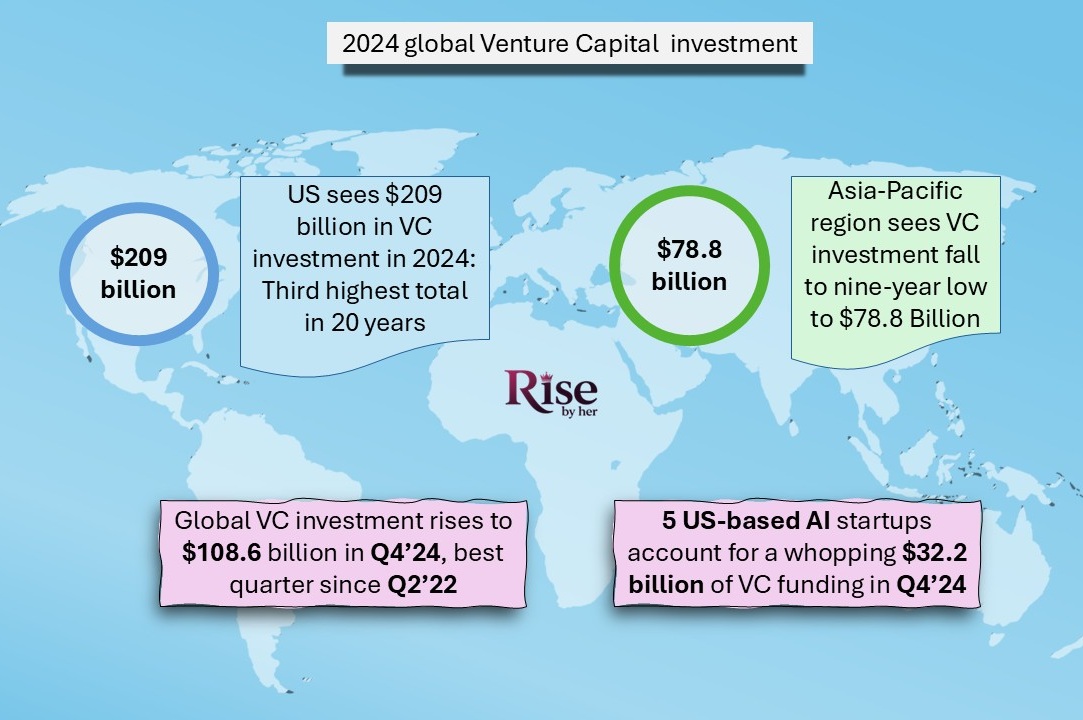
Venture funding is startup financing where investors, such as venture capital firms and angel investors, provide capital in exchange for equity in high-growth businesses. It is designed for startups that are ready to scale quickly and need significant funding to expand operations, develop products, or enter new markets.
In 2026, venture funding continues to be a key growth driver for startups across technology, healthcare, and consumer industries. For women entrepreneurs, it offers access to larger investment rounds and strategic support, but funding gaps still exist due to limited networks and persistent investment bias.
This guide explains the main types of venture funding, how each option works, and highlights top venture capital firms actively investing in women-led startups in 2026.
Why Funding & Accelerators Matter for Women Entrepreneurs
Securing funding and joining accelerator programs are crucial for women entrepreneurs looking to scale their businesses. Unfortunately, women still face significant barriers when it comes to accessing venture capital. Research shows that female entrepreneurs receive less than 10% of all venture capital funding, despite owning a growing number of businesses. This gender gap in startup funding makes it harder for women to grow their companies, create jobs, and innovate.
However, the importance of venture funding and accelerator programs cannot be overstated. These resources not only provide financial backing but also offer mentorship, networking opportunities, and exposure to potential investors. For women entrepreneurs, joining an accelerator program can significantly increase the chances of success by providing the necessary tools and guidance to scale their startups.
Accelerators focused on women-led businesses are especially valuable. They understand the unique challenges faced by women entrepreneurs, including limited access to funding, gender bias, and balancing work and family responsibilities. Programs like these create an inclusive environment, offering support that goes beyond funding.
In short, funding and accelerators are key to leveling the playing field for women entrepreneurs, enabling them to succeed and make a lasting impact in the business world.

How Women Entrepreneurs Can Prepare for Venture Funding
Before approaching investors, women entrepreneurs need to ensure their business is structurally and financially ready for venture funding. Venture capitalists look for scalability, strong market potential, and clear evidence that a business can grow quickly with the right investment.
1. Building a Scalable Business Model
Investors prioritize businesses that can grow without costs increasing at the same rate. A scalable model shows that your product or service can reach larger markets efficiently, whether through technology, automation, or repeatable systems.
2. Creating a Strong Pitch Deck
A pitch deck is often the first impression investors have of your business. It should clearly explain your problem, solution, market opportunity, revenue model, traction, and funding needs in a concise and compelling way.
3. Understanding Revenue Traction Requirements
Most venture capital firms expect some level of traction, even at early stages. This can include growing revenue, active users, signed contracts, or strong customer demand that proves market validation.
4. Improving Financial and Legal Readiness
Clean financial records, clear business structure, and proper legal documentation are essential before fundraising. Investors need confidence that your business is well-organized, compliant, and ready for due diligence.
How Women Entrepreneurs Move from Early Funding to Venture Capital
Women entrepreneurs typically do not raise venture capital first. Instead, funding usually follows a step-by-step progression, where each stage helps validate the business, build traction, and unlock access to larger investment rounds.
Bootstrapping (Self-Funding the Business)
Many founders start by using personal savings or early business revenue to launch and validate their idea. This stage is focused on proving demand while maintaining full ownership and control.
Grants and Non-Dilutive Funding
At the early stage, many women entrepreneurs rely on grants, competitions, or government programs to secure capital without giving up equity. This funding helps build the foundation of the business and reduce financial risk.
Angel Investment (Early External Capital)
Once a business shows initial traction, angel investors often step in to provide seed funding. In addition to capital, they typically offer mentorship, industry insight, and valuable investor connections.
Venture Capital (Scaling Stage Funding)
Venture capital usually comes later, when a startup has proven market demand, scalable operations, and strong growth potential. VC funding is designed to accelerate expansion rather than validate the initial idea.
When to Move Between Funding Stages
The transition between funding types depends on business maturity. Founders typically move from bootstrapping to grants or angel funding once they have a validated product, and pursue venture capital when they can demonstrate consistent growth, revenue traction, or clear scalability.
Common Mistakes When Raising Too Early
One of the most common mistakes is seeking venture capital before the business is ready, which can lead to rejection or undervaluation. Another issue is skipping early-stage funding opportunities that could strengthen traction and improve long-term investor confidence.
Types of Venture Funding Available for Women Entrepreneurs
For women entrepreneurs looking to scale their businesses, understanding the different types of venture funding is crucial. Each funding option comes with its own set of features, making it important to select the right type for your business. Here, we explore the most common funding sources available to women entrepreneurs and how each can support your journey.
1. Angel Investors – Early-Stage Funding from Individual Investors
Angel investors are high-net-worth individuals who invest their personal funds in early-stage startups. These investors are particularly valuable for women entrepreneurs who need capital to get their business off the ground.
Angel investors often seek businesses with high growth potential, offering not only financial support but also mentorship and valuable industry connections. This type of funding is typically used to refine business models, develop products, and prepare for more significant investment rounds.
One of the most effective ways to get early-stage capital is to understand How to Secure Angel Investment for Women-Led Startups?, especially when preparing your pitch and targeting the right investors.
2. Venture Capital (VC) Firms – Investment Firms Backing Scalable Startups
Venture capital (VC) firms are investment organizations that provide funding to startups with high growth potential. These firms typically invest in businesses that have moved beyond the stage and are looking to scale rapidly.
For women entrepreneurs, securing venture capital can significantly accelerate business growth, providing the resources needed for expansion, marketing, and hiring. In addition to capital, VC firms often offer strategic guidance, expertise, and networking opportunities, helping businesses refine their operations and position themselves in the market.
3. Grants & Government Funding – Non-Dilutive Funding Options
Grants and government funding offer women entrepreneurs’ non-dilutive capital, meaning there is no need to give up equity in the business. These funds are provided by government agencies, nonprofit organizations, and private foundations to promote innovation, economic development, and job creation.
Women entrepreneurs can find specific grants designed to support businesses that align with social impact goals or encourage women’s involvement in traditionally male-dominated industries. These funds are often more accessible than traditional venture capital and allow entrepreneurs to retain full control of their businesses.
4. Crowdfunding & Alternative Financing
Crowdfunding platforms like Kickstarter, Indiegogo, and GoFundMe enable women entrepreneurs to raise capital from a wide base of small investors. By sharing their business ideas or products with the public, entrepreneurs can attract funding in exchange for rewards, early access to products, or other incentives.
In addition to traditional crowdfunding, women entrepreneurs can explore alternative financing options such as revenue-based financing or peer-to-peer lending, which allow businesses to secure funds based on future revenue without giving up equity. These options provide a more flexible way to raise capital while also offering a platform for marketing and brand exposure.
Explore more here: Best Crowdfunding Sites to Empower Women Entrepreneurs
Challenges Women Entrepreneurs Face in Venture Funding
Women entrepreneurs continue to face structural barriers in accessing venture capital, which can impact both fundraising success and long-term business growth. Recognizing these challenges helps founders prepare stronger strategies and improve their positioning with investors.
- Funding bias and the gender gap: Women-led startups receive a smaller share of venture capital funding, often influenced by unconscious bias and underrepresentation in investment decision-making roles
- Limited access to investor networks: Many venture funding opportunities depend on warm introductions, which women entrepreneurs may have less access to compared to male founders
- Lower initial valuations: Some women-led startups may receive lower early valuations, which can affect equity ownership and future fundraising rounds
- Lack of mentorship and strategic support: Beyond capital, many founders miss out on investor mentorship and high-level guidance that can accelerate scaling and fundraising success
10 Best Venture Capital Firms Investing in Women Entrepreneurs (2026)
When it comes to securing venture capital, women entrepreneurs can turn to a variety of firms that are either female-focused or have specific programs dedicated to investing in women-led startups. Below, we highlight some of the leading VC firms supporting women entrepreneurs in 2026, alongside the key criteria these firms look for when evaluating startups.
1. BBG Ventures
BBG Ventures is one of the leading female-focused venture capital firms, specializing in funding women-led businesses. They focus on early-stage investments and support companies in sectors like consumer products, media, and technology. BBG Ventures aims to back startups that have strong growth potential and address significant market opportunities. They look for innovative ideas and high-performing teams that can scale quickly.
Key Investment Criteria:
- Strong, diverse founding team with women in leadership roles.
- Market-leading products or services with a clear value proposition.
- Potential for rapid growth and scalability.
Official Website: BBG Ventures
2. Female Founders Fund
Female Founders Fund (FFF) is a top venture capital firm that invests in women-led businesses across various industries, including technology, health, and consumer goods. FFF is known for supporting women entrepreneurs who are building scalable, high-growth companies with innovative solutions. They are committed to creating a more inclusive ecosystem by empowering women founders.
Key Investment Criteria:
- Women founders or co-founders with strong entrepreneurial experience.
- High-growth potential businesses with disruptive technologies or innovative business models.
- Passionate teams committed to solving large-scale problems.
Official Website: Female Founders Fund
3. Backstage Capital
Backstage Capital focuses on investing in underrepresented entrepreneurs, particularly women, people of color, and LGBTQ+ founders. Backstage Capital offers seed and early-stage funding, supporting companies in industries like tech, healthcare, and consumer products. Their mission is to close the funding gap for underrepresented groups and provide equal opportunities in the startup ecosystem.
Key Investment Criteria:
- Underrepresented founders, with a strong commitment to inclusivity and diversity.
- Early-stage startups with innovative products and market potential.
- Founders who demonstrate resilience, leadership, and passion for their businesses.
Official Website: Backstage Capital
4. Kapor Capital
Kapor Capital is another VC firm that prioritizes diversity and inclusion. They invest in seed-stage startups led by founders from diverse backgrounds, with a focus on companies solving significant social issues. Kapor Capital looks for businesses that aim to close gaps in access and opportunity, creating value for underserved communities.
Key Investment Criteria:
- Strong, diverse founding teams committed to social impact.
- Startups with scalable solutions to pressing societal issues.
- Potential for long-term profitability and market leadership.
Official Website: Kapor Capital
5. Rise of the Rest (by Steve Case)
Rise of the Rest, founded by Steve Case (co-founder of AOL), is a venture capital fund that invests in startups outside of traditional tech hubs like Silicon Valley. They have a specific focus on supporting women entrepreneurs in emerging markets. The firm offers both funding and mentorship, focusing on early-stage companies in diverse industries that show promise and the ability to scale.
Key Investment Criteria:
- Strong founding teams, with a focus on diverse leadership.
- Businesses outside of traditional tech hubs with high-growth potential.
- Companies solving meaningful problems with scalable solutions.
Official Website: Rise of the Rest
6. Sequoia Capital
Sequoia Capital is one of the most well-known general venture capital firms, but they have increasingly focused on investing in women-led startups. Their women-focused programs, like the Sequoia Women in Tech initiative, provide funding to startups led by women, particularly in the tech sector. Sequoia has a proven track record of supporting high-growth companies, and they provide strategic guidance to help startups succeed.
Key Investment Criteria:
- Scalable, innovative startups with strong product-market fit.
- Founding teams with demonstrated leadership, including women in key roles.
- Businesses with potential to become market leaders.
Official Website : Sequoia Capital
7. Accel
Accel is a global venture capital firm that invests in early to growth-stage companies. While Accel is a general VC firm, they have specific initiatives aimed at supporting women entrepreneurs and increasing diversity within the tech and innovation sectors. Accel focuses on high-growth companies in software, cloud computing, and mobile technologies.
Key Investment Criteria:
- Companies with disruptive technologies or business models.
- Founders who demonstrate exceptional vision, leadership, and industry knowledge.
- Startups that show strong growth potential in their respective markets.
Official Website : Accel
8. The Venture Reality Fund (VRF)
The Venture Reality Fund (VRF) is a prominent VC firm focused on investing in virtual reality (VR), augmented reality (AR), and AI startups, many of which are women-led. With a particular emphasis on cutting-edge technology, VRF has a history of backing female entrepreneurs in the tech space. The firm looks for businesses that are innovating in immersive technologies and have the potential to revolutionize industries.
Key Investment Criteria:
- Startups focused on immersive technologies like VR, AR, or AI.
- Founding teams with a passion for innovation and high technical expertise.
- Companies are poised to disrupt industries with new tech solutions.
Official Website : The Venture Reality Fund
9. Golden Seeds
Golden Seeds is a leading angel investment firm focused on supporting women entrepreneurs. They invest in early-stage women-led companies across a wide range of industries, from tech to healthcare. Golden Seeds is committed to funding women entrepreneurs who are building innovative businesses with the potential to scale.
Key Investment Criteria:
- Women-led startups with scalable business models.
- Businesses in industries such as tech, healthcare, consumer goods, and more.
- Strong leadership teams with a clear vision for growth.
Official Website : Golden Seeds
10. Astia
Astia is a global network and investment firm that focuses on empowering women entrepreneurs by providing venture capital, guidance, and mentorship. They invest in companies led by women, with a particular focus on tech, life sciences, and healthcare startups. Astia’s mission is to support women founders by connecting them to capital and a network of experts to help them grow.
Key Investment Criteria:
- Women-led startups in high-growth sectors like technology and healthcare.
- Founders who are passionate about solving significant global challenges.
- Companies with scalable solutions and innovative business models.
Official Website : Astia
FAQs About Venture Funding for Women Entrepreneurs
Do venture capital firms invest in women-led startups?
Yes, many venture capital firms invest in women-led startups, especially those with strong growth potential, scalable business models, and clear market demand. However, competition is high, and access can still vary depending on industry and investor networks.
How much equity do venture capitalists take?
Venture capitalists typically take between 10% and 30% equity in early-stage funding rounds. The exact percentage depends on the startup’s valuation, funding amount, growth stage, and negotiation terms.
What is the difference between angel investors and venture capital firms?
Angel investors are individuals who invest their personal money in early-stage startups and often provide mentorship. Venture capital firms invest pooled funds from multiple investors and usually focus on scaling businesses with proven traction and high growth potential.
Can early-stage startups get venture capital funding?
It is possible, but uncommon. Most venture capital firms prefer startups that already demonstrate traction such as revenue, user growth, or product-market fit. Early-stage startups often start with angel investment or seed funding first.
What do venture capitalists look for in women entrepreneurs?
Venture capitalists typically look for scalability, strong market opportunity, a clear revenue model, competitive advantage, and a capable founding team with execution ability and growth vision.
How long does it take to raise venture capital funding?
The process can take anywhere from 3 to 9 months on average. It depends on investor interest, business readiness, market conditions, and how quickly due diligence is completed.
Do women entrepreneurs have access to special VC funds?
Yes, there are venture capital firms and funds specifically focused on supporting women-led startups, as well as diversity-focused investment initiatives that prioritize underrepresented founders.
What is a typical stage for raising venture capital?
Most startups raise venture capital at the seed, Series A, or Series B stages, once they have validated their product, achieved early traction, and demonstrated scalable growth potential.
Can you raise venture capital without revenue?
Yes, but it is more difficult. Pre-revenue startups can sometimes raise VC funding if they show strong market potential, a compelling product, experienced founders, and clear traction signals such as users or pilot programs.
Conclusion
Venture funding can be a powerful growth driver for women entrepreneurs, but success depends on preparation, timing, and choosing the right funding path rather than rushing into venture capital too early.
To increase your chances of securing investment, focus on a clear progression strategy. Start by validating your business through bootstrapping or early-stage funding, then strengthen your position with grants or angel investment before approaching venture capital firms.
- Apply to funding types in the right order, starting with early validation sources before moving to equity-based funding
- Build investor readiness first by refining your business model, traction, pitch deck, and financial structure
- Start networking early by connecting with investors, mentors, and startup communities before you actively raise funds
Women entrepreneurs who succeed in venture funding are typically those who prepare early, build strong fundamentals, and treat fundraising as a long-term strategy rather than a one-time event.

By Aveline Lowell
Founder & Editor-in-Chief, RisebyHer
Aveline Lowell is the Founder and Editor-in-Chief of Rise by Her, where she publishes research-driven content focused on women’s entrepreneurship, financial independence, and scalable income strategies. Her work covers profitable business models, grant opportunities, digital income growth, and strategic career advancement for modern women building sustainable wealth.
She is committed to providing structured, practical guidance that helps women make informed financial and business decisions.