

The artificial intelligence boom isn’t just changing software—it’s rewriting the rules of the entire workforce. For women in tech, mastering artificial intelligence skills is no longer just a resume booster; it’s the ultimate leverage to bypass traditional tech gatekeepers, secure remote flexibility, and land high-paying roles.
Whether you want to break into AI engineering, transition into data science, or future-proof your current role, we’ve cut through the noise. Here are the best AI learning platforms designed to help women build confidence, master technical skills, and dominate the tech landscape today.
Why AI Skills Are Essential for Women in Tech Careers Today
The artificial intelligence shift is no longer a futuristic prediction—it is actively redrawing the tech landscape. For women looking to future-proof their careers, learning AI is the most effective way to secure high-leverage roles, claim premium salaries, and build bulletproof job security. If you want to control where the tech industry is going, you need to understand the technology driving it
AI Innovation Is Reshaping Every Modern Career Path
AI is no longer confined to backend engineering teams; it is the fundamental infrastructure powering every modern business department. From algorithmic marketing and automated financial forecasting to AI-driven product management, intelligent workflows are replacing legacy systems.
Staying relevant requires moving from an AI user to an AI builder. Understanding how data pipelines, large language models (LLMs), and automated systems function ensures you are leading digital transformations rather than navigating the layoffs associated with disrupted, non-technical roles.
High Industry Demand for AI-Skilled Tech Professionals
The current tech market faces a massive talent deficit: organizations are eager to implement machine learning frameworks, but they face a critical shortage of skilled talent to execute them. Industry data reveals a staggering mathematical wall in the current workforce.
The 2026 AI Talent Deficit
Global enterprise AI demand now outpaces qualified supply by a 3.2 to 1 ratio. Currently, there are over 1.6 million open AI positions worldwide chasing a talent pool of just 518,000 certified professionals.
Because demand heavily outpaces supply, anyone who acquires practical AI literacy immediately becomes a highly competitive candidate. Companies are actively expanding internal investments to land talent capable of managing, implementing, and optimizing intelligent systems.
Securing Better Salaries and Remote Work Opportunities
Specialized technical skills yield significant financial leverage. Tech leaders regularly offer substantial premiums for machine learning and data science expertise, with AI roles commanding up to a 67% salary premium over traditional software engineering positions.
| Job Title (2026 Data) | Median Remote Salary | Market Demand |
|---|---|---|
| AI / Machine Learning Engineer | $194,000 | Very High |
| AI Product Manager | $150,000 | High |
| Data Scientist | $153,750 | High |
Furthermore, because AI development relies entirely on cloud infrastructure and digital collaboration, these positions offer unmatched geographic flexibility. Over 52% of remote tech workers are women, making AI expertise a direct pathway to high-paying, fully remote corporate autonomy.
Actively Closing the Gender Gap in Emerging Technology
The global AI workforce remains heavily male-dominated. While women have achieved near-parity in general higher education, the technical architecture of tomorrow’s software is still missing critical perspectives.
AI Workforce Representation
- Male Professionals: 74%
- Female Professionals: 26%
Note: This representation drops even further to just 18% for specialized Machine Learning Engineer roles.
When women actively enter the AI space, the technology itself improves. Diverse technical teams have been shown to reduce algorithm bias errors by 15%. By mastering these tools, you don’t just land a cutting-edge job—you directly influence the equity and ethics of the systems shaping tomorrow’s world.
Structural Barriers Women Face When Entering the AI Field
Breaking into artificial intelligence can feel like attempting to decode a black-box algorithm. While the market demand is undeniable, the road into the industry features systemic friction points that uniquely impact women. Recognizing these structural roadblocks isn’t about admitting defeat—it is about mapping the terrain so you can navigate past it with precision.
Overcoming a Lack of Technical Background and Coding
A widespread misconception is that you need a Ph.D. in pure mathematics or advanced Python expertise to touch artificial intelligence. This narrative creates an artificial barrier to entry, discouraging brilliant problem-solvers from entering the field. While core engineering roles require deep code mastery, the modern AI ecosystem relies heavily on diverse functional skill sets.
To bypass this barrier, focus on how your current skills intersect with intelligent systems:
- Domain Expertise: AI models need industry context. Understanding healthcare, finance, or marketing workflows is highly valuable for training and deploying accurate models.
- Low-Code/No-Code Frameworks: The rise of modern visual ML tools allows you to build, test, and deploy models without writing complex backend architecture from scratch.
- Functional Roles: Positions like AI Product Management, Prompt Engineering, and AI Ethics require deep logical thinking and strategic oversight rather than raw coding speed.
Navigating the Gender Gap and Workplace Bias in Tech
The technology sector’s historic struggle with diversity is amplified within advanced machine learning teams. Women frequently face subtle workplace biases, ranging from being talked over in technical design reviews to being funneled into administrative tasks rather than core algorithmic development.
Navigating this reality requires defensive, data-driven positioning:
- Vet Prospective Employers: When interviewing, actively look for teams that showcase diverse technical leadership and transparent, merit-based promotion paths.
- Document Technical Contributions: Keep a running log of your architectural decisions, code commits, and model improvements.
- Tie Work to Revenue: Always link your output directly to quantifiable business metrics, such as a 12% increase in model processing speed or a reduction in cloud-compute costs.
Dealing with Limited Access to Mentors and Role Models
It is incredibly difficult to project yourself into a leadership position when the podium is entirely homogeneous. The distinct lack of visible female machine learning executives, researchers, and principal engineers makes navigating an AI career path feel isolating. Without insider guidance, finding structured learning materials becomes twice as hard.
The Sponsorship Shift: While mentoring provides great advice, sponsorship drives actual career progression. Seek out senior leaders—regardless of gender—who have the organizational capital to advocate for your inclusion in high-visibility AI projects.
Simultaneously, you can bypass isolated corporate structures by plugging into global, external networks. Joining dedicated communities provides the immediate reference architectures, peer accountability groups, and hidden job boards needed to advance.
Conquering Imposter Syndrome and Confidence Barriers
Because the field of artificial intelligence evolves daily, even veteran engineers struggle to keep pace with the velocity of new research papers. This constant shift frequently triggers imposter syndrome, leading many qualified women to count themselves out before they even try.
- The Internal Standard: Internal studies across the tech sector show that women frequently hesitate to apply for a role unless they meet 100% of the criteria, whereas peers with different backgrounds often apply when meeting just 60%.
- Wish Lists vs. Realities: Recognize that job descriptions in emerging tech are essentially corporate wish lists written by HR teams, not rigid baselines.
- Build Public Proof: Shift your energy from “knowing everything” to building a public repository of your work. Documenting your learning journey on professional networks turns your growing technical skills into an undeniable, visible asset.
How to Choose the Right AI Learning Platform for Success
Selecting an artificial intelligence training program isn’t about finding the platform with the flashiest marketing; it is about finding the one that bridges the gap between your current technical reality and your future career ambitions. With thousands of courses circulating online, you must evaluate choices systematically to protect your time and financial investments.
Define Your AI Career Goals from Data to Engineering
Before clicking “enroll” on any platform, you must establish your specific destination within the vast landscape of artificial intelligence. Artificial intelligence is not a singular job title; it is an ecosystem with distinct technical demands.
- The Analytical Path (Data Science & Analytics): Focuses on statistics, predictive data modeling, and data extraction using tools like Python, R, and SQL. Look for platforms that excel in data wrangling and business intelligence.
- The Architectural Path (AI & Machine Learning Engineering): Requires deep technical execution, deep learning frameworks (like PyTorch or TensorFlow), and deployment pipelines. Platforms offering deep-dive neural network architecture are your target.
- The Functional Path (AI Product Management & Strategy): Focuses on the business integration, ethics, and scaling of AI applications rather than raw backend code. Look for high-level enterprise modules that emphasize product lifecycles.
Evaluate Beginner-Friendliness and Learning Structures
Emerging technologies carry a steep learning curve. Jumping straight into mathematical formulas can stall your momentum before you even build your first script.
A high-converting educational architecture should offer a scaffolded curriculum that assumes zero prior computer science exposure. Look for courses that introduce complex concepts via microlearning blocks—bite-sized video segments paired with instant knowledge checks. A high-quality platform handles math and syntax as scalable layers, introducing advanced concepts naturally as your practical confidence grows.
Prioritize Hands-On Projects and Practical Exercises
Theoretical comprehension does not pass technical interviews. Modern enterprise organizations do not look at certificates; they look at code commits, execution logic, and live application deployment.
When evaluating a curriculum, prioritize platforms built around interactive learning environments:
- Embedded Coding Sandboxes: Look for browser-based environments that allow you to write and execute code immediately without wasting hours troubleshooting local system configurations.
- Real-World Datasets: Ensure the practice sets use messy, non-linear enterprise data rather than pristine, pre-cleaned textbook examples.
- End-to-End Deployment: The best courses require you to take a model from local training environments and deploy it as a functioning API or web interface.
Seek Out Global Mentorship and Active Community Forums
Online learning can feel highly isolated, and isolation is the primary driver of high course drop-out rates. When you hit a complex bug in your data science pipeline, waiting days for an email response kills your momentum.
Top-tier learning ecosystems integrate thriving human support networks directly into their infrastructure. Look for platforms that feature peer accountability groups, live slack channels, and scheduled office hours with industry practitioners. Having access to a global network of peers and mentors provides the structural safety net required to troubleshoot errors in real time and secure referrals for unlisted job openings.
If you want extra support on your career journey, check out How Mentorship Programs Boost Career Growth for Women.
Analyze Cost Differences Between Free and Paid Courses
Acquiring premium technical talent doesn’t require emptying your bank account, but it does require understanding what your financial investment is actually buying.
| Platform Type | Pricing Metric | Best For | What You Are Buying |
|---|---|---|---|
| Open Audits (Free) | $0 | Initial Exploration | Access to video lectures and lecture notes without graded feedback. |
| SaaS Subscriptions | $25 – $49 / month | Consistent Upskilling | Structured learning paths, portfolio reviews, and technical badges. |
| Immersive Bootcamps | $5,000+ | Fast-Track Transitions | Live instruction, dedicated career coaches, and job placement guarantees. |
If you are a self-starter who simply needs raw information, leverage massive open online courses (MOOCs) via free audit modes. However, if your primary goal is career transformation, paying for a premium tier is often worth the expense. Paid tracks unlock the crucial components that attract hiring managers: portfolio grading, verified credentials, and exclusive access to employer-aligned talent pools.
Top AI Learning Platforms for Women Building Skills Now
The internet is packed with generic tutorials, but moving from basic awareness to industry-level execution requires an intentional environment. To save you months of trial and error, we have vetted the premier technical ecosystems dominating the market today. These specific networks combine rigorous technical training with the community architecture necessary to build genuine momentum.
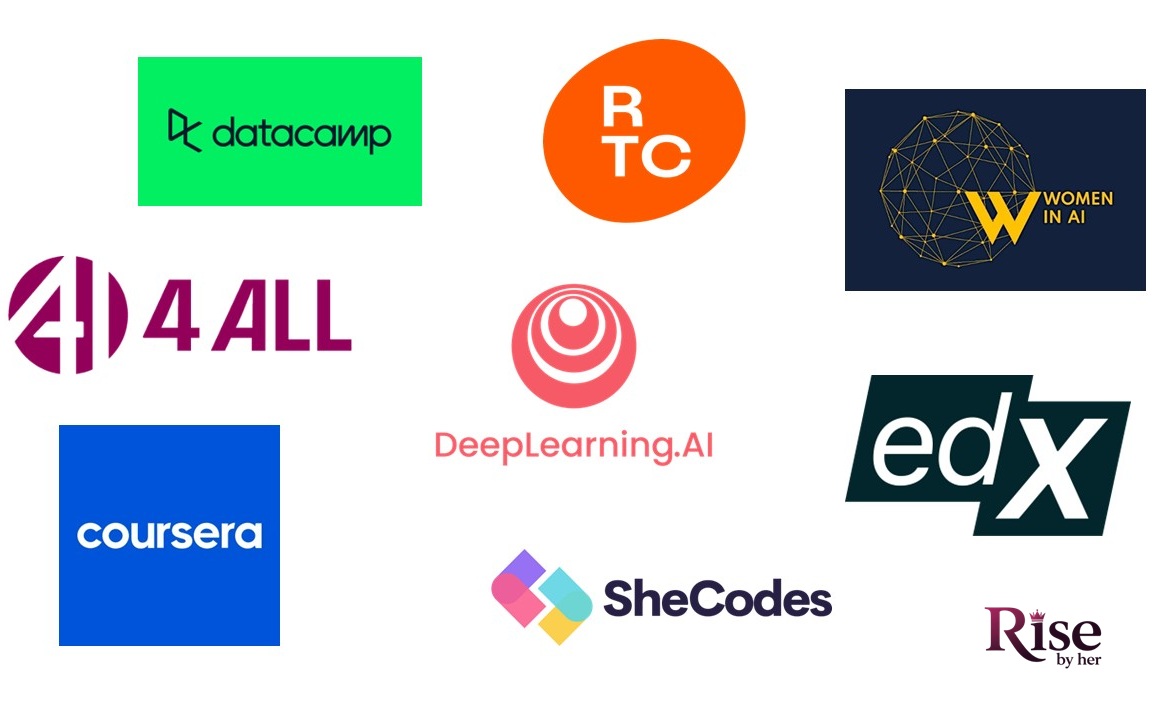
Here’s a closer look at the leading platforms transforming the future of AI education for women:
Coursera – Global Academic Certificates and Degrees
Coursera serves as the premier bridge between global tech organizations and structured higher education. By partnering with elite universities and enterprise giants like Google, IBM, and Stanford, the platform offers deeply engineered, progressive curriculums.
- The Experience: Learning occurs via pre-recorded lecture tracks, rigorous graded assessments, and automated hands-on coding modules.
- Best For: Professionals who need universally recognized, resume-ready credentials and verified certificates to showcase during traditional corporate hiring cycles.
- Top Programs: Look for the IBM AI Engineering Professional Certificate or Google’s latest foundational tracks for high-yield baseline literacy.
To strengthen your transition into the tech industry, explore Top Tech Certifications Women in STEM Need for Jobs and identify the credentials that align best with your career goals.
edX – High-Quality Advanced Technical Specializations
If you want to dive straight into the deep mathematical frameworks of artificial intelligence, edX is your absolute baseline. Founded by Harvard and MIT, this platform delivers enterprise-grade computer science tracks that mirror actual university lecture environments.
- The Experience: Heavy emphasis on theory, structural computer science concepts, and rigorous local environment coding assignments.
- Best For: Self-starters who want advanced data science, deep learning, or neural network training directly from elite international research professors.
- Top Programs: Look into the HarvardX Professional Certificate in Computer Science for AI to gain an ironclad understanding of structural algorithms.
AI4ALL – Dedicated to Diversity and Ethics in Tech
AI4ALL is a dedicated non-profit organization focused entirely on breaking historical tech barriers and diversifying the artificial intelligence pipeline. Through specialized initiatives like their AI4ALL Ignite virtual accelerator, they provide high-touch support specifically designed for historically underrepresented talent.
- The Experience: A balance of fundamental technical application, interactive mentorship, and critical focuses on ethical AI governance.
- Best For: Emerging professionals who value social impact, ethical machine learning deployment, and structured cohort-based study groups.
Rewriting the Code – Empowering Early-Career Women
Rewriting the Code (RTC) functions as a massive, hyper-engaged community ecosystem tailored specifically for early-career women in tech. While they do not author code compilers directly, they partner directly with leading tech companies to supply specialized, subsidized tech education pipelines.
- The Experience: Peer accountability groups, direct execution bootcamps, and direct pipelines to major technology recruiting channels.
- Best For: College students, recent graduates, and early-stage professionals who want to transition into technical engineering and technical product roles simultaneously.
Women in AI – Global Networking and Project Support
Operating as a premier global community across more than 100 countries, Women in AI is built on the absolute fact that community drives retention. They offer a unique mix of localized meetups, intensive educational masterclasses, and highly competitive regional research fellowships.
- The Experience: High-touch, community-driven masterclasses paired with deep project collaborations alongside working industry experts.
- Best For: Non-technical women looking to transition into the field or doctoral researchers requiring peer code reviews and structural project guidance.
DataCamp – Interactive Coding and Data Science Paths
DataCamp eliminates the standard installation friction that kills technical momentum for beginners. Their platform is built entirely around an interactive, browser-based coding environment that allows you to write Python, R, and SQL scripts instantly.
- The Experience: Gamified micro-learning videos immediately followed by interactive, embedded terminal programming blocks.
- Best For: Total beginners who want to build immediate daily coding muscle memory without spending days troubleshooting local terminal software installations.
- Top Programs: The Data Scientist with Python or AI Fundamentals tracks offer high-retention learning milestones.
DeepLearning.AI – Master Complex Neural Network Skills
Founded by machine learning pioneer Andrew Ng, DeepLearning.AI is the absolute gold standard for transitioning from a standard software developer into an active machine learning engineer.
- The Experience: Rapid-fire, conceptually dense technical lectures matched with complex local Jupyter Notebook coding exercises.
- Best For: Individuals who already possess a solid grasp of basic programming logic and want to master large language models (LLMs), deep learning, and generative engineering frameworks.
- Top Programs: The Deep Learning Specialization or the Generative AI with Large Language Models course.
SheCodes – Beginner-Friendly Coding Bootcamps for Women
SheCodes is crafted from the ground up to conquer the tech industry’s confidence gap. Recognizing that advanced AI tracks can feel intensely intimidating, SheCodes provides an exceptionally welcoming, step-by-step introduction to programming foundations.
- The Experience: Structured weekly deadlines, highly accessible homework reviews, and a massive global network of female peers.
- Best For: Absolute beginners who want to establish a solid coding foundation before branching off into complex, data-heavy machine learning tracks.
How to Start Your AI Journey and Build Lasting Momentum
Ambitious career transitions rarely fail due to a lack of talent; they fail due to a lack of structure. Because the artificial intelligence landscape moves at an breakneck pace, trying to learn everything simultaneously is a direct path to burnout. To successfully break into the field, you must treat your education like an agile software project—breaking it down into predictable, high-impact milestones.
Begin with Fundamental Concepts Before Coding Classes
Stepping straight into a complex Python IDE without understanding the underlying logic of machine learning is a recipe for frustration. Before you write a single line of code, you need to understand what the algorithms are trying to accomplish.
Spend your initial week mastering the baseline vocabulary and core systems of the industry:
- Supervised vs. Unsupervised Learning: Understand how models learn from labeled historical datasets versus how they uncover hidden patterns on their own.
- The Role of Data Pipelines: Learn how raw information is collected, cleaned, and structured before it ever touches a neural network.
- Generative AI Baselines: Demystify how Large Language Models (LLMs) use probability metrics to predict tokens and generate contextual text.
Construct a Step-by-Step Personalized Learning Path
A common trap is falling into “tutorial hell”—endlessly consuming random courses without ever progressing. To avoid this, map out a structured roadmap tailored to your specific career outcome.
A standard, industry-vetted sequence for a technical role looks like this:
| Step 1: Foundations | Step 2: Core Tools | Step 3: Deep Dive |
|---|---|---|
| AI Terminology | Python Programming | Neural Networks |
| Data Literacy | SQL & Data Wrangling | LLMs & Transformers |
| Basic Math Basics | Scikit-Learn Library | Model Deployment |
If your goal is functional (like AI Product Management or Business Analysis), substitute advanced engineering modules with courses covering AI ethics, data governance, and agile product development frameworks.
Build a Portfolio of Real-World Machine Learning Work
Certificates look nice on a resume, but live, functional projects are what actually win job offers. Hiring managers want to see your technical problem-solving logic, documentation standards, and architectural execution in real time.
When constructing your public portfolio on GitHub or Hugging Face, aim for quality over quantity:
- The Data Sourcing: Avoid overused, clean public datasets. Instead, scrape your own unique data or use messy, raw API feeds to show you can handle real-world complexity.
- The Codebase: Document your scripts meticulously. Include clean markdown summaries explaining your architecture, your feature engineering choices, and your hyperparameter tuning steps.
- The Production Shift: Take your finished model and deploy it as a functional, interactive web application using lightweight tools like Streamlit.
This makes it easier to move into roles like data analyst, AI specialist, or machine learning engineer.
Join Specialized Communities for Better Collaboration
Isolating yourself behind a computer screen increases your risk of giving up when you hit a difficult roadblocks. The tech industry relies heavily on open-source collaboration, and plugging into the right network can cut your learning curve in half.
- Peer Code Reviews: Sharing your repository in technical forums allows working engineers to critique your logic and offer optimization advice.
- The Hidden Job Market: Many tech organizations post open-label internships and early-stage roles directly within specialized slack channels or community boards long before they hit traditional job sites.
- Accountability Partnerships: Partnering with someone on the exact same learning module helps maintain consistency during complex topics.
Stay Consistent by Tracking Your Weekly Study Progress
Consistency beats intensity every single time. Studying for 30 minutes every morning is vastly more effective for building neural muscle memory than attempting a grueling, erratic 6-hour cram session on weekends.
Establish a transparent tracking framework to maintain velocity:
- Set Metric-Driven Goals: Instead of telling yourself to “study Python this week,” aim to “complete three interactive SQL query modules and push two code commits to GitHub by Sunday.”
- Log System Bugs: Maintain a digital journal of the complex errors you encounter and how you resolved them. This reinforces your problem-solving skills and provides material for future technical interviews.
- Celebrate Small Wins: Building tech skills is an incremental process. Treat every successfully executed script or clean data visualization as tangible proof of your growing authority.
Common Pitfalls to Avoid When Learning Machine Learning
The road to mastering artificial intelligence is littered with abandoned courses, half-finished code repositories, and frustrated students. Most of these setbacks do not happen because the material is too difficult; rather, they stem from a flawed approach to learning. By identifying the psychological and strategic traps that stall most beginners, you can bypass months of stagnation and protect your technical momentum.
Attempting to Master Too Many Tools and Frameworks
The machine learning ecosystem moves at a breakneck pace. Every week, a new large language model variant drops, a new vector database gains traction, or a new framework promises to replace existing infrastructure. Trying to keep up with every trend will quickly lead to cognitive burnout.
- The Trap: Jumping constantly between PyTorch, TensorFlow, JAX, Scikit-Learn, and specialized MLOps platforms before fully understanding any of them. This creates a superficial familiarity without building true technical execution skills.
- The Solution: Pick an industry-standard stack and stick with it until you can build models comfortably without a guide.
Mastering the baseline logical architectures behind feature engineering, data loading, and gradient descent in one ecosystem allows you to pick up any new tool seamlessly when a job demands it.
Skipping Practical Application and Hands-On Projects
Consuming educational content provides a false sense of progress. It is easy to watch a highly skilled data scientist build a convolutional neural network on a premium lecture track and feel like you understand the underlying architecture perfectly.
However, real machine learning is inherently messy:
- Tutorial Hell: Spending months watching videos, taking notes, and collecting certificates while never opening a clean integrated development environment (IDE) to build an independent script.
- The Math Realities: True mastery happens when your data suffers from severe imbalance, your model overfits, or your training pipeline crashes because of a subtle tensor shape mismatch.
- The Fix: Maintain a strict 2:1 ratio of creation to consumption. For every hour you spend reading a textbook or watching a lecture, devote two hours to writing code, cleaning dirty datasets, or troubleshooting system errors.
Neglecting to Document and Share Your Growth Early On
Many women wait until they feel like an absolute “expert” before publishing a single line of code or writing a professional update. This hesitation creates a massive visibility gap in a field where proof of capability is the primary currency.
- The Vault Trap: Keeping all your notebooks hidden locally on your computer because you feel they aren’t “perfect” or advanced enough to show the public.
- Build a Public Ledger: Start documenting your technical journey from week one. When you resolve a confusing error, write a brief, clean markdown summary on GitHub or share a quick breakdown on professional networks.
- The Compound Benefit: Documenting your progress serves multiple vital functions:
- It forces you to articulate complex technical ideas simply, which directly prepares you for engineering interviews.
- It builds a visible, dated archive that proves your consistency, self-starter mentality, and technical evolution to tech recruiters long before you ever submit an application.
Final Thoughts: Launch Your Professional Future in AI Now
The landscape of artificial intelligence is moving too quickly for you to wait until you feel completely ready. The structural gaps, industry demand, and technical platforms we have explored all point to a single truth: the best time to build your technical authority is right now. You do not need a computer science background to claim your seat at the table—you just need the consistency to start.
Step Into Your Authority
Every major shift in tech creates a brief, high-leverage window where practical skills matter far more than traditional pedigree. Because AI frameworks are evolving so rapidly, the gap between a seasoned developer and an ambitious newcomer is narrower than ever.
As you transition from a passive consumer of technology to an active builder, focus on the immediate variables within your control:
- Commit to the Process: Protect your calendar to ensure you can dedicate consistent, focused time to coding and data exploration every week.
- Lean Into Community: Rely heavily on global networks of women in tech to troubleshoot complex code blocks, share resources, and counter imposter syndrome.
- Publish Your Proof: Build your public portfolio transparently. Let hiring managers see your raw engineering logic, your error logs, and your deployed models.
The future of artificial intelligence shouldn’t be built without your perspective. Choose your initial learning platform, map out your first micro-project, and begin building the technical foundation for your next career breakthrough today.
By Aveline Lowell
Founder & Editor-in-Chief, RiseByHer
Aveline Lowell writes research-driven content covering women’s finance, entrepreneurship, STEM, technology, and career growth. Her work focuses on practical, well-researched information that helps women make informed decisions.
Editorial & Disclaimer: RiseByHer aims to provide accurate, well-researched, and up-to-date information. Articles are reviewed and updated when necessary and are intended for general informational and educational purposes, not personalized financial, legal, tax, or professional advice.