

Is It Really Possible to Build a Profitable Home-Based Business in 2026?
Let’s be honest. Most women don’t want “a cute little side hustle.” They want income that pays real bills, builds savings, and creates freedom. The question is not whether home-based businesses work. The real question is: which models are actually profitable in 2026?
With AI tools, remote clients, digital payments, and global marketplaces, running a serious business from home is no longer unusual. It’s strategic. But not every idea trending on social media turns into stable income. Some models scale. Others stall.
If you’re searching for profitable home-based business models for women in 2026, you likely want clarity, not fluff. You want options that are realistic, scalable, and aligned with long-term growth.
Below is a practical, actionable list of high-demand, high-profit business models that women can build from home, structured by income potential, startup simplicity, and scalability.
Why 2026 is the Best Year for Women to Launch a Home-Based Business
The landscape of remote entrepreneurship has fundamentally shifted. Moving past the initial “work from home” wave, 2026 represents a mature, tech-driven marketplace that disproportionately rewards agility, specialized skills, and lean operations. For women looking to reclaim their time, bypass corporate glass ceilings, and build scalable wealth, the current economic climate offers an unprecedented launchpad.
Several macroeconomic trends have aligned to make home-based business models not just viable, but highly profitable.
The Shift Toward the Fractional Economy
The traditional corporate hiring model is broken. In 2026, companies are aggressively moving away from expensive, full-time executive and managerial hires, choosing instead to mitigate risk by hiring fractional talent. A fractional business model involves offering your high-level expertise to multiple companies simultaneously on a retained, part-time basis (e.g., 10 hours a week per client).
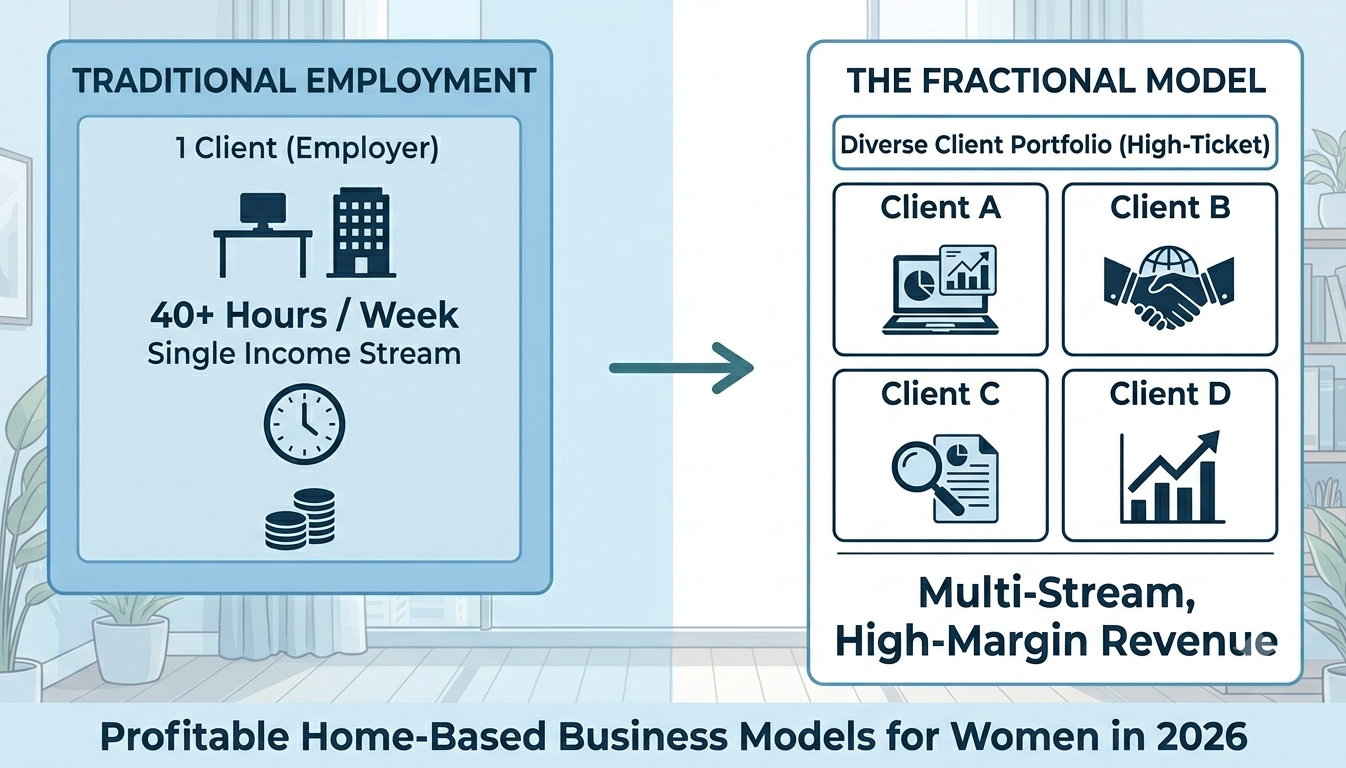
This structural shift is a massive win for female entrepreneurs for several reasons:
- The Premium Multiplier: Instead of earning a flat salary from one employer, a fractional Chief Marketing Officer (CMO), HR Director, or Operations Strategist can charge $3,000 to $5,000 per month per client. Securing just three clients yields a six-figure income on a fraction of the time.
- Autonomy Over Architecture: The fractional economy allows women to architect their work schedules around their lives—not vice versa. It bridges the gap between high-level professional fulfillment and absolute geographic and temporal freedom.
- Risk Diversification: Relying on a single employer is increasingly risky. By distributing your income across three or four clients, losing one client represents a temporary dip rather than a financial crisis.
Low-Code and AI Tools Lowering the Barrier to Entry
In the past, launching a digital or product-based business required a heavy capital layout or advanced technical skills. In 2026, that barrier to entry has been completely obliterated. The democratization of advanced AI agents and mature low-code ecosystems means a solo female founder can operate with the efficiency of a 10-person agency from day one.
The 2026 tech stack allows you to automate the non-revenue-generating tasks that used to burn out solo entrepreneurs:
- Operational Automation: Tools like Zapier, Make, and low-code databases allow you to build custom client onboarding workflows, automated invoicing, and CRM tracking without writing a single line of code.
- AI-Augmented Execution: Modern AI tools aren’t just writing basic copy; they are acts of leverage. From generating hyper-personalized outbound strategy decks to analyzing client financial data or editing short-form video content in seconds, AI handles the heavy lifting.
- Minimal Capital Required: Because software has replaced headcount, the cost to start a highly sophisticated service or digital product business is practically negligible. Your primary investment is your expertise; your profit margins frequently hover between 80% and 95%.
By combining high-level domain expertise with the leverage of 2026’s tech stack, women are no longer just building “side hustles“—they are building highly profitable, asset-backed modern enterprises directly from home.
Top Service-Based Home Businesses with High Profit Margins
For solo female entrepreneurs looking to generate immediate cash flow without significant upfront capital, service-based models are the gold standard. In 2026, the most lucrative services capitalize on business efficiency and growth acceleration.
By selling your expertise rather than cheap labor, you can maintain overhead costs below 10%, resulting in massive net profit margins.
High-Ticket Consulting or Fractional Leadership
The demand for high-level, part-time executive talent has skyrocketed. Small-to-midsized enterprises (SMEs) and venture-backed startups regularly require the strategic vision of a C-suite executive but lack the budget for a $250k full-time salary. This gap has created a booming market for fractional leadership (such as a Fractional Chief Operating Officer [COO], Fractional Chief Marketing Officer [CMO], or specialized corporate strategy consultant).
- The Core Offer: Instead of executing day-to-day tasks, you architect the strategy, build the systems, and manage existing internal teams. You are selling outcomes, structural growth, and efficiency.
- Pricing & Profitability: This is a pure high-ticket play. Fractional executives typically charge a monthly retainer ranging from $3,000 to $7,000 per client for 5 to 10 hours of work per week. Managing just three to four clients yields a highly lucrative, low-stress six-figure business.
- How to Position Yourself: Focus on a specific niche where you have corporate track records (e.g., “Fractional COO for Female-Led E-commerce Brands scaling past $1M”).
This post explores Leadership Qualities You Need to Become a Strong Female Leader and how they can help you grow into a confident and effective leader.
Specialized Virtual Assistant (VA) Services for AI-Driven Businesses
The days of making a premium living by manually managing standard email inboxes are gone. In 2026, general virtual assistance has been largely automated. However, this has created a highly profitable counter-trend: the Tech-Enabled, Specialized VA. Modern businesses desperately need assistants who know how to manage, audit, and orchestrate automated workflows.
- The Core Offer: You move beyond data entry to handle advanced administrative architecture. This includes managing AI-driven customer service pipelines, data curation for custom software, prompt engineering for internal content queues, and managing complex low-code project spaces like Notion and Airtable.
- Pricing & Profitability: While general VAs compete on price floors ($15–$25/hr), Specialized Technical VAs easily command $50 to $90+ per hour, or premium monthly packages starting at $2,500.
- How to Position Yourself: Position yourself as a strategic operations partner. Your pitch isn’t “I will save you time”; it is “I will audit, optimize, and maintain your business automation systems so nothing falls through the cracks.”
This guide covers How to Become a Virtual Assistant: Skills, Salary and Tips and what you need to start and succeed in this career path.
Fractional Digital Marketing & Growth Hacking
The digital advertising space has grown increasingly complex. With privacy shifts and AI-generated content cluttering search engines, businesses can no longer rely on simple ad plays. They need holistic growth hackers—marketers who understand cross-channel optimization, community-led growth, and organic brand authority.
- The Core Offer: Rather than just scheduling social media posts, you build data-backed conversion funnels. This involves managing multi-channel acquisition strategies, optimizing email marketing automation, coordinating short-form video distribution, and engineering viral referral mechanics.
- Pricing & Profitability: Because your work directly correlates to a client’s revenue growth, you can command premium pricing. Retainers typically run between $2,500 and $6,000 per month per client, often bundled with a performance-based bonus or a small percentage of the revenue generated.
- How to Position Yourself: Track your metrics relentlessly. To capture high-ticket clients, your portfolio should lead with concrete data (e.g., “How I decreased customer acquisition cost by 34% while doubling conversion rates for a B2B SaaS startup”).
This article highlights 25 Inspiring Success Stories of Women in Digital Marketing and the lessons you can learn from their journeys.
Scalable Digital Product & Community Business Models
If service-based models trade time for dollars, digital products and communities do the exact opposite. They allow you to decouple your income from your working hours entirely. Once built, a digital product carries an almost 100% gross profit margin and can be sold infinitely to a global market.
In 2026, the market has evolved away from passive consumption toward active, transformation-based digital ecosystems.
Micro-Courses and Cohort-Based Learning
The traditional 20-hour, asynchronous online course is dead. In 2026, consumer fatigue and abysmal completion rates (frequently hovering under 10%) have forced a massive shift toward micro-learning and cohort-based experiences. Modern buyers pay a premium for hyper-specific, short-form education that guarantees an immediate, practical outcome.
- The Core Offer: Instead of a bloated “Ultimate Guide to Marketing,” you sell a micro-course focused on a single execution sprint (e.g., “How to Build an Automated Lead Engine in 48 Hours”). Alternatively, you run a cohort-based course—a live, 2-to-3-week group learning experience centered on peer accountability and real-time feedback.
- Pricing & Profitability: Micro-courses act as high-volume digital assets priced between $49 and $199. Cohort courses, due to the live human element and structured accountability, easily command premium prices from $499 to $1,500+ per seat while retaining massive margins because the curriculum is pre-built.
- Why It Ranks / Success Strategy: Combine your asynchronous video components with a highly interactive, simulated, or peer-review element. Educational platforms that feature community connection boast completion rates over 60%, driving word-of-mouth growth and eliminating customer acquisition costs.
Niche Digital Downloads and Notion Templates
The creator economy thrives on operational efficiency. Solo entrepreneurs, remote teams, and busy professionals are actively buying pre-made digital systems to skip the setup phase of their tech stacks. The fastest-growing sub-niche within this space is specialized Notion architecture and productivity workspaces.
- The Core Offer: You build and license plug-and-play digital workspace ecosystems. High-demand 2026 niches include comprehensive Notion frameworks for small business CRM tracking, automated social media content calendars, ADHD-friendly personal planners, and specialized financial trackers.
- Pricing & Profitability: Standard templates command $19 to $49, while premium, niche-specific workspace bundles sell for $50 to $200+. Using platforms like the Notion Marketplace, Gumroad, or Sellfy, fulfillment is completely automated.
- Why It Ranks / Success Strategy: Avoid generic templates. To clear the algorithmic quality bar, your assets must solve a highly precise workflow bottleneck for a targeted user persona (e.g., “Notion Client Portal Template for Interior Designers”).
This guide explores 10 Best Dropshipping Niches for Women in 2026 to help you choose profitable and sustainable products.
Paid Membership Communities and Micro-Masterminds
In an increasingly hyper-automated, AI-driven world, human connection is the ultimate premium commodity. The most reliable recurring revenue stream in 2026 is the micro-community model: a private, paid digital space where curated professionals gather for networking, curated resources, and shared accountability.
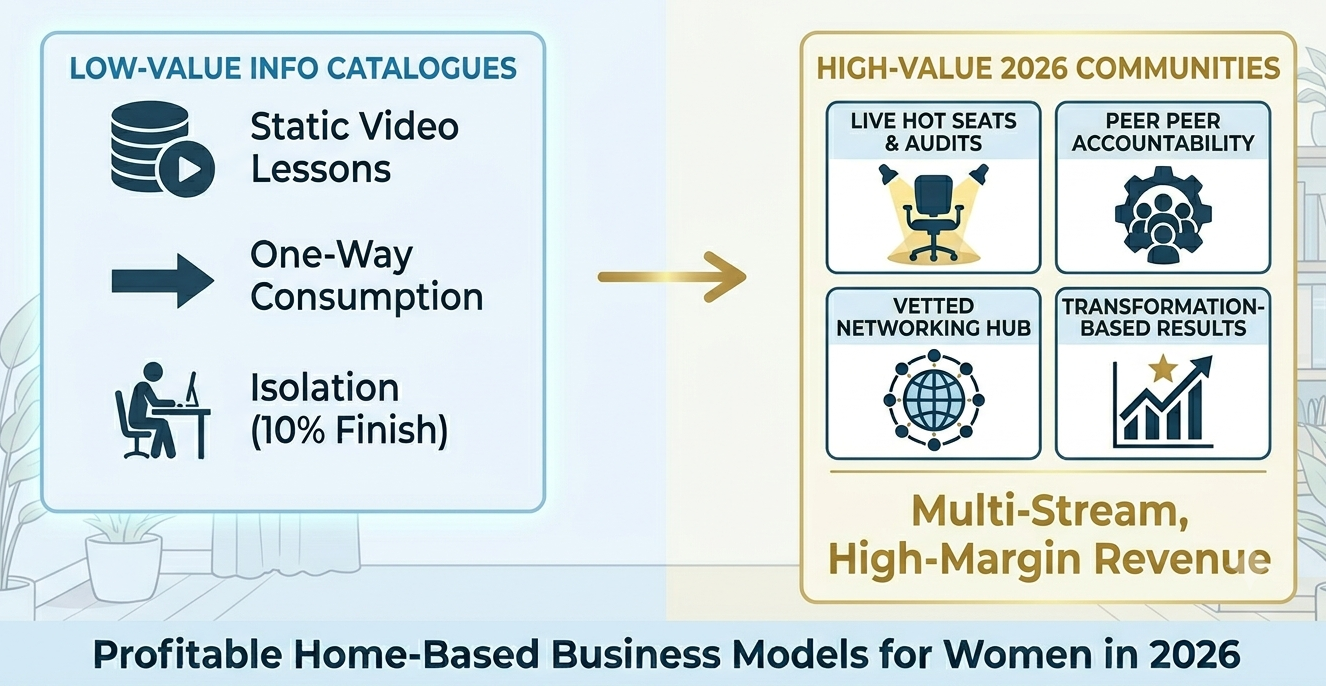
- The Core Offer: Using community platforms like Skool, Circle, or Mighty Networks, you host a gated network. You don’t need to constantly create content; instead, you facilitate monthly live Q&As, hot-seat audits, group challenges, and maintain a vetted peer directory.
- Pricing & Profitability: Membership models create predictable Monthly Recurring Revenue (MRR). Micro-masterminds and specialized communities typically structure tiers at $49 to $199 per month. A tight-knit group of just 100 members paying $99/month nets a predictable $9,900 MRR.
- Why It Ranks / Success Strategy: Market your community around access and curation, not information overload. Position it as an exclusive circle of peers solving a unified problem (e.g., “The Tech-Enabled Founders Circle: A private hub for solo female founders scaling via AI integration”).
Profitable Product-Based Businesses (Low Inventory)
Selling physical goods used to mean transforming your garage into a crowded fulfillment warehouse and sinking thousands of dollars into upfront inventory. In 2026, that capital risk is completely obsolete.
The most successful female-led product brands utilize just-in-time manufacturing and micro-batch logistics. This keeps your cash flow positive, minimizes storage overhead, and lets you pivot your product catalog instantly based on real-time market data.

Niched Print-on-Demand (POD) & Custom Merchandise
Print-on-Demand has evolved far beyond cheap, generic graphic t-shirts. Driven by advanced AI design suites and localized, eco-friendly textile printing networks (like Printify and Printful), POD in 2026 is a premium infrastructure play. The key to elite profitability is hyper-personalization combined with micro-niche targeting.
- The 2026 Shift: Consumers are actively seeking out hyper-specific alignment. Massive evergreen niches have fragmented into highly passionate sub-cultures (e.g., instead of just “Dog Lovers,” successful stores target “Cottagecore Botanical Custom Pet Portraits” or “Tech Humor Syntax Merchandise for Female Software Engineers”).
- The Logistics Framework: You design the product digitally and sync your storefront (Shopify, Etsy, or TikTok Shop) to a POD provider. When a customer places an order, the item is printed, packaged, and shipped directly to them. You never touch inventory, resulting in a predictable 30% to 50% net profit margin.
- How to Position and Rank: Capitalize on the 2026 consumer demand for sustainability and aesthetic typing. Build curated collections featuring organic fibers, heavyweight minimalist street apparel, or premium insulated drinkware. Use mockups that showcase a high-end lifestyle rather than flat digital graphics.
Small-Batch Artisan & Specialty Brands (Direct-to-Consumer)
If you want to sell a proprietary physical product—like organic skincare, custom-blended wellness teas, or artisanal home decor—the old rule was to order 5,000 units minimum to get a decent price per unit. Today, the rise of specialized local copackers and raw ingredient micro-suppliers enables highly profitable small-batch formulation.
- The Core Strategy: You produce or formulate inventory in highly controlled, limited batches (e.g., 50 to 100 units at a time). You launch these via “limited-edition capsule drops” directly on social-commerce channels like TikTok Shop or Instagram Shopping.
- Pricing & Profitability: Because small-batch products carry an aura of exclusivity and artisanal craftsmanship, you can charge premium luxury pricing. A wellness brand producing small-batch, sustainably sourced botanical oils can easily run 70%+ gross margins by positioning the product as a fresh, high-potency micro-run.
- Why It Ranks / Success Strategy: Modern search engines look for deep trust signals and authentic branding. Lean heavily into your founding story, highlight transparent ingredient sourcing, and feature user-generated content (UGC) of your production process. By controlling your production volume, you eliminate waste and keep your business exceptionally lean.
Best Low-Investment Home Businesses for Beginners
For women entering the entrepreneurial space with minimal capital, the objective is simple: minimize financial risk while maximizing skill leverage. You do not need a multi-thousand-dollar runway to launch a successful business from your kitchen table.
In 2026, the most profitable entry-level models utilize high-leverage software to handle the technical heavy lifting, allowing you to focus entirely on client relationships and project management.
Short-Form Video Editing & Content Repurposing
The attention economy is completely dominated by vertical video. Across TikTok, Instagram Reels, and YouTube Shorts, short videos earn over 2.5 times more interaction than long-form content. However, busy founders, podcasters, and corporate executives lack the time to slice up their raw footage. This has created an massive demand for content repurposing specialists.
- The Low-Investment Advantage: You do not need expensive, complex desktop editing software like Premiere Pro. Beginners can run this entire business using highly automated AI clipping engines.
- The 2026 Tech Stack: Use tools like OpusClip, Minvo, or Submagic. You simply drop a client’s long-form YouTube link or podcast audio into the software. The AI automatically identifies the top 10 most viral moments, hooks viewers in the first 0.5 seconds, auto-crops the video to a 9:16 vertical frame, and applies animated, word-by-word highlighted captions.
- Pricing & Monetization: Package your services as a monthly asset retainer. Charge $1,500 to $3,000 per month to manage a creator’s entire repurposing pipeline (e.g., delivering 20 edited short clips a month from their existing long-form content core).
Social Media Management & Community Moderation
As brands migrate away from cold ad traffic toward community-led growth, managing the conversation is more valuable than just posting images. Modern social media management isn’t just about aesthetics; it is about maintaining high engagement metrics and keeping digital spaces safe and active.
- The Low-Investment Advantage: Your primary assets are organization, empathy, and communication. Software platforms offer extensive free or low-cost tiers to manage multiple accounts from a single dashboard.
- The 2026 Tech Stack: Use ManyChat to build automated DM comment funnels (e.g., automatically sending a resource link when a user comments “GROWTH” on a reel), combined with platform managers like Buffer or Metricool. For community moderation on Skool, Circle, or Discord, you keep engagement high by hosting weekly prompts and auditing user interactions.
- Pricing & Monetization: General management and daily moderation services easily net $500 to $1,500 per month per client. Managing 3 to 4 local small businesses or online creators provides an incredibly stable baseline income.
This guide explains How To Start A Social Media Agency for Women in 2026 with $0 and the steps to launch with minimal resources.
Tech-Enabled Bookkeeping for Small Businesses
Bookkeeping is a legal and structural necessity for every single business entity, making it completely recession-proof. Many creative entrepreneurs dread numbers, leaving a massive opening for organized beginners to step in as virtual financial guardians.
- The Low-Investment Advantage: Thanks to Level 3 pattern-learning AI inside modern accounting platforms, you don’t need an advanced accounting degree to start—you just need a basic certification and strong organizational oversight.
- The 2026 Tech Stack: Platforms like Growthy, Digits, and Puzzle now automate up to 90% of basic data entry and bank reconciliation out of the box. Your role shifts from manual data entry clerk to an analytics partner who reviews the AI review queue, fixes low-confidence classification flags, and sends clean monthly P&L statements.
- Pricing & Monetization: Small businesses gladly pay $300 to $600 per month for clean, stress-free books. Because AI reduces your manual labor by over 60%, a solo bookkeeper can comfortably manage 15 to 20 clients simultaneously, unlocking an exceptional monthly revenue stream.
Career Branding (LinkedIn Optimization & AI Resume Tailoring)
With corporate restructuring at an all-time high, professionals are constantly transitioning between jobs or pitching themselves for fractional contract roles. They desperately need to optimize their personal brands online, but they rarely know how to write about themselves objectively.
- The Low-Investment Advantage: This is a pure digital consulting play with zero software overhead. If you have an eye for formatting, strong professional writing skills, or a background in corporate life, this is your fastest route to cash.
- The 2026 Tech Stack: Leverage advanced text engines to analyze a client’s old resume against modern, ATS (Applicant Tracking System) software algorithms. You use tech to run keyword-gap analyses, while manually injecting human storytelling, executive voice, and structural elegance.
- Pricing & Monetization: Instead of cheap hourly work, sell “Career Transformation Packages.” A bundle including a fully rewritten, keyword-optimized LinkedIn profile, an AI-tailored resume template, and a custom outreach script sells easily for $499 to $1,200 per client.
Comparison: Which Business Model Has the Highest ROI?
When evaluating a home-based business model, measuring profit in isolation is a trap. A business that generates $20,000 a month but requires $18,000 in inventory, advertising, and software overhead is significantly less viable than a lean service model that brings in $8,000 a month with virtually zero expenses.
To determine true Return on Investment (ROI), we must evaluate three critical vectors: upfront capital required, overhead margins, and the time it takes to clear your first profit margin.
The matrix below outlines how the core business models of 2026 stack up against one another:
| Business Model Type | Upfront Investment | Profit Margins | Time-to-First-Dollar | Scalability Potential |
|---|---|---|---|---|
| High-Ticket Service / Fractional Leadership | Ultra-Low (<$200) | 90% – 95% | Fast (1–4 weeks) | Moderate (Capped by your hours) |
| Tech-Enabled Beginner Services | Ultra-Low (<$100) | 85% – 90% | Fast (2–4 weeks) | Moderate (Scalable via junior hires) |
| Digital Products & Memberships | Low ($100 – $500) | 95% – 98% | Medium (4–12 weeks) | Infinite (Zero incremental delivery cost) |
| Low-Inventory Physical Products | Medium ($500+) | 30% – 50% | Slow (4–8 weeks) | High (Requires supply chain scaling) |
Upfront Investment vs. Time-to-Profit
If your primary objective is to clear a profit as quickly as humanly possible, Service-Based Models (Fractional Leadership and Tech-Enabled Services) are the undisputed winners.
- The Cash-Flow Velocity: Because you are selling your existing cognitive assets and execution skills, your setup costs are limited to basic digital infrastructure (a custom email domain, a LinkedIn premium account, and a scheduling link). You can sign a client on a Tuesday, secure a 50% upfront retainer deposit, and be completely cash-flow positive within your first 14 days.
- The Product Lag: Conversely, Digital Products and Physical Goods suffer from a distinct time lag. Building a premium, high-converting micro-course or engineering a niche digital template workspace requires an upfront time investment before the asset can be listed. Similarly, small-batch physical products require product testing, formulation, and shipping transit times, meaning your time-to-profit typically spans 30 to 90 days.
Scalability and Passive Income Potential
If your primary objective is to break free from trading hours for dollars entirely, Digital Products and Subscription-Based Communities offer the highest long-term financial ROI.
- The Infinite Leverage Effect: Service models ultimately hit a hard revenue ceiling. There are only so many hours in a week, and even high-ticket fractional executives max out around four to five concurrent corporate clients. Digital products completely break this barrier. It takes the exact same amount of effort to sell a digital template or a micro-course to 10 people as it does to sell it to 10,000 people.
- Compounding Recurring Wealth: Paid membership communities introduce the holy grail of business finance: predictable compounding scalability. While a service business resets to $0 at the beginning of every month if they don’t sign new clients, a subscription community builds an compounding baseline of monthly recurring revenue (MRR) that pays dividends on a completely automated loop.
This article shares 15 Passive Income Ideas for Women to Build Wealth in 2026 and how to start generating income streams over time.
The Verdict: The Hybrid Approach
To maximize financial stability and velocity, the absolute highest-ROI strategy for women in 2026 is the Hybrid Scaling Model:
- Phase 1: Launch a high-ticket service or fractional leadership offer to secure fast, high-margin cash flow and deeply understand your market’s real-world pain points.
- Phase 2: Productize that exact expertise into automated digital downloads, micro-courses, or a paid community, shifting your business from a manual service to a highly scalable digital asset machine.
How to Choose and Launch Your Ideal Business Model
Choosing your business model isn’t about picking what sounds the most glamorous; it’s about finding the intersection of your current competence, market hunger, and modern tool efficiency.
Launching successfully requires a lean, execution-first approach. Here is the exact three-step framework to transition from a conceptual idea to an active, operational home-based business.
Audit Your Monetizable Skills
Many women undervalue their corporate or life experience, mistakenly believing they need to go back to school or acquire entirely new degrees to start a business. To build a highly profitable offer, you simply need to audit and package the skills you already possess.
To uncover your high-margin focus, map your experience using the Skills Monetization Matrix:
- Hard Corporate Assets: Look at tasks you were paid to do in your previous or current jobs. Budget management, software deployment, copy pipeline management, sales tracking, and compliance auditing are all highly monetizable fractional skills.
- The “Shadow” Skillset: What do colleagues, friends, or industry peers constantly ask you to help them with? If people regularly seek your advice on structuring their workday, optimizing their LinkedIn profiles, or setting up their digital workspaces, you have a natural consulting or digital product baseline.
- The Efficiency Premium: Identify the business tasks you can execute at a level that is 10 times faster or more organized than the average business owner. That speed gap is exactly what clients will pay a premium retainer for.
Validate Market Demand (Without Spending Money)
Never spend months building a product or website without proof that the market is willing to pay for it. In 2026, building in isolation is the number one cause of business failure. You can validate your business idea completely for free using organic digital validation loops.
- The Search Volume Audit: Use free tools like Google Trends or AnswerThePublic to verify that people are actively searching for solutions to the problem you solve. Look for high-intent phrase growth (e.g., searches for “hire a fractional manager” or “Notion workspace template”).
- The Organic Beta Loop: Before writing a course or launching a service retainer, post a high-value transformation offer directly to your existing professional network on LinkedIn or specialized communities.
The Beta Framework: “I am launching a premium 3-week pilot program to help [Target Client] automate their client onboarding systems using low-code tools. I am looking for exactly 3 beta clients to go through it at a 50% discount in exchange for a deep video testimonial. DM me ‘ONBOARD’ if you want a spot.” - The Absolute Rule of Validation: An idea is only truly validated when money changes hands. If you get 3 beta sign-ups or a deposit invoice paid, your business model is officially verified, and you can confidently scale production.
The 2026 Tech Stack Every Female Entrepreneur Needs
Operating a highly sophisticated, high-margin business from home requires lean software infrastructure. You don’t need a massive software budget; instead, you need a highly integrated ecosystem where tools communicate seamlessly, keeping your overhead incredibly low.
The essential, low-cost foundational tech stack for a modern solo founder includes:
- The Business Hub & Client Portal (Notion or Airtable): Forget complex internal software. Use Notion or Airtable as your centralized workspace to house your client tracking (CRM), manage project delivery pipelines, and build transparent, collaborative portals for your high-ticket clients.
- The Client Acquisition Engine (LinkedIn Premium & Calendly): Use LinkedIn for organic, outbound networking and authority building. Pair it with a scheduling link tool like Calendly or TidyCal integrated directly into your digital calendar, allowing prospects to book strategy sessions seamlessly.
- Automated Financial Operations (Stripe & Wave): To maximize your time-to-profit, invoice clients professionally using Stripe for seamless global merchant processing. Pair it with a free accounting tool like Wave to track incoming revenue, organize tax-write-offs, and monitor your monthly profit margins.
- Workflow Automation (Zapier or Make): Connect your tech stack together. Build simple automated rules—such as “When a client books a call via Calendly, automatically create a dedicated client folder in Notion and send a custom questionnaire via email.” This allows you to handle administrative tasks on a fully automated loop.
Overcoming Common Roadblocks for Work-from-Home Entrepreneurs
Building a highly profitable home business sounds ideal, but execution introduces invisible operational friction. Without the natural boundaries of a traditional corporate office, female founders frequently face two severe bottlenecks: the collapse of work-life boundaries and the paralyzing anxiety of legal/tax compliance.
Overcoming these roadblocks requires moving away from vague mindset advice and implementing concrete systems.
Balancing Business Growth with Family and Life
The most dangerous myth of remote entrepreneurship is “seamless integration.” When you work where you live, your business will ruthlessly expand to consume every waking hour unless you artificially build strict operational guardrails.
To scale your company without burning out your personal life, implement these three structural boundaries:
- The Temporal Hard Stop: Treat your working hours like a physical brick-and-mortar office. Establish a definitive time when your laptop is closed and placed completely out of sight (e.g., 5:00 PM). Algorithms and automated workflows handle your business infrastructure overnight; you do not need to check client communications at midnight.
- The “Time-Blocking” Architecture: Instead of constantly switching between administrative tasks, client fulfillment, and family responsibilities—which causes massive cognitive fatigue—batch your week into dedicated execution blocks.
- The Dedicated Operational Girdle: Even if you are working from a small space, avoid working from your bed or couch. Establish a singular, dedicated physical workspace. This creates a psychological anchor: when you are in that specific chair, you are the CEO; when you step away, you are completely off the clock.
Setting Up the Legal and Financial Foundation
The fear of taxes and legal mistakes keeps thousands of incredibly talented women from ever launching their businesses. However, setting up a legally compliant, structurally sound home business is remarkably straightforward when you decouple your personal assets from your commercial entities immediately.
To establish a bulletproof corporate foundation, complete this checklist within your first 30 days:
- Form a Legal Structure: To protect your personal assets (like your home or personal savings), move away from operating as a simple sole proprietorship. Form a formal legal entity, such as a Limited Liability Company (LLC). This builds a protective legal wall between your personal life and your business liabilities.
- Secure an EIN (Employer Identification Number): Think of an EIN as a social security number for your business. It is entirely free to obtain directly from your government’s tax authority website. Using an EIN means you never have to hand over your personal social security number to clients when filling out onboarding tax documentation.
- Establish Strict Financial Separation: > The Absolute Rule of Business Banking: Never, under any circumstances, co-mingle personal and business funds. Open a dedicated business checking account. All client invoices must be paid into this account, and all business software, hardware, and marketing costs must be paid out of it.
- Automate Your Tax Reserves: The easiest way to avoid a surprise tax bill at the end of the year is to implement a strict profit-first system. Every time a client pays an invoice, immediately route 25% to 30% of that gross revenue into a separate, untouched business savings account dedicated exclusively to taxes.
By implementing these structural boundaries and legal foundations early, you eliminate the mental friction of running a business, allowing you to focus 100% of your energy on client acquisition and revenue generation.
Final Thoughts: Taking the First Step Toward Financial Freedom
The data, the tools, and the macroeconomic shifts all point to a singular conclusion: the barrier to entry for women looking to build a highly profitable, home-based business has never been lower. Whether you choose the immediate, high-ticket cash flow of fractional leadership, the absolute scalability of digital templates and micro-courses, or the lean operational mechanics of modern print-on-demand, the tools to build financial leverage are sitting right on your desk.
However, the greatest trap of entrepreneurship isn’t failure—it is extended contemplation.
It is incredibly easy to get caught in a loop of endless research, tweaking a business name, or waiting for the “perfect” moment to launch. But in the modern digital economy, market feedback is the only currency that matters. You will learn more from sending one pitch email, launching one beta community prompt, or designing one template than you ever will from reading a dozen more guides.
You don’t need to see the entire staircase to take the first step. You don’t need a flawless website, a massive marketing budget, or a finished 10-module course.
Your only objective today is to pick your model, audit your existing skills, and put an imperfect offer out into the world. The technology of 2026 is ready to automate your operations, lower your overhead, and scale your income—but it requires your unique expertise to pull the trigger.
The path to financial freedom, absolute time autonomy, and building an asset you truly own starts with execution. Choose your lane, trust your experience, and launch.
This guide explores High-Income Freelance Jobs for Women to Start From Home and how to get started in each opportunity.
By Aveline Lowell
Founder & Editor-in-Chief, RiseByHer
Aveline Lowell writes research-driven content covering women’s finance, entrepreneurship, STEM, technology, and career growth. Her work focuses on practical, well-researched information that helps women make informed decisions.
Editorial & Disclaimer: RiseByHer aims to provide accurate, well-researched, and up-to-date information. Articles are reviewed and updated when necessary and are intended for general informational and educational purposes, not personalized financial, legal, tax, or professional advice.