


Want to make your money work for you; even while you sleep? Interest-bearing accounts are one of the simplest, safest ways to grow your savings over time. For women focused on building financial independence and long-term security, understanding how these accounts work an essential step is.
Whether you’re saving for a rainy day, planning a vacation, or laying the groundwork for generational wealth, interest-bearing accounts offer reliable growth with minimal risk.
In this guide, we’ll break down what interest-bearing accounts are, how they benefit women, and how to choose the best option based on your personal financial goals. Let’s turn your savings into a tool for smarter, stress-free wealth building.
What Is an Interest-Bearing Account? (APY, Interest, and Compound Growth Explained)
An interest-bearing account is a type of bank account that pays you money for keeping your funds deposited. Instead of your money staying idle, the bank uses it for lending and other financial activities, then rewards you with interest.
This makes it one of the simplest ways to grow savings passively over time.
1. How Bank Interest Is Calculated (Simple Explanation)
Interest is the amount the bank pays you based on your balance and interest rate.
Key points:
- Interest is usually calculated daily, monthly, or annually
- It is expressed as an Annual Percentage Yield (APY)
- Higher balance + higher APY = higher earnings
- Some accounts pay simple interest, but most use compound interest
APY is the most important metric because it reflects your real yearly return.
2. Compound Interest and How Your Money Grows Over Time
Compound interest means you earn interest on both your original deposit and previously earned interest.
Benefits of compounding:
- Your money grows faster over time
- Earlier deposits have more growth potential
- Small savings can turn into large balances over years
- Growth accelerates without extra contributions
Where:
- A = final amount after growth
- P = initial deposit
- r = annual interest rate
- n = number of compounding periods per year
- t = time in years
3. APY Explained (Annual Percentage Yield Meaning)
APY shows how much your money earns in one year including compounding.
Why APY matters:
- It gives the true return on your savings
- Helps compare different banks and accounts
- Higher APY leads to faster wealth growth
- Even small differences in APY compound significantly over time
4. Example of How Interest-Bearing Accounts Grow Your Money
If you deposit $1,000 at 5% APY:
- Year 1: You earn about $50
- Year 2 and beyond: You earn more due to compounding
- Over time: Growth increases without additional deposits
This is why interest-bearing accounts are a key tool for building long-term financial stability.
How Interest-Bearing Accounts Work Step by Step
Interest-bearing accounts grow your money through a simple cycle of deposits, interest calculation, and compounding. Understanding how this process works step by step helps you see exactly how your savings increase over time, even without adding extra money.
Step 1: Opening and Funding Your Account
The process starts when you open an interest-bearing account at a bank or credit union and deposit money into it.
Key points:
- You can open the account online or in person
- A minimum deposit may be required
- Your balance becomes the base for earning interest
- The more you deposit, the more you can earn over time
Step 2: Bank Uses Your Money to Generate Interest
Once your money is deposited, the bank uses it for lending and financial operations. In return, they pay you interest for keeping your funds with them.
Key points:
- Banks lend your money to borrowers (loans, mortgages, etc.)
- You earn a share of the interest generated
- Your funds remain safe in most regulated banks
- Interest rates vary depending on account type and institution
Step 3: Interest Is Calculated on Your Balance
Interest is calculated based on your account balance and the agreed interest rate (APY).
Key points:
- Interest may be calculated daily, monthly, or annually
- APY reflects your real yearly earnings
- Higher balances = higher interest earnings
- Rates differ between traditional and high-yield accounts
Step 4: Interest Is Added to Your Account (Compounding)
This is where your money starts to grow automatically. Earned interest is added back into your account, allowing you to earn interest on interest.
Key points:
- Interest is added to your principal balance
- Future interest is calculated on the new total
- This creates exponential growth over time
- The longer your money stays, the more powerful compounding becomes
Step 5: You Earn More Over Time Without Extra Effort
As time passes, your savings grow automatically through repeated interest cycles and compounding.
Key points:
- No additional work is required after depositing money
- Growth accelerates over longer time periods
- Regular contributions increase total earnings
- Long-term saving significantly boosts financial outcomes
Why Interest-Bearing Accounts Are Important for Women’s Financial Growth
For women managing personal goals, family budgets, or long-term dreams, interest-bearing accounts offer a safe and steady way to grow wealth. These accounts may not offer dramatic returns like investing in stocks or real estate, but they provide something just as valuable: reliability, accessibility, and financial peace of mind.

1. Financial Independence Through Passive Income Growth
Interest-bearing accounts support financial independence by allowing money to grow without active effort. This is especially important for women building multiple income streams or planning long-term financial security.
Key benefits include:
- Earn passive income through interest payments
- Reduce reliance on a single source of income
- Build financial confidence over time
- Create more control over personal financial decisions
This makes savings not just stored money, but an active part of your financial growth strategy.
2. Long-Term Wealth Building With Compound Interest
One of the most powerful advantages of interest-bearing accounts is compound interest, which allows your savings to grow faster over time.
Instead of earning interest only on your original deposit, you also earn interest on previously earned interest.
Why this matters for long-term wealth:
- Small savings grow significantly over time
- The earlier you start, the greater the wealth effect
- Encourages consistent saving habits
- Helps build generational wealth over time
3. Building Financial Security and Emergency Savings
Interest-bearing accounts are also essential for financial security, especially when building an emergency fund. They allow your savings to grow while still being accessible when needed.
This balance makes them ideal for financial planning.
Key advantages:
- Helps build emergency funds faster
- Keeps savings liquid and accessible
- Provides a financial cushion for unexpected expenses
- Reduces financial stress during emergencies
A key part of long-term success is focusing on Financial Independence for Women: Build Wealth & Security, which encourages you to take control of your income, savings, and investments to create lasting financial freedom.
4. Encouraging Smart Money Habits and Wealth Discipline
Using interest-bearing accounts regularly helps develop strong financial habits that support long-term success.
Over time, they encourage a more disciplined approach to saving and wealth building.
You naturally start to:
- Save consistently instead of spending impulsively
- Track how money grows over time
- Think long-term about financial goals
- Prepare for investing and wealth expansion
Types of Interest-Bearing Accounts (High-Yield Savings, Money Market, CDs)
Choosing the right interest-bearing account depends on your financial goals, timeline, and comfort level with accessibility. From short-term saving to long-term planning, different account types offer different benefits and understanding those options helps you make confident, informed choices.
1. Common Types of Interest-Bearing Accounts
Here are three of the most popular options:
High-Yield Savings Accounts (HYSA)
- Best for: Emergency funds, short-term savings
- Pros: Higher interest rates than traditional savings, easy access to funds
- Cons: May have online-only access, withdrawal limits
Money Market Accounts (MMA)
- Best for: Those who want a balance between savings and check-writing access
- Pros: Competitive interest rates, may include debit cards or checks
- Cons: Often require higher minimum balances to avoid fees
Certificates of Deposit (CDs)
- Best for: Long-term savings you won’t need to touch
- Pros: Fixed interest rates, often higher than savings or MMA
- Cons: Money is locked in for a set period, penalties for early withdrawal
2. How to Match Account Type with Your Goals
Use the chart below to guide your choice:
| Goal | Best Account Type |
| Build an emergency fund | High-Yield Savings Account |
| Save for a big purchase (6–12 months) | Money Market Account |
| Lock away savings for a future need (1+ years) | Certificate of Deposit (CD) |
3. Tips for Choosing the Right Account
- Compare interest rates: Use comparison sites or your local credit union to find the best APYs (Annual Percentage Yields).
- Check for fees: Some accounts offer great rates but charge maintenance or withdrawal fees that eat into your growth.
- Think about accessibility: Do you need frequent access to your money, or can you let it grow untouched?
Choosing the right type of interest-bearing account helps you align your saving strategy with your lifestyle. Whether you’re preparing for a rainy day, your child’s future, or your own next big move, matching the account to the goal sets you up for smarter saving and steady growth.
High-Yield Savings vs Traditional Savings Accounts: What’s the Difference?
If you are trying to grow your savings faster, understanding the difference between a high-yield savings account and a traditional savings account is essential. Both are designed to help you save money safely, but the interest rates and earning potential can be very different.
In most cases, a high-yield account offers a much better return, especially for women focused on long-term wealth building and financial independence.
1. Interest Rate and APY Comparison (Biggest Difference)
The main difference between these two accounts is the APY (Annual Percentage Yield), which determines how much interest you earn each year.
- Traditional savings accounts usually offer a low APY
- High-yield savings accounts (HYSA) offer higher APY, often several times higher
Even a small APY increase can make a big difference over time because of compound interest.
2. How Much More Can You Earn With a High-Yield Savings Account?
A high-yield savings account helps your money grow faster without extra effort. If you keep a consistent balance in your account, your interest earnings can add up quickly.
For example:
- Traditional savings accounts may earn only a few dollars per year
- High-yield savings accounts can earn significantly more on the same balance
This makes high-yield accounts one of the smartest tools for building an emergency fund and growing savings faster.
3. Accessibility and Withdrawal Rules
Both account types usually allow easy access to your money, but there may be differences depending on the bank.
Common features:
- You can withdraw funds when needed
- Some banks may limit monthly withdrawals
- Online banks may have slower transfer times than local banks
High-yield savings accounts are often offered by online banks, which is why they can pay higher interest rates.
4. Fees and Minimum Balance Requirements
Fees can reduce your savings growth, so it is important to compare account rules before choosing one.
Things to check:
- Monthly maintenance fees
- Minimum deposit requirements
- Minimum balance to earn the best APY
- Penalties for excess withdrawals
Many high-yield savings accounts have low fees, but requirements vary.
5. Which One Is Better for Women Building Wealth?
For most women, a high-yield savings account is the better option because it supports faster financial growth while keeping money safe.
A high-yield account is ideal for:
- Emergency fund savings
- Short-term financial goals
- Saving for big purchases (home, business, education)
- Women who want low-risk wealth-building strategies
Traditional savings accounts may still work if you prefer an in-person bank or need quick access through a local branch, but the growth potential is usually much lower.
6. Quick Summary: High-Yield vs Traditional Savings
| High-Yield Savings Account (HYSA) | Traditional Savings Account |
|---|---|
| Higher APY Faster savings growth Great for emergency funds and long-term goals Often online-based | Lower APY Slower growth Better for basic saving and branch access Often linked to local banks |
How to Choose the Best Interest-Bearing Account for Your Goals
Choosing the best interest-bearing account depends on what you are saving for and how quickly you want your money to grow. The right account should match your financial goals, offer a competitive APY, and still give you easy access when you need your funds.
Instead of choosing the first bank you see, focus on the features that directly affect your long-term savings growth.
1. Start by Defining Your Savings Goal
Before opening an account, be clear about your purpose. Different goals require different account types.
Ask yourself:
- Am I building an emergency fund?
- Am I saving for a house, wedding, or travel?
- Do I want a safe place for short-term savings?
- Am I saving long-term and can I lock the money away?
Once your goal is clear, picking the right account becomes much easier.
If you’re looking to start improving your finances immediately, these 5 Quick Ways Women Can Save Money Today can help you cut unnecessary expenses and free up extra cash without feeling overwhelmed.
2. Compare APY (Annual Percentage Yield) First
APY is the most important number when choosing an interest-bearing account because it shows how much your savings will grow in one year, including compounding.
When comparing accounts, look for:
- High APY rates (especially in high-yield savings accounts)
- Consistent interest earnings over time
- Promotional rates vs long-term rates
A small APY difference can lead to a big gap in earnings over several years.
3. Check Fees That Can Reduce Your Interest Earnings
Some accounts advertise interest but charge fees that cancel out your earnings. This is why fee structure matters just as much as the interest rate.
Look out for:
- Monthly maintenance fees
- Low-balance fees
- ATM withdrawal charges
- Transfer fees
- Hidden service fees
A truly good savings account should help your money grow, not drain it.
4. Look at Minimum Deposit and Balance Requirements
Some banks require a minimum deposit to open the account or a minimum balance to earn the best APY.
Before choosing, confirm:
- Minimum opening deposit
- Minimum daily balance requirements
- Whether interest applies to the full balance
- Whether the APY drops under a certain amount
If you are starting small, choose an account with low or no minimum balance requirements.
5. Make Sure Your Money Is Easy to Access
An interest-bearing account should be flexible, especially if you are saving for emergencies or short-term goals.
Check access features like:
- Online banking and mobile app quality
- ATM access
- Transfer speed to your checking account
- Withdrawal limits per month
- Same-day or instant transfer options
A high APY is great, but it is not helpful if you cannot access your money when you need it.
6. Choose a Safe Account With Deposit Protection
Safety is a major factor when choosing the best bank account for saving. Always make sure your account is protected by government-backed deposit insurance or a regulated banking system.
Look for:
- FDIC or equivalent insurance coverage (depending on your country)
- Strong bank reputation and transparency
- Secure login and fraud protection tools
This protects your savings and ensures your money stays secure.
7. Match the Account Type to Your Lifestyle and Income
The best interest-bearing account should fit your financial habits. For example, if your income is irregular or you are self-employed, you may need more flexibility.
Best account match examples:
- Emergency savings: High-yield savings account
- Saving for a fixed goal: Money market account
- Long-term locked savings: Certificate of Deposit (CD)
- Daily spending + saving combo: Checking + savings bundle
Choosing based on lifestyle makes saving easier and more consistent.
8. Quick Checklist Before Opening Any Account
Before you commit, double-check these key factors:
- Competitive APY (high interest rate)
- Low or no monthly fees
- Flexible withdrawals and easy access
- Reasonable minimum deposit requirements
- Strong customer service
- Safe and regulated bank or credit union
- Mobile app and online banking tools
How to Earn More Interest on Your Savings (Smart Optimization Strategies)
Earning interest is good, but earning the most interest possible requires strategy. The right moves can help your savings grow faster without taking on extra risk. By focusing on APY, compounding, and smart account management, you can maximize your interest earnings and build wealth more efficiently.
The goal is simple: keep more money in high-interest accounts for longer periods of time.
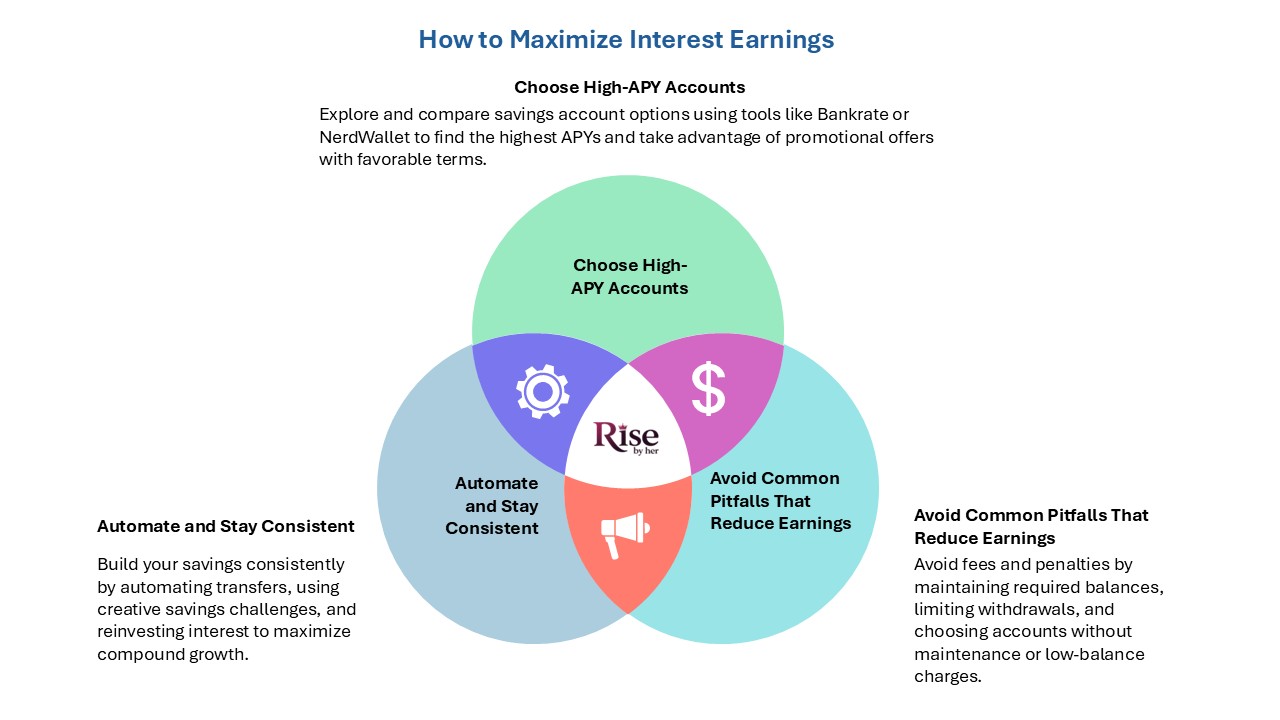
1. Choose a High-APY Account Instead of a Low-Interest Bank
The fastest way to earn more interest is switching from a traditional savings account to a high-yield savings account.
Even small APY differences can lead to big gains over time.
Focus on:
- High-yield savings accounts (HYSA)
- Money market accounts with strong APY
- Promotional APY offers from reputable banks
Keyword tip: Always compare APY, not just interest rate.
2. Avoid Common Pitfalls That Reduce Earnings
Many women lose potential interest because of avoidable mistakes that reduce savings growth. Some banks offer interest but quietly take money back through fees or restrictions.
Common issues to watch for:
- Monthly maintenance fees that cancel out interest
- Low balance penalties
- Excess withdrawals that trigger fees
- Keeping savings in a traditional account with very low APY
- Withdrawing money too often and breaking compounding growth
To truly maximize interest, choose an account that helps your savings grow without unnecessary costs.
3. Automate and Stay Consistent
Consistency is one of the most powerful strategies for growing savings. The more money you keep in your interest-bearing account, the more interest you earn.
A smart system is to automate your savings so you never forget.
Simple ways to stay consistent:
- Set up automatic transfers weekly or monthly
- Save a percentage of every paycheck
- Deposit side hustle income directly into savings
- Treat saving like a monthly bill
Over time, regular deposits plus compound interest create steady financial growth and help you build long-term wealth with less effort.
Common Mistakes to Avoid With Interest-Bearing Accounts
Interest-bearing accounts are one of the easiest ways to grow your savings, but small mistakes can prevent you from earning the full benefit. Many people open a savings account expecting automatic growth, then lose money through low APY rates, hidden fees, or poor saving habits.
Avoiding these common mistakes helps you maximize interest earnings and build long-term financial stability.
1. Choosing a Low-APY Account Without Comparing Options
One of the biggest mistakes is staying with a traditional savings account that offers a very low APY. Many banks pay extremely small interest, which slows down your savings growth.
Before opening an account, always compare:
- APY rates from multiple banks
- High-yield savings accounts vs traditional savings
- Promotional APY offers vs long-term rates
A better APY means faster growth with no extra work.
2. Ignoring Fees That Reduce Your Savings Growth
Some accounts charge monthly maintenance fees, withdrawal fees, or minimum balance penalties. These costs can cancel out the interest you earn, especially if your balance is still small.
Watch out for:
- Monthly account maintenance fees
- Minimum balance requirements
- Excess withdrawal penalties
- Transfer and service fees
To maximize your interest earnings, choose a low-fee account that supports long-term saving.
3. Withdrawing Too Often and Breaking the Compounding Cycle
Interest-bearing accounts grow best when your money stays untouched. If you withdraw frequently, your balance drops and your interest earnings decrease.
Frequent withdrawals can:
- Reduce your monthly interest payment
- Slow down compound interest growth
- Make it harder to reach savings goals
Treat your savings account like a long-term growth tool, not a spending account.
4. Not Taking Advantage of Automatic Savings
Many people rely on motivation to save, which leads to inconsistency. Without regular deposits, your savings grows slowly and interest earnings remain low.
A better approach is automation.
Smart saving habits include:
- Automatic weekly or monthly transfers
- Saving a fixed percentage of your income
- Depositing bonuses or extra income directly into savings
Consistency increases your balance, and a higher balance earns more interest.
5. Assuming the Interest Rate Will Stay the Same
APY rates can change depending on market conditions. Some banks lower rates after promotions end, which reduces your earnings without you noticing.
To avoid this:
- Check your APY every few months
- Compare rates with other banks
- Switch to a better high-yield account if needed
Monitoring your APY keeps your savings optimized.
6. Keeping All Savings in One Account
Many people keep emergency savings, spending money, and long-term savings in one account. This often leads to overspending and slower growth.
A smarter system is to separate savings into categories, such as:
- Emergency fund savings account
- Short-term goal savings
- Long-term savings or CD account
This improves financial organization and helps protect your savings growth.
How to Build an Emergency Fund Faster Using High-Yield Accounts
Building an emergency fund is one of the smartest financial moves you can make, and using a high-yield savings account can help you reach your goal faster. Instead of keeping emergency money in a low-interest account, high-yield accounts allow your savings to grow through a higher APY and compound interest.
This means your emergency fund is not only safe and accessible, but also earning money in the background.

1. Start With a Clear Emergency Fund Target
Before you begin saving, set a realistic goal based on your monthly expenses. Most financial experts recommend saving enough to cover 3 to 6 months of living costs.
Start by calculating:
- Rent or mortgage payments
- Utilities and groceries
- Transportation costs
- Insurance and debt payments
- Childcare or medical expenses
If saving 3 to 6 months feels overwhelming, aim for a smaller first milestone like $500 or $1,000.
2. Use a High-Yield Savings Account for Faster Growth
A high-yield savings account (HYSA) typically offers a much higher APY than traditional savings accounts, which helps your emergency fund grow quicker.
Why it works:
- Higher APY increases monthly interest earnings
- Compound interest boosts growth over time
- Your money stays liquid and easy to access
- Most accounts are low-risk and secure
Even if the interest seems small at first, it adds up over time and supports long-term financial stability.
3. Automate Your Emergency Fund Contributions
The fastest way to build an emergency fund is consistency. Automating your savings removes the need for motivation and makes saving a habit.
Smart automation strategies:
- Transfer a fixed amount weekly or monthly
- Save a percentage of every paycheck
- Automatically deposit side hustle income into savings
- Move leftover money into savings at month-end
Automation keeps your emergency fund growing steadily without effort.
4. Keep Emergency Savings Separate From Spending Accounts
If your emergency fund is too easy to access, you may use it for non-emergency purchases. The best strategy is keeping your emergency fund in a separate high-yield account.
This helps you:
- Avoid impulse withdrawals
- Protect your savings goal
- Track progress more clearly
- Build stronger financial discipline
Your emergency fund should feel accessible, but not “too convenient.”
5. Increase Savings Faster With Small Lifestyle Adjustments
You can build your emergency fund faster by redirecting small expenses into your high-yield savings account. Even minor changes can add up quickly.
Examples:
- Reduce food delivery spending
- Pause unused subscriptions
- Save cash-back rewards
- Use a “no-spend weekend” challenge
- Deposit tax refunds and bonuses directly into savings
Small sacrifices today can create major financial security tomorrow.
6. Know When to Stop Saving and Start Growing Wealth
Once your emergency fund is fully funded, you can shift your focus toward investing and long-term wealth building.
A smart next step is:
- Keep your emergency fund in a high-yield account
- Start investing extra money for long-term goals
- Use retirement accounts or index funds for wealth growth
This keeps your financial foundation strong while building future wealth.
One of the most important foundations of financial stability is following 3 Simple Steps for Women to Build a Strong Emergency Fund, which helps you create a safety net that protects you from unexpected expenses and financial stress.
Are Interest-Bearing Accounts Safe? Understanding Insurance and Risk
Interest-bearing accounts are generally one of the safest places to store money while still earning interest. However, safety depends on whether the institution is regulated, insured, and transparent about its terms. Understanding deposit insurance and the risks involved helps you protect your savings while still benefiting from APY growth.
1. Are Interest-Bearing Accounts Actually Safe?
Yes, most interest-bearing accounts are safe because they are offered by banks and credit unions that follow strict financial regulations. These accounts are designed for saving, which means your money is not exposed to stock market volatility.
They are considered low-risk because:
- Your balance does not fluctuate like investments
- Your money stays accessible for emergencies
- Banks are legally required to follow consumer protection rules
For most people, a savings account is one of the safest financial tools available.
2. How Deposit Insurance Protects Your Money
Deposit insurance is the biggest reason savings accounts are considered secure. In many countries, government-backed insurance protects your deposits if the bank fails.
In the U.S., this includes:
- FDIC insurance (banks)
- NCUA insurance (credit unions)
Deposit insurance usually covers savings products like:
- Savings accounts
- High-yield savings accounts
- Money market deposit accounts
- Certificates of deposit (CDs)
This protection is why it is important to choose an insured financial institution.
3. The Real Risks to Know (Inflation, Fees, and Rate Drops)
The main risk with interest-bearing accounts is usually not losing your money, but losing value over time.
Common risks include:
- Inflation risk (your APY may not beat rising prices)
- Lower APY over time if rates drop
- Hidden fees that reduce your interest earnings
- Fraud or scams if the bank has weak security
So while your savings may be safe, your earning potential depends on choosing the right account.
4. How to Choose a Safe Bank or High-Yield Account
Before opening an interest-bearing account, always confirm the bank is regulated and transparent.
Quick safety checklist:
- The bank is licensed and insured
- APY is realistic (not too good to be true)
- No monthly maintenance fees or unclear penalties
- Strong security features (2FA, fraud alerts)
- Clear terms for withdrawals and transfers
A safe high-yield savings account should offer both protection and steady growth.
Best Features to Look for in a Bank or Credit Union
Choosing the right bank or credit union is just as important as choosing the right interest-bearing account. The best financial institutions offer a strong APY, low fees, and tools that make saving easier. If you want to grow your money consistently, you need a bank that supports long-term savings and protects your financial goals.
1. Competitive APY and Low Fees
A strong APY (Annual Percentage Yield) is the main feature that determines how fast your savings will grow. But high interest only matters if fees are not silently reducing your earnings.
Look for:
- High-yield savings accounts with competitive APY
- No monthly maintenance fees
- No minimum balance penalties
- Transparent account terms and conditions
The best banks help you earn more interest without taking money back through hidden charges.
2. Easy Access, Transfers, and Mobile Banking Tools
A good bank should make it easy to manage your money anytime, especially if you are building an emergency fund or saving for short-term goals.
Important features include:
- User-friendly mobile banking app
- Fast transfers between checking and savings
- ATM access with low withdrawal fees
- Automatic savings tools and alerts
- Easy online account management
Convenience matters because it helps you stay consistent with saving.
3. Strong Security and Deposit Protection
Safety should always come first when choosing a bank or credit union. Your interest-bearing account should be protected by official deposit insurance and strong fraud prevention systems.
Key safety features to check:
- FDIC or NCUA insurance (or your country’s equivalent)
- Two-factor authentication (2FA)
- Fraud monitoring and transaction alerts
- Strong customer support for disputes
- Secure login and account recovery options
A trustworthy bank protects your money while giving you the confidence to save and grow your wealth long-term.
FAQs About Interest-Bearing Accounts for Women
What is the best interest-bearing account for women?
The best interest-bearing account for women is usually a high-yield savings account (HYSA) because it offers a higher APY, low risk, and easy access to funds. It is ideal for building an emergency fund, saving for short-term goals, and growing money through compound interest.
Are high-yield savings accounts safe?
Yes, high-yield savings accounts are safe when they are offered by regulated banks or credit unions. To stay protected, make sure the institution is covered by deposit insurance (such as FDIC or equivalent in your country) and has strong security features like fraud alerts and two-factor authentication.
How much interest can I earn from an interest-bearing account?
How much interest you earn depends on your balance, the account’s APY, and how often interest compounds. The more money you keep in the account, the more you earn. Even small deposits can grow over time when interest is compounded monthly or daily.
What is the difference between APY and interest rate?
The interest rate is the basic percentage the bank pays you. APY (Annual Percentage Yield) is more important because it includes compounding, which shows your real yearly earnings. This makes APY the best number to compare when choosing a savings account.
Can I lose money in an interest-bearing account?
You usually will not lose money in an interest-bearing account unless you withdraw during penalties (like CDs) or pay fees that reduce your balance. The biggest risk is inflation, which can reduce the purchasing power of your savings if your APY is too low.
Should I use an interest-bearing account for my emergency fund?
Yes. A high-yield interest-bearing account is one of the best places for an emergency fund because your money stays accessible while still earning interest. It helps your emergency savings grow faster compared to a traditional savings account.
Final Thoughts: Building Wealth Starts With Where You Save
Interest-bearing accounts may seem simple, but they are one of the most powerful starting points for building financial independence and long-term wealth. By choosing a high-APY account, avoiding unnecessary fees, and staying consistent with your savings, you allow your money to grow steadily with minimal effort.
The key takeaway is that wealth building is not only about how much you earn, but also about how effectively your money works for you over time. Even small deposits can grow into meaningful savings when combined with compound interest and disciplined saving habits.
Start where you are, use the right account, and let time do the heavy lifting.
Explore more on: Women Financial Independence
By Aveline Lowell
Founder & Editor-in-Chief, RiseByHer
Aveline Lowell writes research-driven content covering women’s finance, entrepreneurship, STEM, technology, and career growth. Her work focuses on practical, well-researched information that helps women make informed decisions.
Editorial & Disclaimer: RiseByHer aims to provide accurate, well-researched, and up-to-date information. Articles are reviewed and updated when necessary and are intended for general informational and educational purposes, not personalized financial, legal, tax, or professional advice.