

Women entrepreneurs are increasingly becoming a formidable force in reshaping industries worldwide. Their innovative approaches, resilience, and unique perspectives have not only led to the creation of successful businesses but have also driven significant economic growth. However, despite their remarkable contributions, women entrepreneurs continue to face substantial challenges, particularly in securing funding. This article delves into the impact of women entrepreneurs, the funding disparities they encounter, and resources available to support their ventures.
1. The Rise of Women Entrepreneurs in the Global Economy
Women entrepreneurship is expanding rapidly across the world and becoming a major force in economic growth and innovation. Over the past decade, more women have entered entrepreneurship due to digital transformation, improved access to funding ecosystems, and flexible business models. While progress is clear, significant gaps still exist in funding access and scaling opportunities.
Strong Growth in Women Entrepreneurship Over the Last Decade
Women entrepreneurship has seen consistent growth in the past ten years, especially in digital-first and service-based industries. Lower startup costs and global online access have made it easier for women to launch and grow businesses.
Key drivers of this growth include:
- The rise of e-commerce and online marketplaces
- Expansion of freelance and remote work opportunities
- Increased access to digital tools and business platforms
- Greater visibility of successful women founders
- Growth of startup education and entrepreneurship programs
Key Industries Where Women Are Leading Innovation
Women entrepreneurs are making a strong impact across a wide range of industries, especially those driven by digital innovation and consumer demand.
Some of the leading sectors include:
- E-commerce and retail: Building global direct-to-consumer brands and niche online stores
- Health and wellness: Developing solutions for fitness, mental health, and lifestyle improvement
- Education technology: Creating platforms for online learning and skills development
- Sustainable businesses: Launching eco-friendly and socially responsible startups
- Creative industries: Growing businesses in media, fashion, and content creation
Economic and Social Impact of Women-Led Businesses
Women-led businesses contribute significantly to both economic development and social progress. They help create jobs, stimulate innovation, and strengthen local and global economies.
Key impacts include:
- Job creation and economic growth in local communities
- Increased innovation through diverse leadership perspectives
- Higher reinvestment in communities and social causes
- Stronger focus on sustainability and ethical business practices
- Improved gender diversity in leadership roles
Challenges That Still Shape Women Entrepreneurship
Although progress has improved, women entrepreneurs still face structural barriers that affect growth and funding opportunities.
Main challenges include:
- Limited access to venture capital and funding networks
- Gender bias in investment and decision-making processes
- Lack of mentorship in high-growth industries
- Fewer networking opportunities with investors and accelerators
- Work-life balance pressures that affect scaling speed
2. Why Women Entrepreneurship Is Transforming Modern Business
Women entrepreneurs are reshaping modern business by introducing new perspectives, innovative solutions, and leadership styles that align with today’s market demands. As more women launch and scale businesses, they are driving change across industries, creating inclusive workplaces, and developing companies that prioritize long-term value alongside profitability.
This transformation is not limited to a single sector. From technology and healthcare to sustainability and e-commerce, women-led businesses are influencing how organizations innovate, grow, and connect with customers.
Innovation Driven by Women-Led Startups
Women-led startups are bringing fresh ideas to the market by identifying unmet customer needs and creating solutions that address real-world challenges. Many successful female founders build businesses based on personal experiences, industry expertise, or gaps they have observed in existing products and services.
Areas where women-led startups are driving innovation include:
- Digital health and wellness solutions
- E-learning and skills development platforms
- Financial technology services for underserved communities
- Sustainable consumer products
- E-commerce and direct-to-consumer brands
Diversity and Inclusive Leadership as Competitive Advantage
Diverse leadership has become an important factor in business success, and women entrepreneurs are playing a key role in promoting more inclusive workplaces. Different perspectives often lead to better decision-making, stronger collaboration, and a deeper understanding of customer needs.
Women-led businesses frequently prioritize:
- Inclusive hiring and talent development
- Collaborative leadership and team engagement
- Employee well-being and workplace flexibility
- Diverse viewpoints in decision-making
- Strong company culture and values
The Role of Women in Shaping Sustainable Businesses
Sustainability has become a major business priority, and many women entrepreneurs are leading the shift toward more responsible business practices. Rather than focusing solely on short-term profits, many women-led companies aim to balance financial growth with environmental and social impact.
Women entrepreneurs are contributing to sustainability by:
- Developing environmentally friendly products and services
- Reducing waste through sustainable business models
- Supporting ethical sourcing and responsible supply chains
- Promoting diversity, equity, and social responsibility
- Creating businesses that address community and global challenges
3. The Funding Gap Women Entrepreneurs Still Face
Despite the growing presence and proven capabilities of women entrepreneurs, significant disparities persist in securing funding. These disparities are evident across various regions and stages of business development, underscoring systemic challenges that hinder the full potential of female-led enterprises.
Global Funding Disparities in Venture Capital
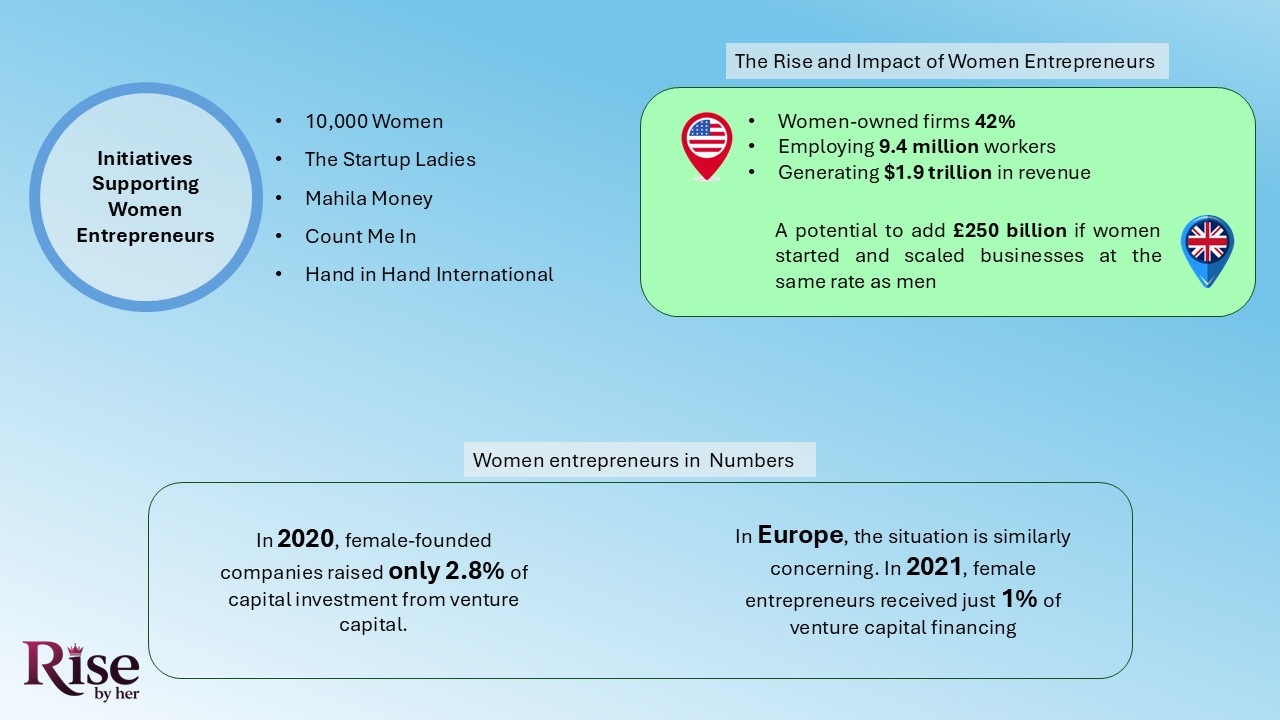
In 2020, female-founded companies raised only 2.8% of capital investment from venture capital, marking the highest amount recorded to date. Despite this modest increase, the vast majority of venture capital funding continues to flow to male-led ventures. (Wikipedia, Venture capital)
In Europe, the situation is similarly concerning. In 2021, female entrepreneurs received just 1% of venture capital financing, highlighting a significant gender gap in funding allocation. (Wikipedia, Women in Europe)
These statistics highlight a persistent and global issue: female entrepreneurs face substantial barriers in accessing the capital necessary to start and grow their businesses.
Why Women Receive Less Startup Funding
Several factors contribute to the funding disparities experienced by women entrepreneurs:
- Homophily in Investment Decisions: The tendency of individuals to associate with others who are like themselves, known as homophily, plays a significant role in venture capital funding. With men comprising most venture capitalists, there is a propensity to fund male entrepreneurs, perpetuating the cycle of underrepresentation for women. (Wikipedia, Female entrepreneurs)
- Gender Stereotyping: Investors often hold unconscious biases that align entrepreneurial success with traditionally masculine traits. This bias leads to women entrepreneurs being evaluated more critically and facing higher standards to prove their credibility and potential. (Wikipedia, Female entrepreneurs)
- Differential Questioning by Investors: Research indicates that during pitch sessions, women entrepreneurs are more likely to be asked prevention-focused questions (e.g., addressing potential risks), while men are asked promotion-focused questions (e.g., highlighting potential gains). This discrepancy can influence the perception of the venture’s potential and affect funding outcomes. (Wikipedia, Female entrepreneurs)
Structural Barriers in Investment Ecosystems
The funding gap not only limits the growth of women-led businesses but also has broader economic implications:
- Economic Growth: Addressing the gender gap in entrepreneurship could significantly boost economies. For instance, in the UK, it is estimated that £250 billion could be added to the economy if women started businesses at the same rate as men. (The Scottish Sun, 2025)
- Innovation and Diversity: Women entrepreneurs often venture into underrepresented sectors, bringing unique perspectives and solutions. Their underfunding means missed opportunities for innovation and addressing diverse market needs.
- Business Performance: Studies have shown that female-led firms often outperform their male counterparts. For example, female-founded firms backed by venture capital firm First Round Capital performed 63% better than those led by men. (The Times, 2025)
Impact of Funding Inequality on Business Growth
Funding is one of the most important factors in building and scaling a successful business. When women entrepreneurs face barriers to accessing capital, the effects extend far beyond individual companies. Funding inequality can limit business growth, reduce innovation, and prevent promising startups from reaching their full potential.
Women-led businesses often receive less investment than their male counterparts, making it more difficult to hire talent, develop products, expand into new markets, and compete at scale. As a result, many businesses grow more slowly despite having strong ideas and capable leadership.
Some of the most common impacts of funding inequality include:
- Slower business growth and expansion
- Reduced ability to invest in research and innovation
- Challenges in attracting and retaining skilled employees
- Limited access to new markets and growth opportunities
- Greater reliance on personal savings or debt financing
Funding disparities can also affect investor returns and economic growth. When innovative women-led businesses struggle to secure capital, investors may miss valuable opportunities, and economies lose the benefits of job creation, innovation, and increased competition.
4. Key Barriers Preventing Women Entrepreneurs From Scaling
While the number of women entrepreneurs continues to grow worldwide, scaling a business remains a significant challenge for many founders. Beyond securing initial funding, women often face structural barriers that can slow growth, limit opportunities, and make it harder to compete in high-growth markets.
Limited Access to Venture Capital Networks
Access to the right networks is often critical for securing investment and growth opportunities. Many venture capital deals are driven by relationships, introductions, and professional connections, areas where women entrepreneurs have historically been underrepresented.
This limited access can make it more difficult to:
- Connect with investors and decision-makers
- Receive warm introductions to venture capital firms
- Join influential startup and investment communities
- Gain visibility within high-growth entrepreneurial ecosystems
Gender Bias in Investment Decisions
Although awareness is increasing, gender bias continues to influence some investment decisions. Women entrepreneurs may face greater scrutiny during fundraising processes or encounter assumptions about leadership styles, growth potential, and risk tolerance.
Common examples include:
- Different questioning patterns during investor pitches
- Stereotypes about leadership and business growth
- Lower confidence in women-led startups despite similar performance
- Fewer funding opportunities in traditionally male-dominated sectors
Lack of Financial Literacy and Advisory Support
Financial knowledge and strategic guidance play a major role in business success. However, some women entrepreneurs have less access to financial education, experienced mentors, and professional advisory networks that can help navigate growth challenges.
Without adequate support, founders may struggle with:
- Financial planning and cash flow management
- Understanding investment and fundraising options
- Preparing investor-ready business plans
- Scaling operations efficiently
- Making informed long-term growth decisions
Work-Life Balance and Business Constraints
Balancing the demands of entrepreneurship with personal responsibilities can be a significant challenge for many women founders. While these pressures vary from person to person, they can affect the time, resources, and flexibility available for business growth.
Common constraints may include:
- Managing family and caregiving responsibilities
- Limited time for networking and business development
- Increased pressure during periods of rapid business growth
- Difficulty accessing support systems and resources
Despite these challenges, many women entrepreneurs successfully build and scale thriving businesses. However, addressing these constraints through flexible support programs, mentorship opportunities, and inclusive policies can help create a more supportive environment for long-term success.
5. Proven Solutions to Close the Funding Gap
Closing the funding gap requires action from governments, investors, financial institutions, and the entrepreneurial community. While challenges remain, several proven funding pathways are helping women entrepreneurs access the capital needed to launch, grow, and scale their businesses. Understanding these opportunities can help founders choose the right funding strategy for their stage of growth.
Government Grants and Public Funding Programs
Government grants and public funding programs play an important role in supporting women entrepreneurs, particularly during the early stages of business development. Unlike loans, grants typically do not require repayment, making them an attractive source of non-dilutive capital.
Many countries have introduced initiatives designed to encourage entrepreneurship, innovation, and business growth among women founders. These programs often provide:
- Startup grants for new businesses
- Innovation and research funding
- Business development support
- Training and mentorship opportunities
- Export and market expansion assistance
You may also visit Best Small Business Grants for Women (2026 Guide) to explore funding opportunities tailored to women entrepreneurs.
Venture Capital Funds Focused on Women-Led Startups
In recent years, a growing number of venture capital firms have launched funds specifically dedicated to supporting women-led startups. These investors recognize that many promising businesses have historically been overlooked despite strong growth potential.
Women-focused venture capital funds typically look for:
- Scalable business models
- Strong leadership teams
- Large market opportunities
- Evidence of customer demand
- Clear growth strategies
You may also refer to: The Ultimate 2026 Guide to Venture Funding to gain a broader understanding of venture funding opportunities available to women entrepreneurs.
Angel Investors Supporting Female Founders
Angel investors are often one of the first external funding sources available to early-stage entrepreneurs. These individuals invest their own capital into startups and frequently provide mentorship alongside financial backing.
Many angel investor groups actively support women entrepreneurs because they recognize the value of diverse leadership and untapped market opportunities.
Benefits of angel investment include:
- Faster funding decisions compared to traditional financing
- Access to experienced business mentors
- Valuable industry connections
- Flexible investment structures
- Support during the early stages of growth
You can also check How to Secure Angel Investment for Women-Led Startups (2026 Guide) for practical insights on securing angel investment for women-led startups.
Crowdfunding as a Modern Funding Alternative
Crowdfunding has emerged as a powerful alternative funding option for entrepreneurs who may not have access to traditional investors. Through crowdfunding platforms, founders can raise capital directly from customers, supporters, and communities that believe in their vision.
Crowdfunding offers several advantages:
- Validation of market demand before scaling
- Increased brand awareness and visibility
- Access to funding without traditional gatekeepers
- Opportunities to build an engaged customer community
- Reduced reliance on venture capital during early growth stages
You can also explore Best Crowdfunding Platforms for Women Entrepreneurs (2026 Guide) to compare different crowdfunding options for women entrepreneurs.
How Digital Platforms Are Changing Access to Capital
Technology is transforming how entrepreneurs access funding. Digital platforms have made it easier than ever for women founders to connect with investors, lenders, grant providers, and business support organizations regardless of their location.
Today, entrepreneurs can use online platforms to:
- Discover funding opportunities worldwide
- Apply for grants and accelerator programs
- Connect directly with investors
- Participate in startup competitions
- Access financial education and fundraising resources
6. Programs and Initiatives Empowering Women Entrepreneurs
Across the world, several well-established programs, organizations, and funding initiatives are actively supporting women entrepreneurs. These initiatives provide access to capital, mentorship, training, and global networks that help women start and scale businesses more effectively.
Global Organizations Supporting Women in Business
Several international organizations are dedicated to advancing women entrepreneurship through funding, advocacy, and training programs.
Key global initiatives include:
- UN Women Empowerment Principles (WEPs) – A global initiative helping companies and entrepreneurs promote gender equality in business practices
- International Trade Centre (SheTrades Initiative) – Connects women entrepreneurs to global markets and trade opportunities
- World Bank Women Entrepreneurs Finance Initiative (We-Fi) – Mobilizes funding to improve women’s access to finance in developing economies
- OECD Women Entrepreneurship Platform – Provides research, policy support, and ecosystem development insights
You may also visit Best Organizations Supporting Women in Tech Careers: 2026 Guide to discover organizations that support women in tech careers.
Startup Accelerators and Incubators for Women Founders
Startup accelerators and incubators play a key role in helping women entrepreneurs develop scalable businesses by offering structured support, mentorship, and access to investors.
Notable programs include:
- Y Combinator (female founders track participation increasing globally) – One of the world’s leading startup accelerators supporting high-growth startups
- 500 Global (formerly 500 Startups) – Offers global accelerator programs with strong inclusion of women-led startups
- Techstars Impact and Techstars Accelerator Programs – Provides mentorship-driven acceleration and investor access
- Springboard Enterprises – A US-based accelerator focused specifically on women-led high-growth companies
- Women Startup Lab (Silicon Valley) – Dedicated accelerator helping women founders scale through leadership training and investor readiness
You can also refer to Top 5 STEM Accelerators Helping Women Launch Successful Startups to discover key programs helping women launch and grow startups in STEM.
Mentorship Networks and Business Communities
Mentorship and community support are essential for long-term success, and several global networks are built specifically to support women entrepreneurs.
Key networks and communities include:
- Global Women Entrepreneurs Network (GWEN) – A global community supporting women in business through mentorship and networking
- Women Who Code – A global community supporting women in technology and startups
- Female Founder Collective – A network of women-led businesses supporting collaboration and visibility
- Lean In Circles (Sheryl Sandberg initiative) – Peer mentorship groups focused on leadership and career growth
- AllBright (UK-based network) – A professional community and platform for women in business and leadership
You may also explore Accelerate Your Career in 2026 with Women’s Professional Networks to learn how professional networks can support and advance your career growth.
Corporate Diversity Funding Programs
Many global corporations have launched initiatives to support women-led startups through funding, mentorship, and business development opportunities.
Notable corporate programs include:
- Google for Startups Women Founders Program – Provides mentorship, funding access, and technical support
- Microsoft for Startups Founders Hub – Offers cloud credits, tools, and support for early-stage startups, including women-led companies
- Amazon Small Business Accelerator Program – Supports underrepresented founders in scaling e-commerce businesses
- IBM Global Entrepreneur Program – Provides technology resources and enterprise support for startups
- Visa She’s Next Initiative – Offers grants, mentorship, and funding support for women entrepreneurs
7. Step-by-Step Guide to Securing Funding as a Woman Entrepreneur
Securing funding as a woman entrepreneur requires a clear strategy, strong preparation, and choosing the right type of capital for your business stage. Investors and funding programs look for structured ideas, validated demand, and a scalable business model. The following steps outline how to position your startup for funding success.
How to Build a Fundable Business Idea
A fundable business idea solves a real problem, targets a clear market, and shows potential for growth. Investors are not just funding ideas, they are funding execution and scalability.
Focus on:
- Solving a specific and urgent market problem
- Identifying a clear target audience
- Validating demand through early users or feedback
- Ensuring the idea can scale beyond the initial market
- Differentiating from existing competitors
Writing a Business Plan That Attracts Investors
A strong business plan shows investors how your idea will grow into a profitable company. It should be simple, structured, and focused on execution.
Key elements include:
- Clear value proposition and business model
- Market size and target customer profile
- Revenue model and pricing strategy
- Marketing and customer acquisition plan
- Financial projections and growth roadmap
You may also explore How to Write a Business Plan for Women Entrepreneurs That Gets Funded? to understand how to build a strong business plan that improves your chances of securing funding.
How to Pitch Successfully to Investors
A successful pitch communicates your vision clearly and builds confidence in your ability to execute. It should be concise, data-driven, and compelling.
Focus on:
- A strong opening that explains the problem and solution
- Clear explanation of market opportunity
- Proof of traction or early results
- Business model and revenue potential
- Strong founding team and execution ability
- A clear funding ask and use of funds
Choosing Between Grants, VC, and Bootstrapping
Each funding option serves a different purpose depending on your business stage and goals.
- Grants: Best for early-stage ideas and non-dilutive funding without repayment
- Venture Capital (VC): Ideal for high-growth startups aiming for rapid scaling
- Bootstrapping: Best for founders who want full control and gradual growth using personal or business revenue
8. Inspiring Success Stories of Women Entrepreneurs Changing Business
Women entrepreneurs around the world are building high-growth companies, reshaping industries, and proving that scalable success is achievable across every sector. These real-world founders show how innovation, persistence, and strategic thinking can turn ideas into multi-million dollar businesses, even in competitive and underfunded environments.
Global Female Founders Who Built Multi-Million Dollar Companies
Several women entrepreneurs have built globally recognized companies that demonstrate strong execution and long-term vision.
- Whitney Wolfe Herd (Bumble) – Built Bumble into a global dating platform focused on women-first interaction, taking the company public in 2021.
- Sara Blakely (Spanx) – Started Spanx with limited savings and grew it into a global shapewear brand valued at billions.
- Anne Wojcicki (23andMe) – Co-founded a leading consumer genetics company that transformed access to personal DNA testing.
- Jessica Alba (The Honest Company) – Built a consumer goods brand focused on clean, eco-friendly products with strong retail presence.
- Reshma Saujani (Girls Who Code) – Founded a global nonprofit that has trained hundreds of thousands of girls in coding and tech skills.
Lessons Learned From Successful Women-Led Startups
Successful women founders often share common strategies and mindsets that contributed to their growth.
Key lessons include:
- Start with a real problem, not just an idea
- Focus on customer needs before scaling
- Build strong personal resilience in early-stage uncertainty
- Use storytelling to attract investors and customers
- Prioritize execution over perfection
- Leverage communities and networks for growth support
How These Founders Overcame Funding Barriers
Many successful women entrepreneurs faced funding challenges, especially in early stages, but found ways to move forward strategically.
Common approaches included:
- Starting with bootstrapping before seeking external investment
- Using early customer traction to prove market demand
- Leveraging angel investors and personal networks for initial capital
- Participating in accelerators to gain investor visibility
- Reframing pitches around data, traction, and scalability
You may also explore 10 Inspiring Women in STEM Who Built Successful Startups to get inspired by real examples of women who built successful tech-driven companies.
9. Funding and Growth Resources for Women Entrepreneurs
In addition to the previously mentioned resources, several other organizations and initiatives offer valuable support to women entrepreneurs seeking funding:
- Women’s World Banking (WWB): Led by Mary Ellen Iskenderian, WWB provides nearly one billion unbanked women with financial services. The organization emphasizes practical solutions such as government-backed loan guarantees and adjustments to collateral requirements to overcome financial barriers. (Reuters, 2024)
- Visa Foundation’s CatalyseHer Programme: This initiative supports women-owned start-ups by offering training, micro-grants, and networking opportunities, aiming to address the challenges women face in starting and scaling businesses. (The Scottish Sun, 2025)
- Astia: A venture capital firm that employs unbiased approaches, such as blind and camera-off presentations, to reduce failure rates and support women-led startups. (Financial times, 2025)
- Small Business Britain’s Campaign with Starling Bank: Aiming to increase the number of female small business owners to 30% by 2030, this campaign offers support, resources, and guidance to aspiring women entrepreneurs. (The Scottish Sun, 2025)
These resources, alongside the previously mentioned initiatives, provide comprehensive support to women entrepreneurs, addressing funding challenges and promoting business growth.
10. Future Trends in Women Entrepreneurship
Women entrepreneurship is entering a new phase of global growth driven by technology, digital transformation, and stronger policy support. As markets evolve, women founders are increasingly leading innovation in emerging industries and building businesses that are more scalable, global, and tech-driven than ever before.
Rise of AI-Powered Female-Led Startups
Artificial intelligence is becoming a major driver of startup innovation, and more women entrepreneurs are entering this space to build AI-powered solutions across industries.
Key developments include:
- AI tools for healthcare diagnostics and patient support
- Automation platforms for small business operations
- AI-driven marketing and content creation tools
- Personalized education and learning systems
- Data-driven decision-making tools for enterprises
For further insights, consider exploring Empowering Women in Tech: Best AI Learning Platforms to discover AI learning resources that support women building careers in technology.
Growth of Remote and Digital-First Businesses
Remote and digital-first business models continue to expand, creating more opportunities for women entrepreneurs to start and scale companies without geographic limitations.
Key trends include:
- Fully remote startups with global teams
- Online service-based businesses and consulting
- E-commerce brands operating across international markets
- Freelance and creator-driven business ecosystems
- Subscription-based digital products and platforms
Increasing Global Policy Support for Women Founders
Governments and international institutions are increasingly recognizing the importance of supporting women entrepreneurs as a driver of economic growth.
Key areas of support include:
- Expanded access to startup grants and funding programs
- National policies promoting gender equality in business
- Tax incentives and support schemes for women-led startups
- Public-private partnerships supporting innovation ecosystems
- International funding initiatives focused on women entrepreneurship
Frequently Asked Questions About Women Entrepreneurs
This section answers some of the most common questions about women entrepreneurship, funding, and business growth. It is designed to give clear, practical insights for early-stage and scaling founders.
What are the biggest challenges women entrepreneurs face?
Women entrepreneurs often face a mix of financial, structural, and social barriers when starting and scaling their businesses. The most common challenges include limited access to funding, fewer connections within investor networks, and unconscious bias during investment decisions. Many also experience difficulties balancing business growth with personal responsibilities, which can slow down scaling in the early stages.
How can women get funding for a startup with no experience?
Women can secure funding without prior experience by focusing on building a strong and credible business idea. Investors and funding programs look more at potential, validation, and execution ability than formal experience. Early traction, such as user interest, prototypes, or pilot projects, can significantly improve funding opportunities. Many founders also start with grants, accelerators, or angel investors who are more open to early-stage ideas.
Are there special grants for women entrepreneurs?
Yes, there are many grants specifically designed to support women entrepreneurs. These grants are offered by governments, international organizations, and private initiatives to encourage gender equality in business. They are often non-repayable and focused on early-stage startups, innovation projects, or business expansion. However, competition can be high, so strong applications and clear business plans are essential.
What industries are best for women entrepreneurs in 2026?
In 2026, women entrepreneurs are finding strong opportunities in industries driven by digital transformation and consumer demand. These include e-commerce, health and wellness, education technology, sustainable businesses, and digital services. AI-powered tools and remote-first business models are also creating new opportunities for scalable startups across multiple sectors.
How do women entrepreneurs attract investors?
Attracting investors requires a clear business model, strong market potential, and evidence of early traction. Investors look for startups that solve real problems and have the ability to scale. A well-prepared pitch, supported by data, customer validation, and a clear growth strategy, is essential. Building relationships through networks, accelerators, and industry events also increases visibility with potential investors.
Can women entrepreneurs combine grants and venture capital?
Yes, women entrepreneurs can combine grants and venture capital, and this is a common strategy for scaling startups. Grants are often used in the early stages to support product development or research without giving up equity. Venture capital is usually introduced later to accelerate growth and expansion. Combining both allows founders to reduce financial pressure while maintaining long-term growth potential.
Conclusion
Women entrepreneurs are undeniably reshaping industries and driving economic growth. However, to fully harness their potential, it’s imperative to address the funding disparities they face. By supporting initiatives that promote financial inclusion, offering targeted resources, and challenging systemic biases, we can create an environment where women-led businesses thrive, benefiting economies and societies at large.
References
- The Scottish Sun, 2025. Women struggle to start businesses – but fixing it could deliver £250bn economy boost
- Financial Times, 2025. Wanted: more female voices in venture finance
- Wikipedia, Venture capital. Retrieved from https://en.wikipedia.org/wiki/Venture_capital
- Wikipedia, Women in Europe. Retrieved from https://en.wikipedia.org/wiki/Women_in_Europe
- Wikipedia, Female entrepreneurs. Retrieved from https://en.wikipedia.org/wiki/Female_entrepreneurs
- The Times, 2025. Female-led firms outperform rivals. So why is raising cash so hard?
- Wikipedia, 10,000 women. Retrieved from https://en.wikipedia.org/wiki/10%2C000_Women
- Wikipedia, Count me in. Retrieved from https://en.wikipedia.org/wiki/Count_Me_In_%28charity%29
- Wikipedia, The Startup Ladies. Retrieved from https://en.wikipedia.org/wiki/The_Startup_Ladies
- Wikipedia, Hand in Hand International. Retrieved from https://en.wikipedia.org/wiki/Hand_in_Hand_International
- Wikipedia, Mahila Money. Retrieved from https://en.wikipedia.org/wiki/Mahila_Money
- The Courier Mail, 2024. Retrieved from https://www.couriermail.com.au/lifestyle/qweekend/meet-queenslands-young-entrepreneur-of-the-year/news-story/5a1f676801a88a47075e335f39132a74
- Reuters, 2024. Mary Ellen Iskenderian’s mission to ensure one billion women have bank accounts
By Aveline Lowell
Founder & Editor-in-Chief, RiseByHer
Aveline Lowell writes research-driven content covering women’s finance, entrepreneurship, STEM, technology, and career growth. Her work focuses on practical, well-researched information that helps women make informed decisions.
Editorial & Disclaimer: RiseByHer aims to provide accurate, well-researched, and up-to-date information. Articles are reviewed and updated when necessary and are intended for general informational and educational purposes, not personalized financial, legal, tax, or professional advice.