
Starting a business is exciting, but also incredibly demanding. That’s why having the right co-founder can make all the difference. A strong co-founder brings not only complementary skills and energy to the table, but also emotional support, shared responsibility, and a partner in growth. For women-led startups, this partnership can be especially powerful.
Many women entrepreneurs face unique hurdles, like limited access to funding, underestimated leadership, or balancing family with business growth. The right co-founder can help you break through those barriers, share the weight of strategic decisions, and keep momentum when challenges arise.
But finding that person isn’t just about chemistry or convenience, it’s about alignment, vision, and trust. In this step-by-step guide, we’ll walk you through how to find, vet, and build with the right co-founder, so you can turn your idea into a strong, successful, and scalable business in 2025 and beyond.
1. Do You Actually Need a Co-Founder?
Many aspiring entrepreneurs assume that every successful startup needs multiple founders. While having a co-founder can provide valuable support, expertise, and accountability, it is not a requirement for building a successful business. In fact, many women entrepreneurs have launched and scaled profitable companies on their own before deciding whether to bring in a partner.
Before searching for a co-founder, take time to evaluate your business goals, current resources, and long-term vision. The right co-founder can accelerate growth and strengthen your business, but the wrong one can create conflict, slow progress, and lead to costly mistakes. Understanding whether you truly need a co-founder is the first step toward making a smart decision for your business.
Benefits of Having a Co-Founder
A strong co-founder relationship can offer significant advantages, especially during the early stages of building a business. When two founders bring complementary skills and share a common vision, they can often achieve more together than either could alone.
One of the biggest benefits is the ability to divide responsibilities. For example, one founder may focus on product development while the other handles marketing, sales, or operations. This allows each person to concentrate on their strengths and move the business forward more efficiently.
A co-founder can also provide:
- Complementary skills that fill critical knowledge gaps
- Shared decision-making during challenging situations
- Increased accountability and motivation
- Access to additional professional networks and opportunities
- Greater credibility with investors, partners, and customers
- Emotional support during the ups and downs of entrepreneurship
For many women entrepreneurs, having the right co-founder can reduce feelings of isolation and create a stronger foundation for sustainable business growth.
When Staying Solo Makes More Sense
Although co-founders can offer many benefits, partnering with someone is not always the best choice. In some situations, remaining a solo founder may be the smarter path.
If you already possess the skills needed to launch and operate your business, bringing on a co-founder may add unnecessary complexity. Similarly, if your business model is relatively simple or you prefer maintaining full control over decisions, a solo founder structure may better align with your goals.
Staying solo may make sense when:
- You have a clear vision and prefer independent decision-making
- The business can be launched without specialized expertise
- You have access to contractors, freelancers, or advisors instead of a co-founder
- You are not ready to share ownership or equity
- You have not yet found a partner who genuinely aligns with your values and mission
Remember that hiring employees, consultants, or freelancers is often easier than unwinding a partnership with the wrong co-founder. It’s better to wait for the right fit than rush into a long-term business relationship.
Signs You’re Ready to Bring on a Partner
Many entrepreneurs reach a point where growth opportunities begin to exceed their individual capacity. This is often a sign that it may be time to consider adding a co-founder.
You may be ready to bring on a partner if:
- Your business requires expertise you do not possess
- You’re consistently overwhelmed by competing responsibilities
- Growth opportunities are being delayed because of limited bandwidth
- You need strategic support to scale faster
- You want a long-term partner who shares the workload and vision
- Investors or stakeholders expect a stronger founding team
The key is to identify specific gaps that a co-founder would fill. Rather than searching for someone simply because other startups have co-founders, focus on finding a partner whose skills, experience, and values complement your own.
2. Define Your Business Vision, Values, and Ideal Co-Founder Profile
Before you start searching for a co-founder, take time to understand what you truly need. You’re not just looking for talent. You’re looking for someone whose vision, values, and work style complement your own.
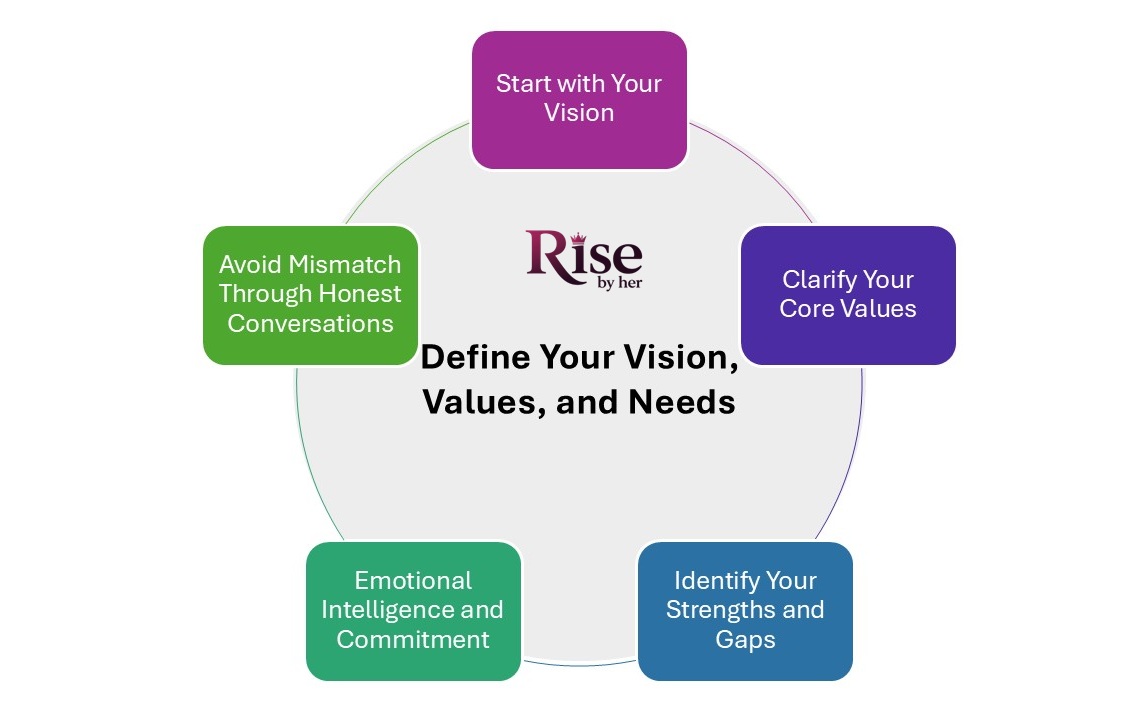
Start with Your Vision
What kind of business are you building? Is it a fast-scaling tech startup or a sustainable service-based brand? Do you want to raise venture capital or keep ownership close? Defining your vision helps you find someone who shares the same goals and understands the journey you’re committing to.
Clarify Your Core Values
Your business values will shape every decision you make. Think about what matters most to you. Is it innovation, transparency, community impact, or flexibility? A co-founder should respect those values and live by them. When your values are aligned, you build trust and avoid unnecessary conflict down the road.
Identify Your Strengths and Gaps
Look at what you’re good at and where you need help. Are you strong in operations but need someone with tech skills? Or maybe you’re creative and need someone with financial expertise. Knowing this helps you find a co-founder who balances your abilities instead of duplicating them.
Emotional Intelligence and Commitment
A great co-founder isn’t just smart. They are emotionally mature, resilient under pressure, and capable of having tough conversations. Also, talk about time and financial commitment early. Are they ready to go all in? Can they handle uncertainty? These questions are critical.
Building emotional intelligence is essential for growth and leadership success, as explained in Emotional Intelligence for Strong Women Leaders in 2026.
Avoid Mismatch Through Honest Conversations
Most co-founder problems come from misaligned expectations. Talk openly about how you make decisions, handle stress, and split responsibilities. It may feel awkward at first, but it will save you a lot of trouble later.
3. Key Skills and Traits Women Entrepreneurs Should Look for in a Co-Founder
Now that you’ve clarified your vision and values, it’s time to figure out the exact qualities your ideal co-founder should bring to the table. Think of this step as writing a Wishlist, not just for professional expertise, but for personal compatibility too.
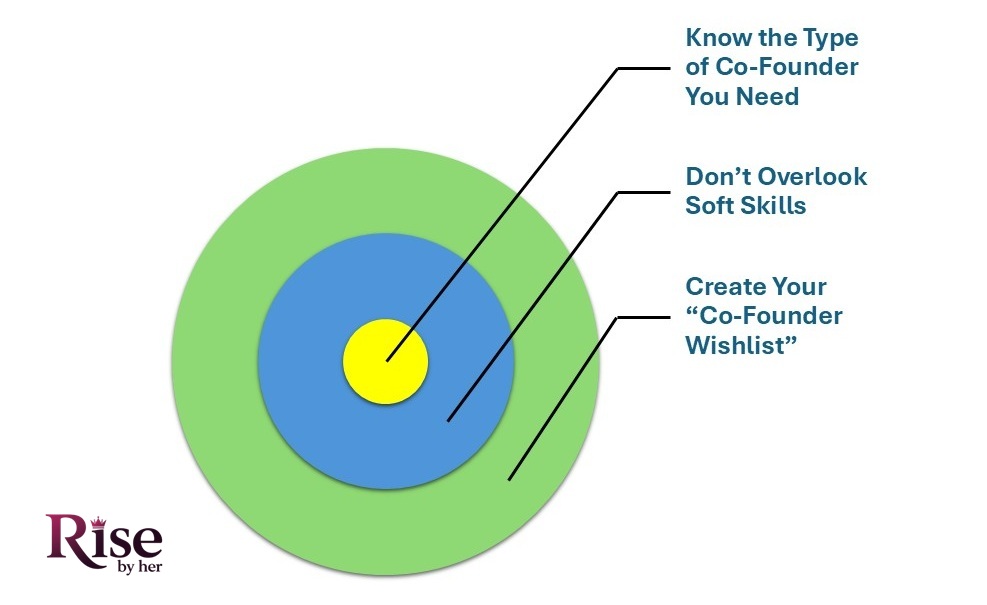
Know the Type of Co-Founder You Need
Start by identifying the skill gap in your business. Co-founders generally fall into three categories:
- Technical co-founders: Ideal if your product is tech-based, like an app or platform.
- Operational co-founders: Great for organizing systems, handling logistics, and managing the backend.
- Creative co-founders: Perfect if your business leans heavily on branding, design, content, or storytelling.
Figure out which area you lack in, then seek someone who complements that space.
Don’t Overlook Soft Skills
While technical or business skills are essential, soft skills can make or break your partnership. Look for someone who:
- Communicates clearly and honestly
- Handles feedback well
- Making decisions under pressure
- Can navigate conflict respectfully
- Is dependable and emotionally grounded
Trust, transparency, and emotional maturity are just as important as a stacked resume.
Create Your “Co-Founder Wishlist”
Take a moment to write down your ideal co-founder’s qualities. This includes both hard and soft skills, industry knowledge, work ethics, and communication style. Think of it as your filter, it will help you say yes to the right person and no to someone who’s not a good fit, even if they’re talented.
Being intentional here will save you time, reduce friction later, and give your business a much stronger foundation.
4. Where Women Entrepreneurs Can Find a Co-Founder in 2026
Finding the right co-founder is often one of the most important decisions you’ll make as an entrepreneur. While many successful partnerships begin through personal connections, today’s founders have access to a wide range of online platforms, startup communities, networking events, and professional groups designed specifically to help entrepreneurs meet potential business partners.

The goal isn’t simply to find someone interested in starting a business. It’s to find a person whose skills, values, work ethic, and long-term vision align with your own. By exploring multiple channels and building genuine relationships, you increase your chances of finding a co-founder who can contribute meaningfully to your venture.
Co-Founder Matching Platforms
Co-founder matching platforms have become one of the most popular ways for entrepreneurs to connect with potential business partners. These platforms allow founders to create profiles, showcase their expertise, describe their startup ideas, and search for individuals with complementary skills.
Many entrepreneurs use these platforms to find:
- Technical co-founders for software startups
- Marketing and sales-focused partners
- Product development specialists
- Operations and business strategy experts
- Industry-specific professionals
When using co-founder matching platforms, focus on building relationships rather than immediately discussing equity or ownership. Take time to understand a person’s experience, motivations, and long-term goals before considering a partnership.
Create a detailed profile that clearly explains:
- Your business idea
- Current stage of development
- Skills you bring to the company
- Skills you’re seeking in a co-founder
- Vision for future growth
The more specific you are, the more likely you’ll attract qualified candidates who genuinely fit your needs.
Startup Communities and Founder Networks
Startup communities remain one of the most effective places to meet potential co-founders. Unlike matchmaking platforms, these communities allow relationships to develop naturally over time through shared experiences and ongoing conversations.
Founder networks often include:
- Startup founders
- Investors
- Mentors
- Product builders
- Developers
- Marketing professionals
- Industry experts
Participating in startup communities offers several advantages. You can observe how people communicate, solve problems, collaborate with others, and contribute to discussions before entering into a formal partnership.
Look for opportunities to:
- Join startup forums and founder groups
- Participate in online mastermind communities
- Attend local startup meetups
- Engage in entrepreneur-focused discussion groups
- Join startup accelerator and incubator programs
Top 5 STEM Accelerators Helping Women Launch Successful Startups can help women access funding, mentorship, and growth opportunities.
Building relationships within these communities often leads to stronger founder partnerships because trust develops gradually rather than through a single introduction.
LinkedIn and Professional Networking
Many successful co-founder relationships begin through professional networking rather than dedicated startup platforms. LinkedIn remains one of the most powerful tools for identifying experienced professionals who may be interested in entrepreneurship.
Start by searching for people who have:
- Experience in your target industry
- Complementary skills
- Previous startup involvement
- Shared professional interests
- Mutual connections
Instead of sending generic messages, focus on building authentic relationships. Engage with their content, contribute meaningful comments, and participate in industry discussions before reaching out directly.
You can also:
- Join LinkedIn groups related to startups and entrepreneurship
- Attend virtual networking events
- Participate in professional associations
- Connect with former colleagues and industry peers
The strongest co-founder partnerships often emerge from existing professional relationships because both parties already understand each other’s work style and capabilities.
Industry Conferences and Networking Events
Industry events remain one of the best ways to meet potential co-founders face-to-face. Whether attending startup conferences, trade shows, workshops, or networking events, these gatherings provide opportunities to build deeper connections than online interactions alone.
Conferences are particularly valuable because they attract people who are actively investing time and resources into their professional growth.
When attending events:
- Focus on meaningful conversations instead of collecting contacts
- Ask questions about business goals and challenges
- Participate in workshops and breakout sessions
- Follow up promptly after meeting promising connections
- Stay engaged long after the event ends
Some of the best founder relationships begin when entrepreneurs discover shared interests while discussing common industry problems.
Women-Focused Entrepreneur Communities
Women entrepreneurs can benefit greatly from joining communities specifically designed to support female founders. These networks provide access to mentorship, funding opportunities, educational resources, and potential co-founders who understand the unique challenges women often face in business.
Women-focused communities frequently attract:
- Startup founders
- Business owners
- Investors
- Executives
- Industry experts
- Aspiring entrepreneurs
These groups create opportunities to connect with individuals who share similar experiences and ambitions while fostering collaboration rather than competition.
Benefits of women entrepreneur communities include:
- Access to trusted referrals
- Supportive networking environments
- Founder accountability groups
- Mentorship opportunities
- Strategic business partnerships
For many women founders, these communities become valuable long-term resources that extend far beyond the initial search for a co-founder.
How to Find a Technical Co-Founder
One of the most common challenges non-technical entrepreneurs face is finding a technical co-founder. If your startup relies on software, mobile applications, artificial intelligence, or technology products, having technical leadership can be critical to success.
Before searching for a technical co-founder, clearly define what you need.
Ask yourself:
- Do you need a software developer?
- Do you need a product architect?
- Do you need a CTO-level strategic partner?
- What technical skills are essential for your business?
Potential places to find technical co-founders include:
- Startup communities
- Hackathons
- Developer meetups
- Technology conferences
- Coding communities
- University entrepreneurship programs
- Co-founder matching platforms
A strong technical co-founder should be more than a developer. They should be a business partner capable of helping shape the future of the company alongside you.
5. How to Vet Potential Co-Founders with Smart, Strategic Questions
Choosing the right co-founder is crucial for the success of your startup. Before you make any commitments, ensure that you and your potential partner are on the same page about key aspects of running the business. Here’s a list of essential co-founder interview questions that can help assess your compatibility:
What Are Your Long-Term Goals?
It’s essential to ensure that both of you are aligned in terms of the vision and direction of the company. Discuss your ambitions and the company’s future. Are you looking for quick growth, or are you aiming for long-term sustainability? Clarity here can help avoid conflicts later.
How Do You Handle Conflict Resolution?
Conflicts are inevitable in any business relationship. It’s important to know how your potential co-founder deals with disagreements or challenges. Do they prefer to discuss things openly, or are they more likely to avoid confrontation? Understanding their conflict resolution style can help you avoid friction down the road.
What’s Your Time Commitment?
Ensure that your co-founder is willing to dedicate enough time to the startup. Early-stage businesses often require intense effort. If one partner can’t meet the time expectations, it can cause strain. Talk about your expected work hours, and make sure you’re on the same page.
How Do You Feel About Financial Risk?
Starting a business often involves financial uncertainty. Discuss how comfortable your co-founder is with taking financial risks. Are they ready to make sacrifices, or are they only in it for the potential reward? This conversation helps avoid disagreements when tough decisions need to be made.
Test Your Compatibility with Co-Working
Before committing fully, consider working together on a project or a trial period. This helps you gauge your working style and assess whether you mesh well in a day-to-day startup environment. A short-term collaboration can reveal if you’re a good fit or if there are red flags.
6. Why You Should Test a Co-Founder Relationship Before Committing
Not every co-founder relationship is built to last. On paper, someone may look perfect, but real startup work quickly reveals how they handle pressure, uncertainty, and responsibility. Before you share equity or commit long-term, you need proof that you can actually build together, not just talk about building together.
Start with a Small Project Before Choosing a Co-Founder
One of the smartest ways to test compatibility is to work together on a small, low-risk project before making anything official. This gives you real data, not assumptions.
Good trial projects include:
- Building a simple MVP or prototype
- Running a short marketing campaign
- Conducting customer discovery interviews
- Creating a landing page and testing demand
- Working on a freelance or consulting project together
Pay close attention to how they behave under real conditions. Do they meet deadlines? Do they communicate when things go wrong? Do they take initiative or wait to be pushed?
A strong co-founder doesn’t just perform well when things are easy. They stay consistent when things are unclear and stressful.
Set Clear Expectations About Roles, Responsibilities, and Goals
Most co-founder conflicts don’t come from big disagreements. They come from unclear expectations that were never discussed early enough.
Before committing, get specific about:
- Who is responsible for what
- How much time each person will commit weekly
- Who makes final decisions in different areas
- Whether anyone is contributing capital
- How equity will be discussed and structured
- What success looks like in the first 3, 6, and 12 months
If you skip this step, you are essentially building a company on assumptions instead of alignment. That almost always leads to friction later.
Clarity early protects both the relationship and the business.
Evaluate Communication, Leadership, and Decision-Making Styles
Skills matter, but working style matters just as much. Many co-founder breakdowns happen because two capable people simply operate differently under pressure.
Watch closely for patterns like:
- Do they communicate directly or avoid difficult conversations?
- How do they react when challenged or corrected?
- Are they consistent in updates and follow-through?
- Do they make decisions quickly or stall under uncertainty?
- Do they focus on solutions or problems?
You are not looking for perfection. You are looking for compatibility.
The strongest co-founder relationships are built on trust, clarity, and the ability to disagree without breaking momentum.
Know When to Walk Away from the Wrong Co-Founder Partnership
One of the hardest startup decisions is also one of the most important: recognizing when a partnership is not the right fit.
Red flags that should not be ignored include:
- Repeated breakdowns in communication
- Different levels of seriousness or urgency
- Avoidance of responsibility or accountability
- Misaligned values or long-term goals
- Inconsistent effort or follow-through
- Discomfort during honest conversations
If these issues appear early, they rarely disappear later. In most cases, they become worse as pressure increases.
Walking away before committing is not failure. It is risk management. The right co-founder should make your vision stronger, not more complicated.
7. How to Split Equity Fairly Between Co-Founders
Equity is one of the most sensitive decisions in any startup. It is not just about ownership, it reflects trust, contribution, risk, and long-term commitment. Getting it wrong early can create tension that grows as the company scales, so this decision needs clarity, structure, and honest conversation.
Equal vs Unequal Co-Founder Equity Splits in a Startup
One of the first decisions founders face is whether to split equity equally or assign different percentages based on contribution.
An equal split (50/50 or equal among multiple founders) is common when:
- Both founders contribute similar time and effort
- Skills are equally important to the business
- Both are involved from the earliest stage
- There is strong trust and shared vision
Unequal splits make more sense when:
- One founder had the original idea and started earlier
- One founder is investing more time or capital
- One founder brings rare or technical expertise
- Responsibilities are clearly imbalanced
There is no universal “correct” split. The right structure is the one that reflects real value creation, not just initial ideas or assumptions.
Factors That Influence Fair Startup Equity Allocation
Fair equity is not emotional, it is based on contribution and risk. Before deciding, founders should evaluate what each person is truly bringing to the table.
Key factors include:
- Time commitment (full-time vs part-time involvement)
- Capital investment or financial risk taken
- Technical or specialized expertise
- Business development or revenue contribution
- Leadership responsibilities
- Stage at which each founder joined
- Opportunity cost of joining the startup
The earlier someone joins and the more risk they take, the higher their potential equity should be. Equity should reward both contribution and commitment, not just titles.
Common Co-Founder Equity Split Mistakes to Avoid
Many startups run into problems because equity decisions are rushed or based on assumptions instead of structured thinking.
Common mistakes include:
- Splitting equity equally without discussing contributions
- Giving too much equity too early without vesting
- Ignoring future roles and workload differences
- Failing to account for evolving responsibilities
- Not revisiting equity as the business grows
- Making verbal agreements instead of documented ones
Equity is difficult to fix later, so unclear decisions early often lead to conflict, resentment, or even founder exits.
Real Examples of Startup Co-Founder Equity Splits
Understanding how equity works in practice can help founders make more informed decisions.
For example:
- Two co-founders launching a tech startup together from day one may choose a 50/50 split if both are full-time and equally essential.
- A founder who builds the idea and product may take 60 percent, while a technical co-founder joining later takes 40 percent due to timing and risk differences.
- In some cases, a third co-founder handling operations or marketing may receive a smaller share, such as 20 percent, depending on their role and involvement stage.
The key is not the exact numbers, but whether the split reflects contribution, timing, and long-term responsibility.
A fair equity structure is one that all founders can confidently stand behind even when the company faces pressure, growth, and difficult decisions.
8. Make It Official: Legal and Financial Agreements for Co-Founders
Once you’ve found the right co-founder and are ready to take your startup to the next level, it’s time to get the legal and financial setup in place. This ensures you both have a clear understanding of each other’s roles, responsibilities, and expectations. Here are the essential legal steps to take:
Define the Startup Co-Founder Equity Split Clearly and Early
One of the first and most important aspects of your startup’s legal setup is deciding how to split the equity. It’s vital to discuss and agree on an equity split that reflects each co-founder’s contribution. This includes financial investments, time commitment, and expertise. Make sure the split is fair to both parties to avoid future disagreements.
Consider Vesting Schedules to Protect Your Co-Founder Equity Structure
Equity vesting is a mechanism that ensures co-founders earn their equity over time. Typically, equity vests over a 4-year period with a 1-year cliff. This means that if a co-founder leaves the company before the 1-year mark, they don’t get any equity. Vesting protects both parties by ensuring long-term commitment to the company. It also discourages co-founders from leaving early without fulfilling their obligations.
Draft a Formal Co-Founder Agreement for Legal Clarity
A co-founder agreement is a foundational legal document that defines how the business relationship will operate. It reduces ambiguity and helps prevent disputes before they happen.
A strong co-founder agreement typically covers:
- Roles and responsibilities of each founder
- Equity ownership and vesting terms
- Decision-making authority and voting rights
- Intellectual property ownership
- Exit terms and what happens if a founder leaves
- Conflict resolution mechanisms
This document should be treated as a business protection tool, not a formality.
Essential Legal Agreements Every Startup Should Have in Place
Beyond a co-founder agreement, startups often need additional legal structures to operate safely and professionally. These documents help protect the business as it grows and attracts customers, investors, or partners.
Key agreements may include:
- Founders’ agreement (core partnership structure)
- Operating agreement or shareholder agreement (depending on business type)
- Intellectual property assignment agreements
- Confidentiality (NDA) agreements
- Contractor and employee agreements
Having these in place early reduces legal risk and builds credibility with investors and stakeholders.
Use Legal Tools and Platforms to Simplify Startup Formation
You don’t always need expensive legal processes to get started. Many founders use modern legal tools to create compliant, professional agreements quickly and affordably.
These tools can help with:
- Generating co-founder and equity agreements
- Creating legal templates tailored to startups
- Managing digital signatures and document storage
- Reducing dependency on early-stage legal costs
However, for complex equity structures or high-growth startups, it’s still advisable to have a startup lawyer review key documents before finalization.
9. Common Mistakes and Red Flags When Choosing a Co-Founder
Choosing a co-founder is one of the highest-risk decisions in building a startup. Many failed partnerships don’t collapse because of the idea, but because warning signs were ignored or avoidable mistakes were made during the selection process. Understanding both common mistakes and early red flags can help you avoid costly long-term problems.
Choosing a Co-Founder Based on Friendship Instead of Business Fit
One of the most common mistakes entrepreneurs make is assuming that a strong personal relationship automatically translates into a strong business partnership.
In reality:
- Friends may avoid difficult conversations
- Personal history can cloud judgment
- Business disagreements can damage personal relationships
A co-founder should be evaluated based on skills, alignment, and execution ability, not emotional connection alone.
Ignoring Skill Gaps Instead of Finding Complementary Strengths
Another major mistake is choosing a co-founder who is too similar in skills, mindset, or experience.
This often leads to:
- Gaps in technical or operational capability
- Overlap in responsibilities
- Slower execution and scaling challenges
Strong co-founder teams are complementary, not identical.
Lack of Transparency and Early Communication Issues (Major Red Flag)
Poor communication early on is one of the strongest predictors of future founder conflict.
Warning signs include:
- Avoiding difficult or direct conversations
- Vague answers about commitment or availability
- Inconsistent follow-through on agreed tasks
- Hesitation to discuss equity or responsibilities
If communication feels unclear early, it rarely improves under pressure.
Inconsistent Commitment and Uneven Effort Levels
A co-founder relationship requires aligned intensity and commitment. If one person treats the project casually while the other is fully invested, imbalance will quickly create frustration.
Watch for signs like:
- Missed deadlines without explanation
- Limited availability or responsiveness
- Lack of initiative or ownership
- Treating the startup as a side project without clarity
Skipping Legal Agreements or Avoiding Formal Structure
Avoiding legal documentation is a serious mistake that often leads to disputes later.
This includes:
- Not defining equity clearly
- Delaying co-founder agreements
- Relying on verbal promises
- Ignoring vesting structures
If someone resists formalizing the partnership, it can indicate future trust or accountability issues.
Misaligned Vision, Values, and Long-Term Goals
Even if everything looks good operationally, misalignment in vision is a major red flag.
Examples include:
- Different exit goals (build vs. sell vs. lifestyle business)
- Conflicting risk tolerance
- Different growth expectations
- Disagreement on company direction
These differences often become more pronounced as the startup grows.
Rushing the Decision Without Proper Testing
Many founders rush into partnerships due to excitement or urgency, without properly testing compatibility.
This leads to:
- Weak alignment under pressure
- Unclear expectations
- High risk of early breakup
A strong co-founder relationship should be proven through real collaboration, not just conversations.
Knowing When to Walk Away Before It Becomes a Costly Mistake
One of the most important skills in entrepreneurship is recognizing when not to proceed.
It may be time to walk away if:
- Communication issues persist despite effort
- Core values do not align
- Trust feels uncertain or inconsistent
- Commitment levels are clearly mismatched
The wrong co-founder can slow down or even destroy a promising startup. Walking away early is often the best long-term decision.
10. Success Stories of Women Entrepreneurs Who Found the Right Co-Founder
Sara Blakely and Jesse Itzler – Spanx
Sara Blakely, founder of Spanx, partnered with Jesse Itzler, a co-founder of Zico Coconut Water. Their complementary skills, Sara’s product expertise and Jesse’s business acumen, helped scale Spanx into a billion-dollar brand.
Lesson: Find partners who complement your strengths.
“Collaboration is key.” – Sara Blakely
Whitney Wolfe Herd and Chris Gulczynski – Bumble
Whitney Wolfe Herd and Chris Gulczynski co-founded Bumble, blending Whitney’s experience from Tinder and Chris’s design skills. Their shared vision for a safe, empowering dating platform made Bumble a success.
Lesson: Shared values and vision are essential.
“Empowering women is our driving force.” – Whitney Wolfe Herd
Jessica Alba and Christopher Gavigan – Honest Company
Jessica Alba and Christopher Gavigan co-founded The Honest Company, creating eco-friendly and non-toxic products. Their partnership combined Jessica’s passion for wellness and Christopher’s sustainability expertise.
Lesson: Choose a co-founder who shares your passion and brings complementary skills.
“We’re focused on making a real difference.” – Jessica Alba
Tracy Chou and Megan Holcomb – Project Include
Tracy Chou and Megan Holcomb co-founded Project Include to promote diversity in tech. Their shared mission has empowered many companies to adopt inclusive hiring practices.
Lesson: A shared mission and values are crucial.
“Build a company that reflects who you want to be.” – Tracy Chou
Lessons Women Entrepreneurs Can Learn from Project Include’s Founder Collaboration Model
Project Include is a well-known initiative that emphasizes inclusion, equity, and sustainable startup ecosystems. What makes its approach valuable is not just its mission, but how its founders and contributors built a collaborative structure around shared values and long-term impact.
Key lessons from this type of founder collaboration include:
- Shared mission is stronger than shared background
- Diversity of expertise improves decision-making quality
- Clear values alignment reduces long-term conflict
- Collaboration works best when roles are clearly defined
- Trust and transparency are essential in scaling impact-driven startups
For women entrepreneurs, this highlights an important truth: successful co-founder relationships are not only based on skills, but also on aligned values and purpose-driven execution.
Key Lessons from Successful Startup Co-Founder Partnerships
Successful startups are rarely built by solo effort alone. Behind many high-growth companies are co-founder teams that demonstrate strong alignment, complementary skills, and shared commitment during both growth and crisis phases.
Common patterns in successful founder partnerships include:
- Clear division of responsibilities based on strengths
- Consistent and open communication under pressure
- Mutual respect for decision-making roles
- Willingness to adapt and evolve responsibilities over time
- Long-term alignment on company vision and exit strategy
One of the most important takeaways is that successful co-founder relationships are not defined by the absence of conflict, but by the ability to resolve conflict constructively and keep moving forward.
For women entrepreneurs, studying these partnerships can provide a blueprint for identifying what “right fit” actually looks like in practice, beyond initial excitement or surface-level compatibility.
Frequently Asked Questions About Finding a Co-Founder
This section answers the most common questions women entrepreneurs have when searching for a co-founder. The goal is to help you make faster, more confident decisions while avoiding common startup mistakes.
How Do I Find a Co-Founder for a Startup as a Woman Entrepreneur?
You can find a co-founder through startup communities, networking events, LinkedIn, co-founder matching platforms, and women entrepreneur groups. The most important part is building real connections, not rushing into partnerships.
Where Can Women Entrepreneurs Meet Potential Co-Founders and Startup Partners?
You can meet potential co-founders in startup events, coworking spaces, online founder communities, hackathons, and industry conferences. These places bring together people who are actively building or looking to build startups.
Should Friends Become Business Partners or Co-Founders?
Yes, but only if there is strong alignment. Friendship alone is not enough. You still need clear communication, shared goals, and agreement on roles and equity.
How Much Equity Should a Co-Founder Get in a Startup?
It depends on contribution, timing, and responsibility. Early full-time co-founders usually get more equity. The split should feel fair and reflect real work and risk.
Can You Add a Co-Founder After Starting or Launching a Business?
Yes. Many startups add co-founders later. You just need to clearly define roles and adjust equity based on contribution and stage of the business.
What Is the Difference Between a Co-Founder and a Business Partner?
A co-founder helps build the company from the beginning and usually owns equity. A business partner is a broader term and may include investors or collaborators who are not involved in building the company day-to-day.
How Long Should You Work With Someone Before Making Them a Co-Founder?
There is no fixed time, but you should work together long enough to trust their skills, communication, and reliability. Many founders test collaboration for a few weeks or months first.
Can a Startup Have More Than Two Co-Founders or Founding Members?
Yes. A startup can have multiple co-founders. However, more co-founders also means more coordination, so roles and responsibilities must be clearly defined.
Build Your Business with Intention and the Right Strategic Partner
Building your startup with the right co-founder is one of the most important decisions you’ll make. The right partnership can bring diverse skills, ideas, and perspectives, while a poor one can lead to frustration and setbacks. As a woman entrepreneur, choosing a partner who shares your vision, values, and work ethic is essential for long-term success.
- Startup Success Tip: Take your time in finding a co-founder who complements your strengths and challenges you to grow. Be intentional, communicate openly, and ensure your goals align.
- Business Partner Tip for Women: Don’t rush the process. A thoughtful, well-aligned partnership can be the foundation of your startup’s success.
In conclusion, working with the right co-founder mindset and financial guidance can make a major difference in building a sustainable business, as highlighted in Best Female Financial Advisors for Women (Expert Tips).
Are you currently looking for a co-founder? Share your ideas or challenges below!
By Aveline Lowell
Founder & Editor-in-Chief, RiseByHer
Aveline Lowell writes research-driven content covering women’s finance, entrepreneurship, STEM, technology, and career growth. Her work focuses on practical, well-researched information that helps women make informed decisions.
Editorial & Disclaimer: RiseByHer aims to provide accurate, well-researched, and up-to-date information. Articles are reviewed and updated when necessary and are intended for general informational and educational purposes, not personalized financial, legal, tax, or professional advice.