


Why do so many high-performing women stall between senior management and executive leadership? You have spent years delivering exceptional results, building high-performing teams, and driving business goals, yet the transition to the C-suite remains elusive. The reality is that the skills and behaviors that got you to senior management are fundamentally different from those required to step into executive leadership. Doing your job well is no longer enough; the game changes at the top.
To break through this barrier, you need to shift from tactical execution to strategic influence. This guide introduces five strategic levers designed to help high-performing women navigate the unspoken rules of executive advancement. By implementing these levers, you will learn how to secure active C-suite sponsorship, demonstrate enterprise-level business impact, amplify your executive presence, and negotiate the authority and compensation you deserve.
Why Career Advancement Is Different for Women Leaders
High performance opens doors, but it won’t unlock the C-suite.
As you approach executive levels, the promotion criteria shift entirely. Delivering results becomes table stakes, while advancement decisions turn on strategic vision, influence, and political capital.
Compounding this transition are real systemic barriers that narrow the pipeline long before the executive level. Navigating this landscape requires understanding two core realities:
- The Performance Trap: Expecting hard work to speak for itself while decision-makers look for enterprise-level strategy.
- The Broken Rung: Structural friction that shrinks female leadership representation at the very first step of management.
Why Performance Alone Doesn’t Lead to Executive Promotion
Early in your career, technical mastery and flawless execution drive advancement. But as you approach executive leadership, performance becomes baseline criteria rather than a differentiator. Executive promotions are awarded based on perceived leadership capacity, organizational influence, and strategic alignment—not sheer output.
Women who focus exclusively on delivering exceptional work often miss out to peers who actively manage relationships and build enterprise visibility. To step into executive leadership, you must shift from being the best executor to demonstrating how you drive long-term business value.
The “Broken Rung” and Other Systemic Barriers
The challenge of reaching executive leadership isn’t just an individual hurdle; it’s a pipeline problem. According to McKinsey & Company and LeanIn.org’s Women in the Workplace report, the biggest obstacle women face isn’t the “glass ceiling” at the top—it’s the broken rung at the first step up to manager.
For every 100 men promoted to first-level manager, only about 81 to 87 women make that same leap. Because men significantly outnumber women at this initial management level, the pool of female candidates available for senior director, VP, and C-suite roles shrinks dramatically at every stage. Overcoming this structural imbalance requires deliberate, high-leverage positioning.
Lever 1: Build Strategic Relationships That Accelerate Your Career
Hard work gets you noticed, but strategic relationships get you promoted. At the executive level, career trajectory is rarely decided in formal performance reviews—it is decided in closed-door discussions among senior leaders.
To break into the C-suite, you must transition from relying on quiet merit to actively cultivating high-impact relationships across all levels of the organization.
Mentorship vs. Sponsorship for Female Executives
Many high-performing women are over-mentored and under-sponsored. Understanding the distinction between these two roles is critical to accelerating your leadership career:
- Mentors advice you: A mentor acts as a sounding board, helping you refine your skills, navigate internal dynamics, and solve tactical challenges.
- Sponsors advocate for you: A sponsor is a high-level executive with decision-making power who actively uses their political capital to champion you for key projects, promotions, and board seats.
Key Takeaway: Mentors help you build your roadmap; sponsors open the doors that allow you to drive through it.
How to Access and Engage C-Suite Decision-Makers
Gaining access to senior executives requires shifting from seeking permission to offering value. C-suite leaders are focused on growth, risk mitigation, and enterprise efficiency—your interactions should align directly with these priorities.
- Align with enterprise goals: Connect your current projects to top-level company KPIs, such as revenue growth, operational efficiency, or market expansion.
- Initiate brief, value-add touchpoints: Share brief, insightful feedback on a recent company initiative, market trend, or competitor move rather than asking for general advice.
- Capitalize on high-visibility moments: Use town halls, committee meetings, and cross-functional task forces to contribute strategic insights that demonstrate enterprise-level thinking.
Managing Up Without Feeling Self-Promotional
Advocating for your achievements isn’t bragging—it is providing transparency into operational performance and business impact. Managing up effectively ensures senior leaders understand the strategic value your team delivers.
- Focus on business metrics: Frame achievements around concrete business outcomes—revenue generated, cost savings realized, or risks mitigated—rather than personal effort.
- Share team wins: Highlight your team’s success while clearly contextualizing the strategic leadership that drove the outcome.
- Integrate updates naturally: Use routine 1-on-1s and status reports to highlight major milestones alongside future strategic goals.
Building Lateral Influence Across Peer Networks
Executive success relies heavily on horizontal leadership—the ability to align priorities and lead peers over whom you have no direct authority.

- Identify cross-functional dependencies: Map out key departments (Finance, Product, Sales, Legal) whose support is essential for enterprise execution.
- Solve shared friction points: Build trust by helping peer leaders address operational bottlenecks that affect both your departments.
- Create collaborative win-wins: Structure cross-departmental initiatives so that credit and measurable impact are shared equally across teams.
Lever 2: Demonstrate Executive-Level Business Impact
To earn a seat at the executive table, you must change how you measure your value. Functional excellence gets you into senior management, but executive leaders are evaluated on their ability to drive enterprise-wide strategy, manage capital, and mitigate risk.
The Shift from Functional Expertise to Enterprise Strategy
Stepping into executive leadership requires expanding your scope beyond your immediate domain.
- Functional/Tactical Thinking: Focusing on departmental outputs, team efficiency, and execution of assigned tasks within a specific domain (e.g., Marketing, HR, Engineering).
- Enterprise Strategy: Evaluating decisions through a holistic business lens—understanding how your initiatives impact financial performance, cross-functional operations, and long-term market positioning.
Executives do not just solve problems within their functional silo; they deploy resources to maximize overall business value.
How Boards and C-Suites Evaluate Executive Leaders
When decision-makers consider candidates for executive roles, they evaluate performance against three core dimensions:
- Commercial Acumen: Your understanding of the P&L, business drivers, and market dynamics.
- Resource Allocation: How effectively you deploy capital, talent, and technology to generate measurable ROI.
- Strategic Foresight: Your ability to anticipate industry shifts, manage risk, and position the organization for sustainable growth.
Quantifying Key Business Drivers
To position yourself as an executive, translate your achievements into the primary financial and operational metrics that matter to the C-suite:
- Revenue Growth: Directly driving top-line expansion through new markets, products, or strategic partnerships.
- Cost Savings: Eliminating operational redundancies and optimizing vendor or resource contracts.
- Operational Efficiency: Streamlining workflows to reduce time-to-market or increase output capacity.
- Customer Impact: Improving retention, Lifetime Value (LTV), or Net Promoter Score (NPS) to secure core revenue streams.
- Innovation: Commercializing new technologies, service models, or business practices.
- Risk Reduction: Strengthening compliance, governance, cybersecurity, or brand risk mitigation.
The Personal Brag Sheet Framework
Waiting for your annual review to document your achievements is a mistake. The Personal Brag Sheet Framework is a rolling record of your high-impact contributions, engineered to provide immediate evidence during promotion and compensation discussions.
Structure your record around three key components:
- The Business Problem: The strategic challenge or opportunity identified.
- The Executive Action: The cross-functional leadership and strategy deployed.
- The Quantified Impact: The measurable financial or operational result achieved.
Strategies to Secure High-Visibility Stretch Assignments
High-visibility projects accelerate executive positioning by giving you direct exposure to C-suite decision-makers.
- Identify Enterprise Pain Points: Monitor board-level priorities and volunteer for initiatives addressing urgent organizational challenges.
- Offer Turnkey Solutions: Propose structured pilot programs rather than just identifying problems.
- Lead Cross-Functional Initiatives: Volunteer to spearhead task forces that cross departmental lines, proving your ability to influence outside your direct chain of command.
Use this framework to elevate how you frame your work—shifting your track record from tactical execution to executive-level impact.
| Evaluation Area | Senior Manager Focus (Tactical) | Executive Leader Focus (Strategic) |
|---|---|---|
| Primary Metric | Activity and output completion | Measurable ROI and P&L impact |
| Scope of Authority | Direct team performance and budget | Enterprise-wide alignment and resource allocation |
| Communication Style | Process, tactics, and operational details | Business outcomes, risk management, and strategic trade-offs |
| Problem Solving | Fixing immediate operational bottlenecks | Scaling systems and anticipating market disruptions |
| Key Relationships | Functional team and immediate peers | Board members, C-suite leaders, and key external partners |
Lever 3: Increase Your Executive Visibility and Presence
Doing exceptional work in silence does not build executive momentum. To transition into the C-suite, your strategic contributions must be seen, understood, and championed by key stakeholders.
Executive presence is not about charisma—it is the alignment of your communication, confidence, and leadership brand to signal that you can operate effectively at the highest levels.

Elevate Your Executive Presence and Strategic Communication
Executive communication requires a fundamental shift in how you structure and deliver information. C-suite leaders operate with limited time and cognitive bandwidth; they expect crisp, outcome-driven insights.
- Lead with the recommendation (Bottom Line Up Front): State the decision, outcome, or strategic recommendation first. Provide background details only when requested.
- Master strategic brevity: Frame discussions around trade-offs, financial return, and risk management rather than tactical steps.
- Command the room: Cultivate composure under pressure—welcome direct challenge, project vocal authority, and hold space with intentional pauses rather than rushing to fill silence.
Build a Leadership Brand Inside and Outside Your Organization
Your leadership brand is your professional reputation in action—it is what decision-makers say about your capability when you leave the room.
- Internal Branding:
- Own key forums: Volunteer to present high-priority initiatives at town halls, leadership offsites, and board-level meetings.
- Publish internal thought leadership: Share brief commentary on industry shifts or company milestones across enterprise channels.
- External Branding:
- Establish industry authority: Speak on panel discussions, guest on industry podcasts, or author strategic articles within your domain.
- Leverage digital platforms: Maintain an active presence on platforms like LinkedIn by sharing original insights on enterprise leadership, market trends, and team culture.
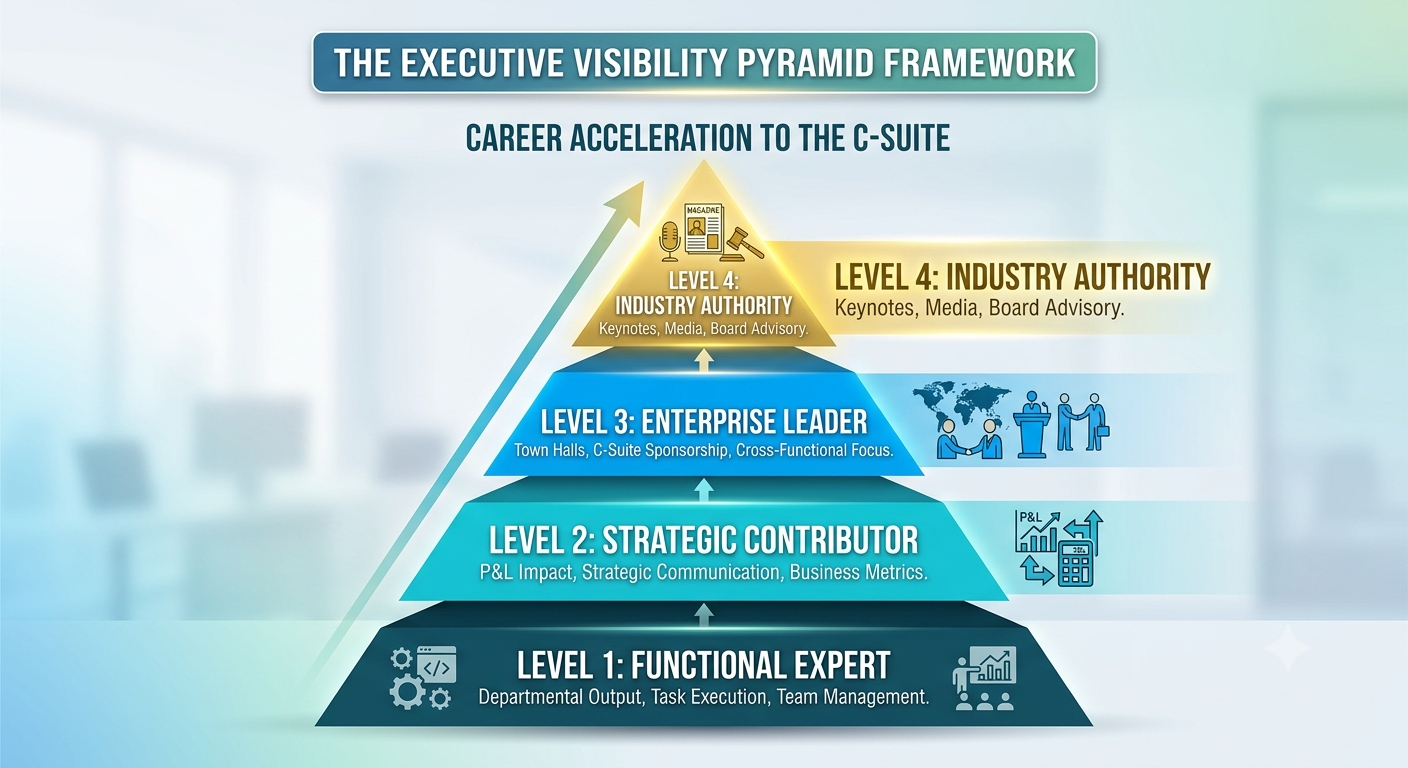
Asset: Executive Visibility Pyramid Framework
The Executive Visibility Pyramid outlines the progressive stages required to transform your reputation from a functional operator to an recognized industry authority:
Lever 4: Negotiate Every Leadership Opportunity
At the executive level, negotiation is no longer just a personal compensation discussion—it is a live test of your business acumen and strategic influence. How you advocate for your compensation, authority, and resources signals to leadership how effectively you will negotiate on behalf of the company.
Negotiating Total Compensation: Salary, Bonuses, and Equity
Executive compensation packages extend far beyond base pay. To capture your full value, evaluate the complete financial structure:
- Base Salary: Establish your baseline using market benchmarks for enterprise scope, P&L responsibility, and geographic complexity.
- Performance Bonuses: Ensure performance metrics are tied to achievable, high-impact business outcomes. Negotiate clear thresholds for target payouts and upside accelerators.
- Equity and Stock Options: Focus on long-term wealth drivers, including restricted stock units (RSUs), stock options, vesting schedules, and change-of-control provisions.
Expanding Role Scope, Team Resources, and Headcount Budgets
Negotiating resources before accepting a promotion or major initiative is critical to securing success in the role.
- Capital and Operational Budget: Secure dedicated funding to support strategic priorities without pulling from existing operational margins.
- Headcount and Talent Acquisition: Define required team structures, key leadership hires, and budget for specialized external advisors.
- Decision-Making Authority: Establish clear boundaries regarding approval limits, sign-offs, and governance oversight.
Critical Executive Negotiation Mistakes to Avoid
- Focusing Solely on Base Pay: Neglecting long-term incentives, bonus structures, or board visibility limits your total value and authority.
- Negotiating Without Leverage: Entering discussions without internal sponsors, external market data, or documented proof of enterprise impact.
- Accepting Responsibility Without Authority: Agreeing to ambitious deliverables without securing the budget, headcount, or decision-making power needed to achieve them.
Lever 5: Build a Sustainable Leadership Career
Reaching the executive level is a marathon, not a sprint. Maintaining peak performance requires setting intentional boundaries and surrounding yourself with strategic advisors who protect your energy and accelerate your growth.
Prevent Burnout While Leading at the Executive Level
Burnout at the executive level isn’t just a personal issue—it’s an enterprise risk. Leading effectively requires cognitive bandwidth, emotional intelligence, and long-term strategic clarity.
- Delegate with Intentionality: Shift from controlling execution to driving governance. Empower direct reports with clear ownership while maintaining high-level oversight through structured metrics.
- Protect Cognitive Energy: Block dedicated time on your calendar for deep, strategic thinking. Treat these blocks as unmovable commitments to avoid reacting to daily operational fires.
- Establish Firm Boundaries: Define non-negotiables for your personal health, family, and rest. High performance requires sustainable recovery cycles to maintain resilience under pressure.
Build Your Personal Board of Directors
Navigating the unique challenges of executive leadership requires a diverse network of trusted advisors outside your immediate reporting structure.
- The Sponsor: A high-ranking executive within your organization who actively advocates for you behind closed doors during promotion and resource decisions.
- The Mentor: A seasoned leader who provides guidance, shares tactical advice, and helps you navigate complex corporate politics.
- The Industry Peer: An external colleague at a similar leadership level who offers unvarnished perspective, market context, and benchmark insights.
- The Strategic Coach: A neutral third party focused on expanding your executive presence, communication effectiveness, and leadership capability.
Your 90-Day Career Acceleration Action Plan
Strategy without execution is just an idea. To break into the C-suite, you must translate these strategic levers into a structured, time-bound roadmap.
This 90-day plan is designed to move you systematically from auditing your current positioning to formalizing your transition into executive leadership.
| Phase | Core Objective | Primary Deliverable | Key Success Metric |
|---|---|---|---|
| Days 1–30 | Audit positioning and establish baseline visibility | Completed Personal Brag Sheet & Sponsor Map | 2–3 target C-suite sponsors identified |
| Days 31–60 | Expand influence and align with P&L drivers | Cross-functional strategy proposal drafted | High-visibility presentation or cross-team win |
| Days 61–90 | Pitch expanded role and secure executive sponsorship | Formal Executive Business Case & Resource Request | Alignment on promotion path or expanded role scope |
Frequently Asked Questions (FAQ)
How can women reach executive roles faster?
Accelerating your path to the C-suite requires shifting your day-to-day focus from functional execution to enterprise-wide strategy. High performers often get stuck in tactical roles because they excel at delivering results, but executive leadership requires proving you can drive organizational growth. Focus on three core shifts: secure an active C-suite sponsor who will advocate for you behind closed doors, align your projects directly with revenue or cost efficiency, and build cross-functional influence across departments.
What is the difference between a mentor and a sponsor?
A mentor talks to you, providing guidance, advice, and feedback to help you navigate your career path. A sponsor talks about you, leveraging their personal executive clout and political capital to advocate for your promotion when high-stakes decisions are made. While mentorship helps you build skills, sponsorship is what actually opens doors to executive appointments.
How do I build visibility without sounding self-promotional?
Reframe your accomplishments around enterprise impact rather than personal effort. Instead of listing task completions, showcase how your team’s initiatives reduced risk, optimized costs, or accelerated revenue. Sharing data-backed outcomes and highlighting your team’s contribution allows you to demonstrate strategic leadership naturally without coming across as boastful.
What core skills do executive boards value most?
Boards and C-suite decision-makers evaluate candidates on enterprise strategy rather than functional expertise. They look for strong financial acumen, risk mitigation capabilities, systemic vision, cross-functional influence, and the proven ability to lead organizations through large-scale change and market volatility.
How should I negotiate an executive promo package?
Approach executive negotiations as a holistic discussion of your overall leadership scope rather than just a base salary increase. Quantify your past business impact to build a solid business case, then negotiate all elements of compensation—including equity options, performance bonuses, signing bonuses, and role resources such as expanded headcount and project budgets.
Conclusion
Breaking the C-suite ceiling requires moving beyond exceptional execution and stepping into strategic leadership. By activating these core strategic levers—from securing high-impact sponsorship and measuring business performance to expanding your executive presence—you regain control of your career trajectory.
Organizational change and individual agency go hand in hand; while you build your trajectory, understanding How to Empower Women Leaders: 7 Actionable Workplace Strategies helps cultivate the corporate ecosystem necessary for executive women to thrive. Advancement is not about waiting to be noticed—it is about deliberately positioning your value where it matters most.
Call to Action: Choose one strategic lever today. Audit your current network, quantify your latest business win, or reach out to a potential sponsor to begin shifting your trajectory this week.
By Aveline Lowell
Founder & Editor-in-Chief, RiseByHer
Aveline Lowell writes research-driven content covering women’s finance, entrepreneurship, STEM, technology, and career growth. Her work focuses on practical, well-researched information that helps women make informed decisions.
Editorial & Disclaimer: RiseByHer aims to provide accurate, well-researched, and up-to-date information. Articles are reviewed and updated when necessary and are intended for general informational and educational purposes, not personalized financial, legal, tax, or professional advice.