


Robo-advisors are changing the way women invest, and the best part? You do not need to be a financial expert to use them. If you’re looking for a simple, low-cost, and stress-free way to grow your money, this beginner’s guide is for you. Whether you’re new to investing or want to make your finances work smarter, robo-advisors can help you achieve your financial goals with ease.
In this post, we’ll explain what robo-advisors are, how they work, and why they are one of the best investment tools for women who want to build wealth. From automated investing to goal-based planning, you’ll discover why more women are choosing robo-advisors to take control of their financial future.
Ready to learn how to invest confidently, even if you’re just starting out? Let’s explore how robo-advisors can simplify your financial journey.
What Is a Robo-Advisor (And How Does It Work?)
A robo-advisor is an automated investing platform that helps you grow your money by building and managing a diversified investment portfolio for you. It uses technology to make smart investing decisions based on your goals, risk level, and timeline.
Instead of manually choosing stocks or worrying about market timing, a robo-advisor handles the investing process in a structured, hands-off way.
1. Robo-advisor definition (simple explanation)
A robo-advisor is an automated online platform that uses algorithms to manage your investments. Unlike traditional financial advisors who charge high fees for one-on-one consultations, robo-advisors offer a low-cost, hands-off investing experience tailored to your goals.
Here’s how it works:
- You sign up on a robo-advisor platform like Betterment, Wealthfront, or Ellevest (designed with women in mind).
- You answer questions about your financial goals, risk tolerance, and investment timeline.
- Based on your answers, the robo-advisor builds a diversified portfolio for you, usually made up of low-cost ETFs (exchange-traded funds).
- The platform automatically monitors, rebalances, and reinvests for you over time.
2. How Robo-Advisors Build Portfolios (ETFs + Algorithms)
Robo-advisors typically invest your money in ETFs (Exchange-Traded Funds).
ETFs are baskets of investments that can include:
- U.S. and international stocks
- Bonds
- Real estate funds
- emerging markets
- sometimes ESG or sustainable funds
This matters because ETFs offer instant diversification, meaning your money is spread across many companies instead of relying on just one stock.
Once your portfolio is built, the robo-advisor uses an algorithm to manage it by:
- adjusting the mix of stocks and bonds based on your risk profile
- rebalancing when your investments drift out of alignment
- reinvesting dividends automatically
- keeping your portfolio aligned with your long-term goals
This is why robo-advisors are popular for women who want long-term wealth building without daily investing stress.
3. Robo-Advisor vs Traditional Financial Adviser (Key Differences)
A robo-advisor and a traditional financial adviser both help you invest, but the experience and cost are very different.
A robo-advisor is best if you want:
- lower fees
- automated investing
- simple long-term portfolio growth
- an easy way to start investing with small amounts
A traditional financial adviser is usually better if you need:
- complex retirement planning
- tax planning for high income
- business wealth strategy
- estate planning and inheritance planning
- personalized financial coaching and emotional guidance
The biggest difference is pricing.
Most robo-advisors charge around 0.25% per year, while human advisers often charge 1% per year (or fixed hourly fees).
Why Robo-Advisors Are a Smart Investment Option for Women
Robo-advisors have become one of the easiest and most practical ways for women to start investing, especially if you want a solution that feels simple, structured, and low-stress.
They remove many of the common barriers that stop women from investing, such as fear of making mistakes, lack of time, or not knowing where to start. Instead of requiring deep financial knowledge, robo-advisors offer an automated system designed for long-term wealth growth.
Here’s why they are a smart option.
1. Low Minimum Deposits (Start With $5–$100)
One of the biggest reasons robo-advisors are popular is because they make investing accessible.
Many platforms allow you to start with as little as $5 to $100, which is ideal if you’re:
- investing for the first time
- building an emergency fund
- paying off debt while still wanting to invest
- growing wealth slowly and consistently
This flexibility makes robo-advisors a strong choice for women who want to begin investing without needing thousands upfront.
2. Automatic Investing (Set It and Forget It)
Robo-advisors are built for consistency, which is the real key to building wealth.
Once your account is set up, you can automate your investing by scheduling weekly or monthly deposits. The platform will invest your money for you, without requiring daily attention.
This is especially helpful for women balancing:
- career responsibilities
- parenting
- running a business
- multiple financial priorities
Instead of trying to time the market, you build wealth through steady investing over time.
3. Lower Fees Than Traditional Financial Advisers
Fees can quietly destroy long-term investment growth, and many women don’t realize how much traditional advice can cost.
Most robo-advisors charge around 0.25% annually, while many human financial advisers charge around 1% annually (or more depending on the service).
That difference may look small, but over 10 to 30 years it can mean thousands of dollars lost in fees.
Robo-advisors are often the best option when you want professional-style portfolio management without paying premium advisory costs.
4. Helps Women Invest Confidently Without Expertise
Many women delay investing because they feel they need to “learn everything first.”
Robo-advisors remove that pressure.
You don’t need to understand:
- stock picking
- market cycles
- technical analysis
- complicated portfolio strategy
Instead, you answer a few questions about your goals and risk tolerance, and the robo-advisor builds a diversified portfolio that matches your profile.
This gives women a structured entry point into investing while still allowing room to learn at their own pace.
5. Great for Long-Term Goals (Retirement, Home, Kids)
Robo-advisors are designed for long-term investing, not short-term speculation.
They work extremely well for women building wealth for major goals such as:
- retirement and financial independence
- buying a home
- saving for children’s education
- building generational wealth
- growing savings while running a business
Because the platform automatically manages your portfolio and keeps it aligned with your goals, it becomes a reliable system for steady financial progress.
For many women, a robo-advisor is not just an investing tool, it’s a long-term wealth-building strategy.
Are Robo-Advisors Safe? Risks Women Should Know
Yes, robo-advisors are generally safe, especially when they are offered by regulated financial institutions. Most robo-advisor platforms use strong encryption, regulated brokerage partners, and investor protections designed to keep client assets secure.
However, “safe” does not mean “risk-free.”
A robo-advisor can protect your account from fraud and operational problems, but it cannot protect you from market downturns. Understanding the real risks helps you invest with confidence and avoid unrealistic expectations.
1. Are Robo-Advisors FDIC Insured?
This depends on what part of your account you’re talking about.
Most robo-advisors offer two types of holdings:
- Cash balances (uninvested cash sitting in the account)
- Investments (ETFs, stocks, bond funds)
Your cash balance may be FDIC-insured, usually through partner banks, up to the standard FDIC limits.
But your investments are not FDIC insured, because FDIC insurance only applies to bank deposits, not market investments.
Instead, investments are typically protected by SIPC insurance (in the U.S.), which helps protect your assets if the brokerage fails, not if the market drops.
2. What Happens if the Robo-Advisor Company Fails?
This is a common fear, but most investors misunderstand how robo-advisors work.
A robo-advisor typically manages your money through a custodian brokerage, meaning your investments are held separately from the robo-advisor company itself.
If the robo-advisor shuts down or goes bankrupt:
- your assets usually remain in your name
- your investments are still held by the custodian brokerage
- you can transfer your portfolio to another brokerage
This is one of the biggest reasons regulated robo-advisors are considered relatively secure.
That said, if the platform fails, you could temporarily lose access while accounts are transferred, which can be inconvenient but not usually financially devastating.
3. Market Risk vs Platform Risk (Important Difference)
To understand robo-advisor safety, it helps to separate two types of risk:
Market risk is the risk that your investments lose value because the stock market drops.
This is normal and unavoidable in investing.
Platform risk is the risk that the company experiences technical issues, fraud, or business failure.
Market risk is the bigger risk for most investors because it affects everyone, even professional investors.
The good news is that robo-advisors usually reduce risk by offering:
- diversified portfolios
- automatic rebalancing
- long-term investment strategies
But they cannot prevent market volatility.
4. Can You Lose Money With a Robo-Advisor?
Yes, you can lose money in the short term.
If your robo-advisor invests in stock ETFs or bond funds, your account value can go down during:
- recessions
- inflation cycles
- interest rate increases
- major stock market corrections
This is completely normal.
However, robo-advisors are designed for long-term growth, meaning the best results usually happen when you stay invested for 5, 10, or 20+ years.
Robo-Advisor Fees Explained (What You’ll Pay in 2026)
Robo-advisors are often marketed as “low-cost investing,” and in most cases, that’s true. But it’s still important to understand exactly what you’re paying, because small fees can quietly reduce your long-term growth.
In 2026, most robo-advisors charge a mix of platform fees and fund-related fees, plus occasional extra costs depending on the provider.
Here’s a clear breakdown.
1. Management Fees (0.25% and Similar)
The main cost of a robo-advisor is usually its annual management fee (also called an advisory fee).
This fee is charged as a percentage of the money you have invested, commonly around:
- 0.20% to 0.50% per year
- Many popular robo-advisors average around 0.25%
What this means in simple terms:
If you invest $10,000 and the fee is 0.25%, you’ll pay about $25 per year.
Robo-advisors charge this fee for:
- building your portfolio
- automatically rebalancing your investments
- reinvesting dividends
- managing your risk allocation
- offering planning tools (depending on the platform)
Even though the percentage looks small, it matters more as your portfolio grows.
2. ETF Expense Ratios (The Hidden Cost Most Investors Miss)
Most robo-advisors invest your money into ETFs, and every ETF has its own built-in annual fee called an expense ratio.
This cost is not charged directly to you as a bill. Instead, it quietly reduces your returns inside the fund.
Typical ETF expense ratios are around:
- 0.03% to 0.25% per year
- ESG or specialty funds may cost more
So even if your robo-advisor charges 0.25%, your real annual cost might look closer to:
0.25% (management fee) + 0.10% (ETF expenses) = 0.35% total
3. Trading Fees and Withdrawal Fees
Many robo-advisors now offer commission-free trading, but extra fees can still appear depending on the platform and account type.
Common additional fees include:
- Account transfer fees (if you move your portfolio elsewhere)
- withdrawal or closing fees (less common, but possible)
- premium subscription fees (for access to human advisers)
- wire transfer fees (some platforms charge for this)
- expense fees for specialized portfolios (like ESG, smart beta, or alternative assets)
Most standard robo-advisors are still affordable, but it’s important to read the fine print, especially if you plan to withdraw or transfer money later.
4. Example: Fee Comparison on $1,000 vs $50,000
Here’s a simple way to understand how robo-advisor fees scale as you grow.
Assume:
- Robo-advisor management fee = 0.25%
- ETF expense ratio average = 0.10%
- Total estimated annual cost = 0.35%
If you invest $1,000: Estimated yearly cost = $3.50 per year. That’s extremely affordable and beginner-friendly.
If you invest $5,000: Estimated yearly cost = $175 per year
Now compare that to a traditional financial adviser charging 1%: 1% of $50,000 = $500 per year
Over time, that difference can become thousands of dollars, especially as your investments grow.
Key Robo-Advisor Features to Look for in 2026
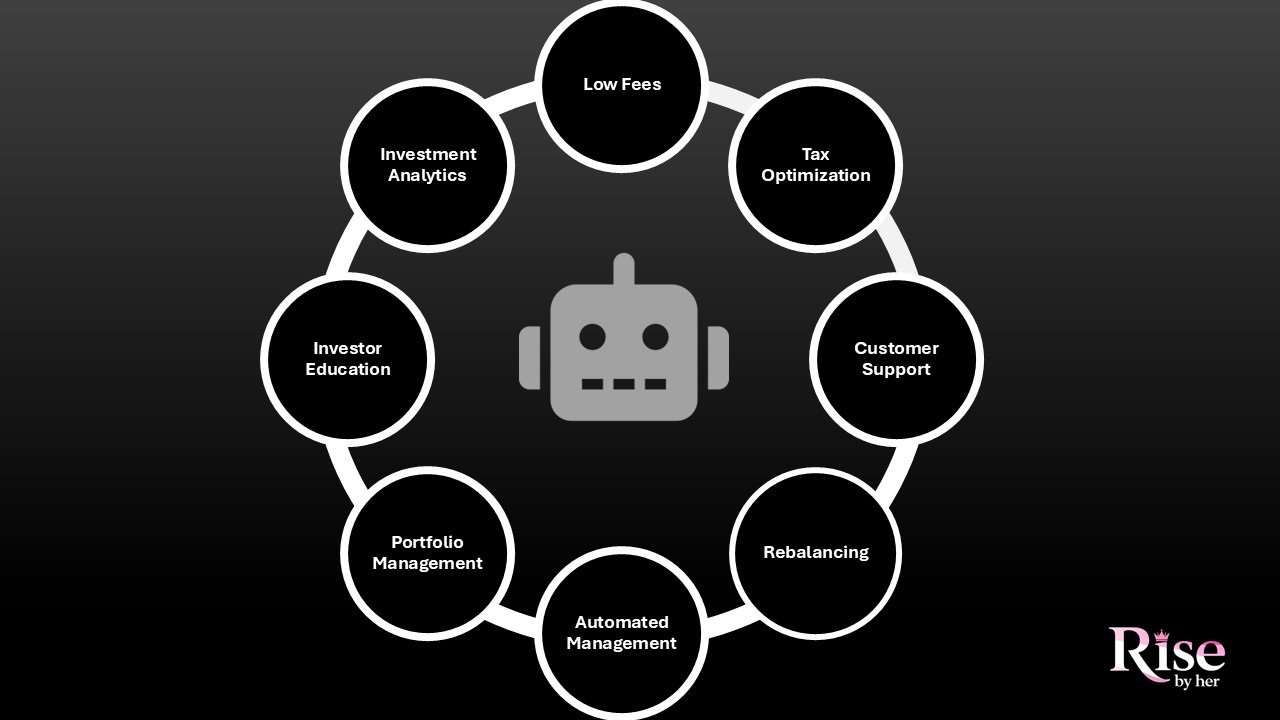
When choosing a robo-advisor in 2026, it is important to go beyond just fees or brand names. The best platforms offer a mix of automation, customization, and educational support, especially helpful for women seeking financial independence and smarter wealth-building strategies. Whether you are investing your first $500 or expanding an existing portfolio, here is what to prioritize:
1. Automatic Portfolio Rebalancing
As markets change, your asset allocation can shift, increasing your risk exposure. A dependable robo-advisor will automatically rebalance your portfolio to match your original investment goals.
Why this matters for women:
- Keeps your risk profile in check without manual effort.
- Ensures long-term investing consistency.
- Removes emotional decision-making from investing.
2. Tax-loss harvesting (for taxable accounts)
Tax efficiency is essential to building wealth over time. Some robo-advisors offer automated tax-loss harvesting, which can reduce your taxable income by selling losing investments and replacing them strategically.
Benefits:
- Lowers your capital gains taxes.
- Boosts after-tax returns.
- Ideal for high-income women and long-term investors
3. ESG and socially responsible investing options
More women today want their money to reflect their values. That is where ESG (Environmental, Social, and Governance) investing comes in. Many robo-advisors now offer portfolios that screen for companies based on ethical and sustainable criteria.
Look for platforms that offer:
- Sustainable and impact investing portfolios
- Filters for diversity, environmental responsibility, or corporate governance
- The option to exclude industries like tobacco, fossil fuels, or weapons.
4. Goal-Based Investing Tools
The best robo-advisors in 2026 don’t just manage your portfolio, they help you plan.
Goal-based investing tools allow you to set specific goals like:
- retirement savings
- buying a home
- building an emergency fund
- starting a business
- saving for a child’s future
These tools often show progress tracking and projected outcomes, which helps you stay motivated and consistent.
This feature is especially valuable for women because it turns investing into a clear plan, not a confusing guessing game.
5. Mobile App + Automation (Auto-Deposits)
In 2026, a strong mobile app is no longer optional. It’s a major part of the investing experience.
A high-quality robo-advisor app should make it easy to:
- check your portfolio performance
- track your goals in real time
- set up recurring deposits
- adjust your risk level when needed
- receive alerts and educational insights
Auto-deposits are especially important because consistent investing beats “perfect timing” almost every time.
The easier the platform is to use, the more likely you are to stay invested long term.
6. Access to Human Advisers (Hybrid Option)
One of the most important upgrades in modern robo-advisors is the hybrid model, meaning you can access a real human financial adviser when needed.
This is a major advantage because even confident investors sometimes need support with:
- retirement planning
- major life changes (marriage, divorce, career shift)
- tax questions
- business income planning
- long-term wealth strategy
Some robo-advisors include human advice in premium plans, while others offer it as an add-on.
If you want automation but still want expert guidance available when life gets complex, choosing a robo-advisor with optional human support is one of the smartest decisions you can make.
Best Robo-Advisors for Women in 2026 (Top Picks)
As more women seek to build wealth, it’s essential to choose the right platform that aligns with your financial goals and values. Below are some of the top robo-investment platforms that cater to a variety of financial objectives, including retirement planning, ethical investing, and long-term wealth accumulation.
1. Betterment: Great for Beginners and Long-Term Growth
Betterment is one of the leading robo-advisors and is known for its easy-to-use interface, making it ideal for women who are new to investing. It offers a range of portfolio options, from basic plans to socially responsible investment strategies.
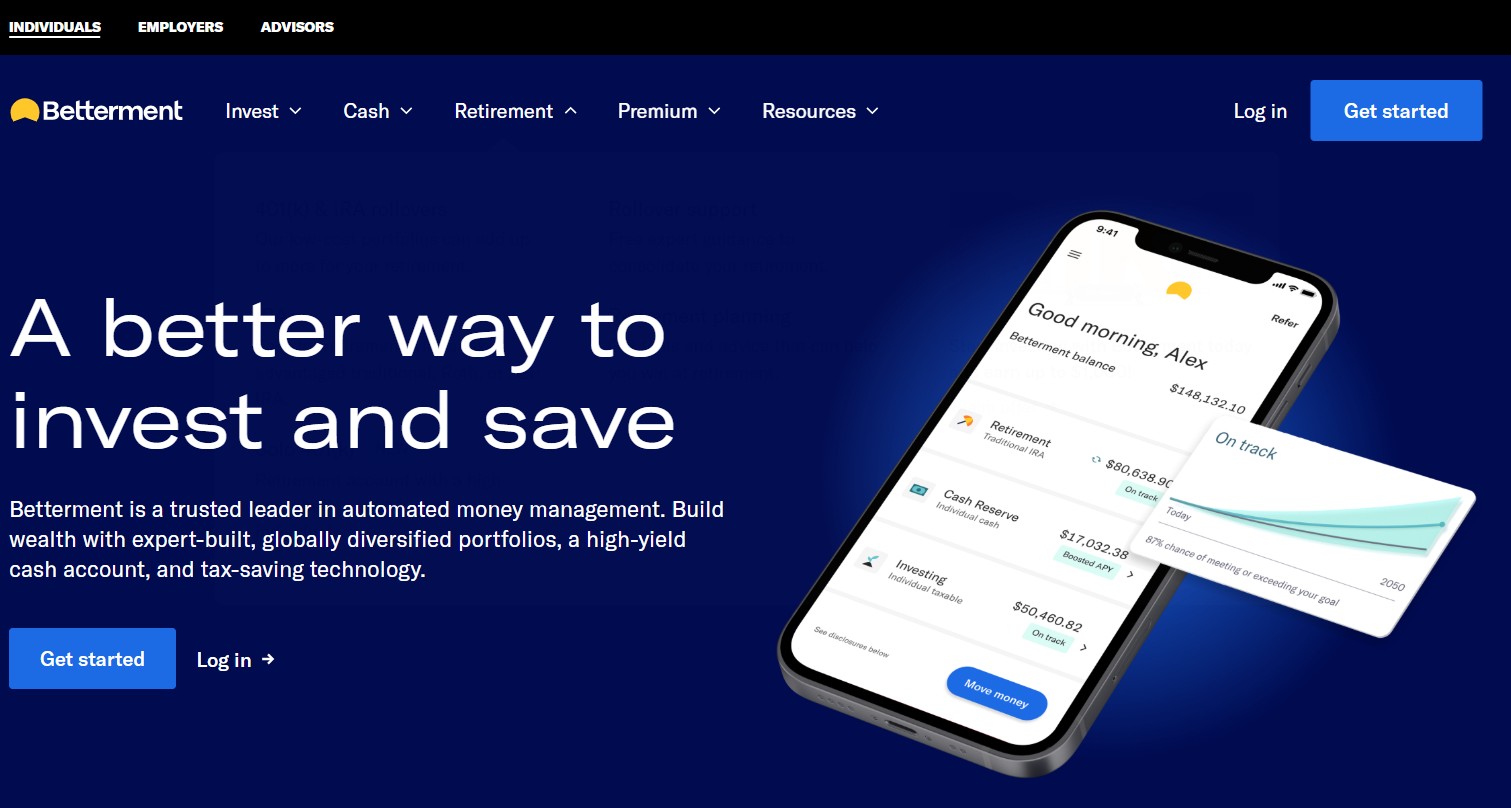
Best for: Women looking for long-term growth and low maintenance with socially conscious investment options.
2. Ellevest: Tailored to Women’s Unique Financial Needs
Ellevest is a female-focused robo-advisor designed with women’s financial needs in mind. It takes into account factors like longer life expectancy and career gaps, making it a great choice for women who want to plan for a secure financial future.
Best for: Women who want a robo-advisor designed specifically for their financial journey and who are focused on long-term goals like retirement.
3. Wealthfront: Ideal for Hands-Off Investors
Wealthfront is one of the most well-known robo-advisors, providing diversified portfolios and automatic rebalancing. It’s a great option for women who want a hands-off investment experience with a focus on retirement planning.
Best for: Women who want a set-it-and-forget-it strategy for retirement or long-term savings.
4. SoFi Invest: A Comprehensive Wealth Management Platform
SoFi Invest is a versatile robo-advisor offering both automated and self-directed investment options. It’s particularly popular among younger women who are just starting their investment journey and want a wide range of tools.
Best for: Women who want a combination of hands-off investing and access to educational resources and financial planning tools.
5. Acorns: Ideal for Small-Scale Investors
Acorns is perfect for women just starting to build wealth but who may not have large sums to invest initially. It rounds up your everyday purchases and invests the spare change into diversified portfolios.
Best for: Women who want to start investing with small amounts and build wealth over time, especially if they are new to investing.
6. Vanguard Digital Advisor (Best Low-Cost Option)
Vanguard Digital Advisor is one of the most trusted and cost-efficient robo-advisors in 2026, especially for long-term investors who want a simple, low-fee approach. It builds diversified portfolios using Vanguard’s well-known index funds, which are designed to keep costs low while maintaining broad market exposure.
This platform is best suited for women who are focused on retirement savings, steady long-term growth, and a “set-it-and-forget-it” investing style. Its strength comes from Vanguard’s reputation for disciplined, low-cost investing rather than flashy features or heavy customization.
While it may not offer the most advanced app experience or lifestyle-based tools compared to newer fintech platforms, Vanguard Digital Advisor stands out for its reliability, transparency, and consistently low fees, making it a strong choice for building wealth over time.
How to Choose the Right Robo-Advisor for Your Financial Goals
Choosing the right robo-advisor is less about picking the “best overall” platform and more about matching the tool to your personal financial goals. Different platforms are optimized for different needs, whether you’re just starting out, investing for retirement, or looking for tax-efficient growth.
Here’s how to choose based on your situation.
1. Best Robo-Advisor for Retirement Investing
If your main goal is long-term retirement security, look for robo-advisors that focus on diversified index investing and low fees.
These platforms typically:
- build globally diversified portfolios
- automatically rebalance over time
- keep costs low to maximize compounding growth
This approach works well for women planning for financial independence, especially through IRAs or long-term taxable accounts.
2. Best Robo-Advisor for Beginners With Little Money
If you’re starting with a small amount, the best robo-advisors are those with:
- low or no minimum deposit
- simple onboarding
- easy-to-understand dashboards
These platforms help you start investing without pressure, making them ideal if you’re still building financial confidence or balancing other financial priorities.
3. Best Robo-Advisor for Ethical Investing (ESG)
For women who want their investments to reflect their values, ESG-focused robo-advisors are the best fit.
They allow you to invest in portfolios that prioritize:
- environmental responsibility
- social impact
- ethical corporate governance
This option is ideal if you want your money to grow while supporting companies aligned with your personal values.
4. Best Robo-Advisor for Hands-Off Investing
If your goal is maximum simplicity, choose a robo-advisor that offers full automation.
Look for platforms that include:
- automatic deposits
- portfolio rebalancing
- dividend reinvestment
- minimal manual decisions
This setup is perfect for busy professionals or entrepreneurs who want to invest consistently without actively managing their portfolio.
5. Best Robo-Advisor for High Earners and Tax Strategies
If you have a higher income or a growing investment portfolio, tax efficiency becomes more important.
In this case, look for robo-advisors that offer:
- tax-loss harvesting
- advanced portfolio optimization
- access to human financial advisers (hybrid models)
These features can help reduce your tax burden and improve long-term after-tax returns, especially as your wealth grows.
How to Get Started With a Robo-Advisor (Step-by-Step)
Starting your investment journey with a robo-advisor is easier than you might think. Follow these simple steps to get started and take control of your financial future today.
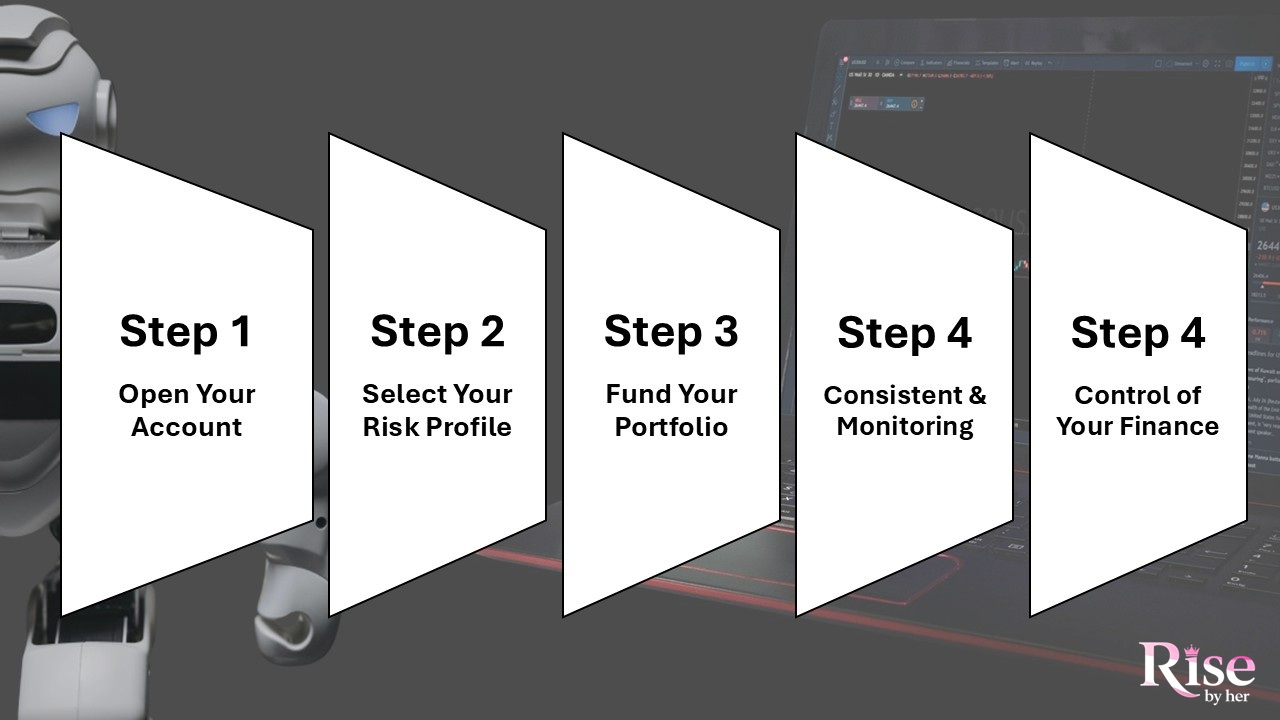
Step 1: Open your account
The first step is to choose a platform and create an account. Most robo-advisors have an easy sign-up process, where you will provide basic personal and financial information. This usually includes your income, financial goals, and investment preferences.
Tip: Look for platforms that offer no minimum deposit or low starting balances, so you can begin investing with as little as $5 or $100.
Step 2: Select Your Risk Profile
Once you have created your account, you will be asked to select your risk profile. This is an essential step as it determines how your investments will be allocated based on your tolerance for risk. Typically, the options range from conservative (low risk, stable returns) to aggressive (high risk, high potential rewards).
Tip: For women who are new to investing, starting with a more conservative profile can be a wonderful way to ease into the market. As you gain confidence and knowledge, you can adjust your profile to align with your financial goals.
Step 3: Fund Your Portfolio
After setting your risk profile, it is time to fund your account. Many robo-advisors allow for one-time deposits, but you can also set up recurring contributions to make saving and investing a habit. Automated investing means your money is regularly put to work, even when life gets busy.
Tip: Automating contributions, even small amounts, is an excellent way to stay consistent and gradually build your wealth over time. Setting up an automatic deposit can take the guesswork out of investing.
Step 4: Stay Consistent and Monitor Your Progress
Investing is a long-term journey. After your portfolio is set up, your job is to stay consistent with contributions and monitor your progress. While robo-advisors manage the day-to-day management, it’s still important to check in regularly to ensure your investments align with your goals.
Tip: Set a reminder to review your portfolio quarterly or after any major life events, like a new job or moving cities, to make adjustments as needed.
Step 5: Take Control of Your Financial Future
By using a robo-advisor, you are empowering yourself to take control of your financial destiny. Whether you are saving for retirement, building an emergency fund, or working toward other goals, automated investing offers a simple, efficient way to grow your wealth.
Encouragement for Women: Investing is an essential step toward financial independence. By taking the first step today, you are making a commitment to your future and your financial security. You do not need to be an expert, just start where you are and let the tools available guide you toward success.
Robo-Advisor vs DIY Investing (Which Is Better for Women?)
Both robo-advisors and DIY investing can help you build wealth, but they work in very different ways. The right choice depends on your time, confidence, and how much control you want over your investments.
Here’s a clear comparison to help you decide.
1. Robo-Advisor vs Investing in Index Funds Yourself
Robo-advisors and DIY index fund investing can look similar because both often use ETFs or index funds, but the key difference is management.
With a robo-advisor, the platform:
- builds your portfolio automatically
- rebalances it for you over time
- adjusts risk based on your profile
- handles diversification and allocation decisions
With DIY index fund investing, you:
- choose your own ETFs or funds
- decide your asset allocation
- manually rebalance your portfolio
- manage contributions and strategy yourself
DIY investing can save fees, but it requires more knowledge and discipline.
2. Robo-Advisor vs Using Vanguard/Fidelity Manually
You can also invest directly through platforms like Vanguard or Fidelity without using a robo-advisor.
In this case, you still benefit from low-cost index funds, but you are responsible for:
- selecting your own funds
- setting your allocation strategy
- rebalancing periodically
- staying consistent during market changes
A robo-advisor, on the other hand, automates all of this for you and removes the emotional decision-making that often leads to mistakes.
3. When DIY Investing Is Better
DIY investing may be a better option if you:
- have investing knowledge and experience
- enjoy researching markets and funds
- want full control over your portfolio
- are focused on minimizing fees as much as possible
- are disciplined with long-term investing decisions
It can be very cost-efficient, but it requires consistency and confidence, especially during market downturns.
4. When Robo-Advisors Are Smarter
Robo-advisors are often the better choice if you:
- are new to investing
- don’t want to manage portfolios yourself
- prefer automation and simplicity
- want to avoid emotional investing decisions
- have limited time to actively manage investments
They are especially helpful for women who want to build wealth steadily while focusing on career, family, or business without adding financial stress.
In short, DIY investing offers more control, but robo-advisors offer more convenience and structure.
Robo-Advisor FAQs for Women Investors
As women increasingly turn to automated investment platforms to manage their finances, it is natural to have questions. Here are some of the most frequently asked questions about robo-advisors, along with answers to help guide your decision-making.
Q1. Are Robo-Advisors Safe?
Yes, robo-advisors are very safe. Most platforms are registered with the Securities and Exchange Commission (SEC) or relevant financial regulatory bodies, which ensures they adhere to strict guidelines. Additionally, they use bank-grade encryption and advanced cybersecurity measures to protect your data and financial transactions.
Make sure to check the platform’s security measures and its registration with financial regulatory authorities before opening an account.
Q2. How Do Fees Compare to Traditional Advisors?
Robo-advisors typically have lower fees compared to traditional financial advisors. The fees are often in the range of 0.25% to 0.50% of your assets under management, which is much lower than the 1% or higher that many traditional advisors charge. This lower cost can result in higher long-term returns, as less of your money is going toward management fees.
It is important to check the pricing structure of each platform to ensure there are no hidden fees or charges that might impact your investment returns.
Q3. Can I Still Speak to a Human If I Need Help?
Yes, many robo-advisors offer some level of human support. While most of your interactions will be automated, platforms like Ellevest, for example, allow you to speak with a financial advisor if needed. This is especially helpful for women who might prefer a personalized approach or need assistance during significant financial decisions.
Look for platforms that offer human support options for more complex financial questions or if you want reassurance about your investment strategy.
Q4. Can I Customize My Investment Portfolio?
Yes, most robo-advisors allow you to customize your portfolio based on your preferences, values, and financial goals. Whether you prefer socially responsible investing (SRI) or are looking for more traditional investment strategies, you can usually adjust your portfolio to match your risk tolerance and interests.
Explore the customization options available on your chosen platform to tailor the portfolio according to your values and financial objectives.
Q5. What Happens if the Market Drops?
Robo-advisors are designed to help you stay the course, even during market downturns. Since your portfolio is often diversified across various asset classes, it’s less likely to suffer the full impact of market volatility. Additionally, many platforms automatically rebalance your portfolio to maintain your desired risk profile.
Stay focused on your long-term goals and remember that market dips are a normal part of investing. It is essential to avoid making rash decisions during times of volatility.
Q6. Are Robo-Advisors Suitable for Beginners?
Yes, robo-advisors are ideal for beginners who are just starting to invest. The platforms are designed to be user-friendly, with simple sign-up processes and educational tools that guide you through your investment journey. They manage the technical aspects of investing, so you can focus on your goals.
If you are new to investing, start with a low-risk profile and gradually learn more about how your investments are managed.
Q7. How Do Robo-Advisors Handle Taxes?
Many robo-advisors offer tax-efficient strategies, such as tax-loss harvesting, to minimize the tax burden on your investments. These features automatically sell securities that have lost value to offset capital gains, which can be especially helpful when managing a taxable account.
Choose a robo-advisor that includes tax optimization features if minimizing taxes is a priority for you.
Q8. Can I Use a Robo-Advisor for Retirement Accounts?
Yes, many robo-advisors offer retirement account options such as IRAs and 401(k) rollovers. This allows you to automate retirement savings and take advantage of tax benefits. Some platforms even offer retirement-specific portfolios designed to optimize your savings for long-term growth.
Consider using a robo-advisor to manage your retirement account, as it simplifies the process and ensures consistent contributions.
Conclusion: Building Wealth With Confidence Using Robo-Advisors
Robo-advisors have made investing more accessible, structured, and less intimidating, especially for women who want to grow their wealth without needing advanced financial knowledge. They combine automation, diversification, and low-cost investing into a simple system that helps you stay consistent over time.
While they are not risk-free and will always follow market movements, their real value lies in removing complexity and emotional decision-making. For many women, this creates a clearer path toward long-term goals like retirement, home ownership, and financial independence.
The key is choosing a platform that matches your goals, staying consistent with contributions, and focusing on time in the market rather than trying to time the market.
Discover more financial strategies here:
- 7 Powerful Investment Strategies for Women with $1000 to Grow Wealth
- 5 Strategic Real Estate Blueprints for Women to Grow Wealth
- How Do Dividend Stocks Work? A 2025 Investing Guide in Finance
By Aveline Lowell
Founder & Editor-in-Chief, RiseByHer
Aveline Lowell writes research-driven content covering women’s finance, entrepreneurship, STEM, technology, and career growth. Her work focuses on practical, well-researched information that helps women make informed decisions.
Editorial & Disclaimer: RiseByHer aims to provide accurate, well-researched, and up-to-date information. Articles are reviewed and updated when necessary and are intended for general informational and educational purposes, not personalized financial, legal, tax, or professional advice.