

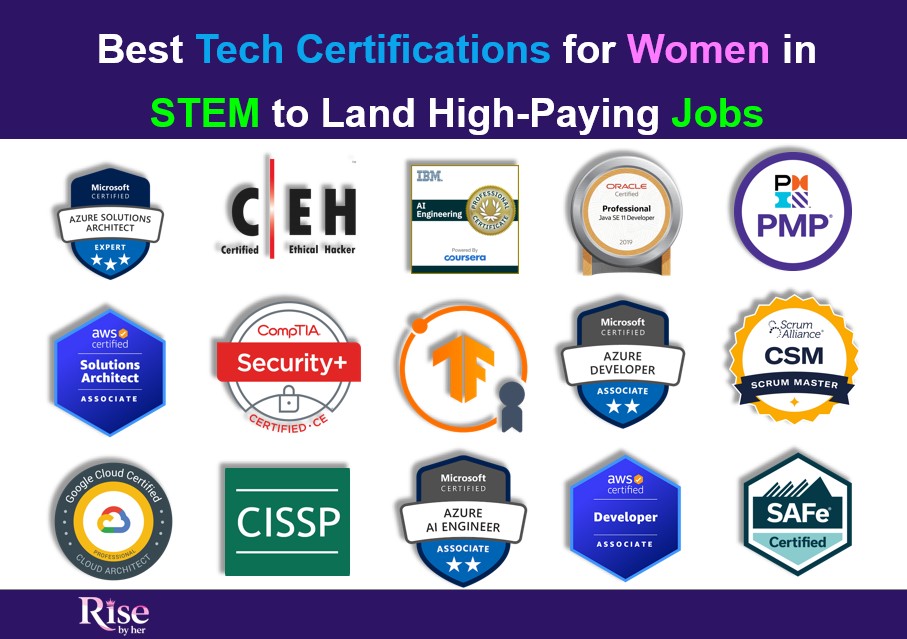
The tech industry has a well-documented leaky pipeline, but the real bottleneck happens at the very first step—the “broken rung.” While entry-level corporate positions often feel guarded by invisible gatekeepers, systemic bias, or an intimidating gender confidence gap, certifications act as the ultimate equalizer. You don’t need a four-year computer science degree or a decade of legacy experience to prove you can do the job. A specialized, industry-recognized certification provides objective, unarguable proof of your technical skills. It bypasses the traditional filters, commands a higher starting salary, and establishes instant authority in rooms where you deserve a seat.
If you are ready to pivot, advance, or completely redefine your career path, choosing the right credential is your highest-leverage move.
To help you skip the analysis paralysis, here is how the top-tier tech certifications stack up by domain, career stage, and financial return on investment.
At a Glance: Top Tech Certifications Ranked by ROI
| Tech Domain | Best Certification | Difficulty Level | Average Salary | Best For |
|---|---|---|---|---|
| Cybersecurity | CompTIA Security+ | Beginner | $85,000+ | Absolute novices & career pivoters |
| Cloud Computing | AWS Solutions Architect – Associate | Intermediate | $140,000+ | Analytical thinkers & career switchers |
| AI & Data Science | Microsoft Azure AI Engineer Associate | Intermediate | $130,000+ | Programmers scaling up for the AI boom |
| Tech Management | Certified ScrumMaster (CSM) | Beginner | $105,000+ | Professionals leveraging transferable organizational skills |
| Enterprise Leadership | Project Management Professional (PMP) | Advanced | $120,000+ | Mid-career women moving into director roles |
The Entry-Level Launchpad: Best Certifications for Complete Beginners
If you are breaking into tech from a completely non-technical background—whether your experience is in retail, education, hospitality, or administrative roles—your biggest hurdle is the resume screen. Recruiters routinely use automated filters that reject candidates without traditional computer science degrees.
The strategy to bypass this filter is simple: achieve a high-market-value credential that demands low technical prerequisites but demonstrates immediate, practical utility. These foundational certifications require zero coding background, can be completed in less than three months of focused study, and open the door to entry-level tech roles with significant upward mobility.
CompTIA Security+
- The Baseline: Best for absolute novices aiming for security operations.
- Average Salary: $55,000 – $75,000 (Entry) | Scales past $85,000+ within two years.
- Why it works: The global cyber talent shortage means hiring managers prioritize verified foundational knowledge over degrees. It tests security concepts, risk mitigation, and compliance—not code.
The Strategic Edge: Security+ satisfies the rigid DoD 8140/8570 directive. This unlocks a massive, highly stable parallel job market within government contracting and defense that most corporate applicants miss.
Google IT Support Professional Certificate
- The Baseline: Best for absolute beginners wanting to learn how technology works from scratch.
- Average Salary: $48,000 – $62,000 (Help Desk & Tech Support roles).
- Why it works: Hosted on Coursera, it features structured, guided sandboxed environments. You can practice fixing systems without the fear of actually breaking anything.
The Strategic Edge: Completing this grants you access to Google’s Employer Consortium—a network of over 150 top-tier companies actively hiring program graduates.
AWS Certified Cloud Practitioner
- The Baseline: Best for analytical thinkers or those aiming for “tech-adjacent” roles.
- Average Salary: $85,000+ (When paired with strong transferable corporate skills).
- Why it works: It avoids deep architectural coding. Instead, it proves you understand cloud billing, security models, and core infrastructure concepts.
The Strategic Edge: This is the ultimate credential if you want to break into tech via project management, technical sales, or product marketing. It proves you speak the native language of the engineering teams.
The Beginner Trap to Avoid:
- Do not collect multiple entry-level certificates. Stacking the Google IT certificate and the AWS Cloud Practitioner without applying for roles signals hesitation.
Pick one track, finish it, build one public portfolio project, and start applying immediately.
High-Paying Cloud Computing Certifications for Career Switchers
If you already have basic technical literacy or general corporate experience, transitioning to the cloud is the fastest route to a high-paying, remote-first career. Organizations are aggressively migrating operations online, yet 87% of companies report a severe shortage of qualified cloud professionals.
Because cloud infrastructure is highly standardized, mastering a specific cloud ecosystem allows you to step directly into a lucrative engineering or architectural path, completely bypassing legacy tech hierarchies.
AWS Certified Solutions Architect – Associate
Amazon Web Services (AWS) commands nearly 30% of the global cloud market share, making this the most universally requested cloud credential on the market.
- The Baseline: Best for analytical problem-solvers who enjoy designing structured, big-picture systems.
- Average Salary: $125,000 – $145,000
- Why it works: It focuses on core architectural design principles—how to build secure, resilient, and cost-effective applications on AWS. Rather than writing lines of code, you are learning how to connect ready-made enterprise components (compute, storage, and database layers).
Because of AWS’s dominant market share, this single certification yields the highest volume of open job postings globally, providing maximum leverage for remote work opportunities.
Microsoft Certified: Azure Solutions Architect Expert
Microsoft Azure dominates the corporate and enterprise landscape, making this advanced track highly sought after by banks, healthcare systems, and massive legacy bus
- The Baseline: Best for career switchers with a background in corporate operations or system administration.
- Average Salary: $135,000 – $155,000
- Why it works: This is an “Expert” level credential that validates both cloud infrastructure design and hands-on deployment. It proves you understand hybrid cloud environments—seamlessly linking a corporation’s physical on-premise servers with Azure’s cloud networks.
Enterprises heavily favor internal promotions or external hires who understand security, compliance, and governance. If you come from a highly regulated corporate background, pairing it with Azure is an instant win.
Google Professional Cloud Architect
Google Cloud Platform (GCP) is the fastest-growing infrastructure choice for tech-native startups, data analytics platforms, and modern AI environments.
- The Baseline: Best for individuals looking to work with cutting-edge tech startups or data-heavy engineering teams.
- Average Salary: $140,000 – $170,000+
- Why it works: GCP certifications consistently rank among the highest-paying in IT. The exam evaluates your ability to design robust cloud architectures specifically optimized for business velocity, security, and advanced cloud-native data processing.
Because GCP is heavily favored by modern tech organizations, this certification positions you directly inside forward-thinking teams that naturally prioritize flexible, asynchronous, and remote-first workplace cultures.
Future-Proofing Your Career with AI and Machine Learning Certifications
The artificial intelligence boom has completely rewritten the tech playbook. While traditional tech domains require ascending rigid ladders, generative AI, natural language processing, and deep learning are frontier fields with a severe talent shortage.
For analytical thinkers, research-driven minds, and data enthusiasts, breaking into AI offers unprecedented salary leverage. Entering this space does not require building complex models from scratch. Instead, companies are paying premiums for professionals who know how to integrate, deploy, and scale existing AI models into enterprise workflows.
Microsoft Certified: Azure AI Engineer Associate
Microsoft’s deep partnership with OpenAI makes Azure the core enterprise infrastructure hub for deploying large language models (LLMs) like GPT-4.
- The Baseline: Best for analytical career switchers who want to build corporate AI applications.
- Average Salary: $120,000 – $145,000
- Why it works: This cert tests your ability to use cognitive services, machine learning, and knowledge mining. It focuses on using pre-built APIs—meaning you don’t need a heavy mathematics or deep coding background to pass.
Enterprise businesses are rushing to adopt AI compliance and automation safely. Holding this credential signals that you can directly manage corporate data securely using Azure’s AI pipelines.
IBM AI Engineering Professional Certificate
Administered via Coursera, this multi-course curriculum focuses on open-source machine learning and deep learning applications, making it highly valuable across diverse, non-Microsoft enterprise environments.
- The Baseline: Best for data enthusiasts who want to build a portfolio of custom machine learning models.
- Average Salary: $110,000 – $135,000
- Why it works: This is a deeply practical, hands-on professional certificate. You will use Python frameworks like SciPy, Scikit-Learn, Keras, and PyTorch to resolve real-world predictive analysis problems.
IBM structures this program around portfolio outcomes. By completion, you will have multiple verified projects published to GitHub, providing immediate proof-of-work to bypass strict recruiter screenings.
Specialized Tracks: Cybersecurity & Software Development
If you prefer building structural foundations or defending digital borders, entering a specialized technical pipeline offers maximum job security. While generalist roles can sometimes blur, software development and core cybersecurity positions have highly distinct, non-negotiable technical requirements.
For women targeting these tracks, certifications act as your primary defense against unconscious bias. They strip away subjectiveness by proving you can write clean, scalable code or secure complex enterprise networks to exact industry standards.
Certified Ethical Hacker (CEH)
The industry baseline for defensive security roles, focusing on understanding the exact mindset, tools, and tactics of malicious actors.
- The Baseline: Best for problem-solvers who want to work in threat hunting, incident response, or penetration testing.
- Average Salary: $95,000 – $115,000
- Why it works: To defend a network, you must know how to compromise it. The CEH certifies that you understand commercial-grade hacking tools, vulnerability analysis, and infrastructure scanning vectors.
Defensive security teams rely heavily on objective metrics. Having “Ethical Hacker” on your resume establishes immediate technical parity in a male-dominated field, signaling that you possess hands-on, adversarial technical knowledge.
AWS Certified Developer – Associate
A cloud-specific programming certification that validates your ability to write, deploy, and debug applications directly inside the Amazon Web Services ecosystem.
- The Baseline: Best for aspiring software engineers who want to focus on cloud-native apps or DevOps.
- Average Salary: $115,000 – $130,000
- Why it works: Modern software development doesn’t happen in isolation; it happens on the cloud. This cert proves you know how to write code that interacts natively with cloud databases, serverless architectures (like AWS Lambda), and secure API endpoints.
Traditional coding boot camps often leave out cloud deployment. By pairing basic coding knowledge with this cloud developer certification, you instantly leap ahead of standard junior developers.
Oracle Certified Professional: Java SE Programmer
A rigorous, deeply technical language certification that proves an exhaustive command of Java—the foundational language of enterprise software.
- The Baseline: Best for women targeting core software engineering positions in banking, fintech, or large-scale backend systems.
- Average Salary: $100,000 – $125,000
- Why it works: This is not a high-level overview. This exam tests deep object-oriented programming concepts, multi-threading, memory management, and data structures. Passing it is a clear statement that you understand programmatic logic at a professional level.
Java runs the global corporate infrastructure. Because this exam has a reputation for being genuinely challenging, holding this credential acts as an undisputed filter-breaker for competitive enterprise software engineering roles.
Fast-Tracking to Leadership: Project Management & Agile Certifications
You do not need to write code to break into tech. If you possess exceptional organization, clear communication, or stakeholder management skills from industries like education, healthcare, or operations, you can pivot directly into tech leadership.
The “broken rung” often prevents women from climbing into management, but Agile and project management certifications validate your ability to steer cross-functional software teams. They bridge the gap between business strategy and technical execution, positioning you as an indispensable facilitator who keeps multi-million dollar tech initiatives on track.
Certified ScrumMaster (CSM)
The fastest, lowest-barrier entry point into an active software development environment.
- The Baseline: Best for career switchers leveraging strong interpersonal skills to manage team workflows.
- Average Salary: $90,000 – $115,000
- Why it works: As a ScrumMaster, you aren’t the boss; you are a facilitator. You remove roadblocks, protect the engineering team from distractions, and ensure the team follows Scrum frameworks. It requires zero programming knowledge but places you directly inside the daily engineering loop.
The CSM course takes only two days of training followed by a straightforward exam. It is the highest-velocity credential to immediately pivot your resume from a non-technical field into software delivery.
Project Management Professional (PMP)
The undisputed global standard for enterprise project delivery, issued by the Project Management Institute (PMI).
- The Baseline: Best for mid-career women with previous managerial or project coordination experience.
- Average Salary: $115,000 – $135,000+
- Why it works: The PMP proves you can manage budgets, risk, and resource allocation across massive timelines. Tech companies value PMP holders because they speak the language of corporate governance and can successfully manage complex, high-stakes infrastructure deployments.
The PMP requires a verified three to five years of experience leading projects before you can even sit for the exam. If you qualify, holding this credential instantly demands executive-level salary brackets.
SAFe Agilist Certification
A specialized framework credential for Scaled Agile Framework (SAFe), designed for large-scale enterprise environments.
- The Baseline: Best for professionals aiming for roles in large corporations, banking, or government tech sectors.
- Average Salary: $110,000 – $130,000
- Why it works: Startups use basic Scrum, but massive global companies need to scale that agility across hundreds of interconnected development teams. The SAFe Agilist certification proves you understand how to implement Lean-Agile principles at the corporate portfolio level.
Because scaling Agile is highly complex, professionals who understand SAFe are rare and heavily sought after by enterprise recruiters. It sets you apart from general project managers by targeting corporate-scale digital transformations.
Step-by-Step Blueprint: How to Transition from Non-Tech to Tech using Certifications
Earning a certification is only half the battle. To successfully break into tech, you need a structured timeline that translates that piece of paper into a paycheck. Passing an exam proves you can memorize concepts; this four-step blueprint ensures you can apply them in the real world to land your first role.
Step 1: Choosing Your Target Tech Domain
The biggest mistake career switchers make is trying to learn everything at once. Focus is your superpower.
- The Action: Align your existing background with a technical counterpart. If you have great soft skills and organize chaotic environments, target Project Management/Agile. If you love deep-diving into data and patterns, target Cloud Architecture or AI/ML.
- The Timeline: Weeks 1–2.
- The Goal: Pick one specific ecosystem (like AWS or Salesforce) or one discipline (like Cybersecurity) and commit to it completely for the next 90 days.
Step 2: Mapping Your Certification Study Plan
Treat your exam prep like a part-time job. A structured roadmap keeps you consistent and defeats imposter syndrome.
- The Action: Block out 1 to 2 hours of deep study per day. Use high-quality, structured platforms like Coursera, Udemy, or native learning hubs (such as Microsoft Learn or AWS Skill Builder).
- The Timeline: Weeks 3–10 (roughly 60 days).
- The Goal: Schedule your exam date before you feel fully ready. Having a hard deadline on the calendar forces accountability and limits over-studying.
Step 3: Building a GitHub or Portfolio Project Around Your Cert
A certification gets your resume past automated HR filters, but a portfolio project is what convinces the hiring manager to extend an offer.
- The Action: Don’t just list the certification on your resume. Build a real, public-facing project that utilizes what you learned. If you earned a cloud cert, host a static website on that cloud. If you earned an AI cert, build a simple script that calls an LLM API to sort data. Document your process on GitHub or a personal blog.
- The Timeline: Weeks 11–12.
- The Goal: Create a visual “proof of work” that you can link directly inside your resume and LinkedIn profile.
Step 4: Networking via Women in Tech Communities
More than 70% of tech jobs are filled through internal referrals rather than cold corporate job boards.
- The Action: Join communities specifically designed to support female career switchers. Platforms like Girls in Tech, AnitaB.org, and local Women in Cloud or Women in Cybersecurity (WiCyS) chapters are goldmines for mentorship and unadvertised job leads.
- The Timeline: Continuous (start this while you are still studying).
- The Goal: Attend virtual meetups or local chapters, share your learning journey out loud on LinkedIn, and ask established professionals for brief informational interviews to get your foot in the door.
You can expand your global connections by exploring Top International Networking Hubs for Female Tech Professionals, where women in STEM and startup ecosystems build valuable partnerships and career opportunities.
Scholarships, Grants, and Free Tech Certification Resources for Women
The single biggest barrier keeping women out of high-ticket tech roles isn’t capability; it’s the cost of entry. Professional certifications from cloud providers and tech giants carry massive weight with hiring managers, but exam fees and training platforms can easily cost hundreds of dollars.
Fortunately, major tech ecosystems fund massive initiatives designed specifically to diversify the tech talent pool. If you know exactly where to look, you can get world-class training, exam vouchers, and career mentorship entirely for free.
The Top Free Tech Training & Certification Programs
The following programs offer direct tracks to industry-recognized credentials without the premium price tag.
| Program | Core Tech Focus | What Is Covered? | Best For |
|---|---|---|---|
| AI Skills 4 Women (Microsoft & Founderz) | Generative AI, Prompt Engineering, AI Ethics | Free core training, official credential, and paths to full advanced scholarships. | Complete beginners and career switchers wanting an enterprise-backed AI credential. |
| Google Launchpad for Women (Google Cloud) | Cloud Computing & Generative AI Leaders | 100% free access to cloud learning paths, hands-on labs, and specific certification exam prep. | Women looking to specialize in cloud architecture or AI data infrastructure. |
| AWS AI & ML Scholars (Amazon & Udacity) | Machine Learning, Agentic AI, Generative AI | Free access to AWS Skill Builder, certification prep, and fully funded Udacity Nanodegrees for top performers. | Aspiring developers and technical professionals looking to master AWS Bedrock and AI programming. |
| IBM SkillsBuild for Women | Cybersecurity, Data Analytics, AI Fundamentals | Permanent free access to over 1,000 self-paced courses, dedicated women’s track mentorship, and IBM digital badges. | Self-paced learners who want structured tracks in cyber defense or data science. |
| Google Career Certificate Scholarships | Cybersecurity, Data Analytics, UX Design, IT Support | Fully funded access to Google’s professional certificates via Coursera (takes 3–6 months to finish). | Women without a tech background looking for a direct, job-ready baseline credential. |
How to Guarantee Your Application Stands Out
Because these programs are fully funded, competition is intense. To secure your slot, structure your application essays or profiles around three elements:
- The Specific Career Pivot: Never write “I just want to learn tech.” State exactly where you want to go (e.g., “My goal is to transition from an administrative role into a Junior Cybersecurity Analyst role”).
- Immediate Application: Explain how you will use the knowledge right away, whether that’s building open-source projects, optimizing a digital business, or volunteering technical skills for a non-profit.
- The Ripple Effect: Tech foundations love community builders. Highlight how you intend to share your journey—whether through LinkedIn updates, local study cohorts, or mentoring other women on a similar path.
Many of these programs operate on rolling deadlines or seasonal cohorts. If a application window is currently closed, register for the host organization’s developer network or newsletter immediately. Early-access notifications are typically sent to registered platform members 2–3 weeks before public launch.
Frequently Asked Questions
Can I break into tech with certifications and no degree?
Yes, you can absolutely break into tech with certifications and no traditional college degree. A massive shift toward “skills-first hiring” means top-tier employers like Google, IBM, Bank of America, and Walmart now prioritize proven technical capabilities over a four-year diploma.
To make this work, you must back up your certification with a public-facing portfolio (like a GitHub repository or a live cloud architecture demo) that serves as unarguable proof of your practical skills.
Which tech certification pays the highest entry-level salary?
Cloud computing and specialized cybersecurity certifications consistently command the highest entry-level salaries, often starting between $70,000 and $95,000. Specifically, the AWS Certified Solutions Architect – Associate and the CompTIA Security+ yield the highest immediate financial return on investment.
When you pair these foundational technical credentials with strong transferable skills from a previous corporate career (like project management or client operations), your earning potential scales even faster.
How long does it take to study for a tech certification?
On average, it takes 60 to 90 days (roughly 100 to 150 hours of total study time) to prepare for an associate-level tech certification. This timeline assumes a consistent commitment of 1 to 2 hours of deep learning per day.
Foundational certificates, such as the Google IT Support Professional Certificate, are self-paced and can be fast-tracked faster if you possess strong baseline technical literacy.
Are there free tech certifications available for women?
While examination bodies usually charge a fee for testing vouchers, multiple global initiatives provide full scholarships, free training, and exam vouchers exclusively for women. Programs like AI Skills 4 Women (Microsoft & Founderz), the AWS AI & ML Scholars initiative, and non-profits distributing Google Career Certificate keys allow qualifying female career switchers to get certified with zero out-of-pocket costs.
What are the best entry-level tech jobs for remote work?
Cloud support associates, entry-level data analysts, junior Salesforce administrators, and tech support specialists offer the highest volume of remote work opportunities for beginners. Because these roles rely entirely on cloud-based software, centralized databases, and digital communication tools, tech companies heavily favor hiring remote talent to fill them.
Securing a foundational ecosystem credential—like the AWS Cloud Practitioner or Google Data Analytics Certificate—is the fastest way to get noticed for these location-independent roles.
How do I handle imposter syndrome when switching to a tech career?
The most effective way to defeat imposter syndrome as a career changer is to focus on “proof of work” rather than trying to memorize everything. Tech is a continuous learning industry; even senior engineers look up answers daily.
Shift your focus from being a passive student to an active builder. Document your learning publicly on LinkedIn, build small projects in public sandboxes, and remember that your non-technical background (communication, empathy, problem-solving) is an asset, not a disadvantage.
Next Steps: Your Launchpad into Tech
Securing a world-class tech certification for free is completely possible, but the credential itself is only fifty percent of the equation. The women who successfully transition into high-paying roles are the ones who turn their newly acquired knowledge into visible, undeniable proof of work.
Do not let fear of a non-traditional background hold you back. The tech industry is actively moving toward a skills-first model, meaning your ability to solve problems, learn continuously, and build in public matters far more than a computer science diploma.
Pick one ecosystem—whether that is cloud architecture with AWS, data analytics with Google, or artificial intelligence with Microsoft. Secure your training slot, set a firm 90-day study deadline, and start building. The resources are entirely free; the only investment required is your consistency.
What to do next: If you are ready to apply for the fully funded tracks we discussed above, your next step is mastering the application essay.
If you’re serious about boosting your salary, check out Top Certifications for High Income Jobs for Women to find the best options for 2026.

By Aveline Lowell
Founder & Editor-in-Chief, RisebyHer
Aveline Lowell is the Founder and Editor-in-Chief of Rise by Her, where she publishes research-driven content focused on women’s entrepreneurship, financial independence, and scalable income strategies. Her work covers profitable business models, grant opportunities, digital income growth, and strategic career advancement for modern women building sustainable wealth.
She is committed to providing structured, practical guidance that helps women make informed financial and business decisions.