


Struggling to manage your business finances effectively? You’re not alone. Many women entrepreneurs face challenges in budgeting, cash flow management, and securing funding, which can impact their business growth.
Effective financial management is the key to long-term success. It ensures stability, profitability, and scalability, allowing you to make strategic decisions without financial stress. Without a solid plan, even the most promising business ideas can struggle to survive.
Here are some common financial challenges for women entrepreneurs:
- Limited access to funding – Women receive less venture capital compared to men.
- Balancing personal & business finances – Many entrepreneurs mix finances, leading to confusion.
- Cash flow issues – Irregular income makes budgeting and reinvestment difficult.
- Lack of financial literacy – Understanding taxes, expenses, and profit margins can be overwhelming.
But don’t worry, smart financial management can help you overcome these hurdles!
Tip 1: Separate Personal and Business Finances (Avoid Costly Mistakes)
Separating your personal and business finances is one of the smartest money moves you can make as a woman entrepreneur. It helps you stay organized, simplifies taxes, improves cash flow tracking, and makes your business look more professional when applying for funding.
Even if you’re just freelancing or running a side hustle, separating finances early prevents major accounting confusion later.
Why Mixing Finances Hurts Your Business Growth
When personal and business expenses are combined, it becomes harder to understand how profitable your business really is. You may think you’re earning money, but in reality, your personal spending could be hiding real business losses.
Mixing finances also creates problems like:
- messy bookkeeping and inaccurate reports
- missed tax deductions
- difficulty tracking cash flow
- stress during tax season
- higher risk of audits or accounting errors
- poor credibility when applying for grants, loans, or business funding
What to Open First: Business Checking, Savings, or Credit Card?
If you’re starting from zero, open your accounts in this order:
- Business checking account (first priority)
This should be your main account for all business income and expenses. Client payments, subscriptions, invoices, and tools should all flow through this account. - Business savings account (second priority)
Use this to save for taxes, emergencies, and future investments. A good rule is to automatically transfer a percentage of your income each month. - Business credit card (third priority but powerful)
A business credit card helps you build business credit, track expenses easily, and keep your cash flow stable during slower months.
Use it for predictable business costs like:
- software subscriptions
- advertising
- inventory
- travel and meals
- business supplies
Best Tools to Track Business Finances (Free + Paid)
Once your accounts are separated, tracking becomes much easier.
Here are the best tools women entrepreneurs use to stay organized:
Best for bookkeeping + accounting
- QuickBooks
- Xero
- FreshBooks
Best for invoicing and getting paid
- Wave (free option)
- PayPal Business
- Stripe
Best for expense tracking
- Expensify
- QuickBooks receipts feature
- Google Sheets (simple and free)
Best for business banking
- Wise Business
- Relay Financial
- Novo
Simple System to Separate Business Finances (Step-by-Step)
Then include:
- open a business account
- set one day per week for finance check-ins
- use one card for business only
- create a “tax savings” category
- track income + expenses weekly
Tip 2: Create a Realistic Business Budget You Can Actually Stick To
A business budget helps you control spending, plan ahead, and stay profitable. Without a budget, it’s easy to overspend during good months and struggle during slower ones.
The goal is not perfection. The goal is consistency.
Simple Budget Formula for Small Business Owners (50/30/20 Method)
A simple budgeting method that works well for small businesses is the 50/30/20 rule.
Use it like this:
- 50% = Business essentials (operating costs)
- 30% = Growth and marketing
- 20% = Profit, taxes, and savings
This formula keeps your business stable while still allowing room to grow.
Examples of business essentials (50%)
- software subscriptions
- rent or coworking space
- internet and phone
- inventory and supplies
- freelancer payments
Examples of growth spending (30%)
- ads and marketing
- branding and website upgrades
- business coaching
- hiring help
- tools that save time
Examples of profit and savings (20%)
- tax savings
- emergency fund
- debt repayment
- reinvesting later
Monthly Budget Categories Women Entrepreneurs Should Track
To make budgeting easier, track the same categories every month.
| Budget Category | What to Include |
|---|---|
| Fixed Costs (Same Every Month) | Rent / office space, subscriptions (Canva, email tools, hosting), insurance, loan payments |
| Variable Costs (Changes Monthly) | Marketing and ads, inventory and packaging, shipping, travel and client meetings, freelancers and contractors |
| Taxes | Income tax savings, VAT or sales tax (if needed) |
| Owner Pay | Monthly salary transfer, personal income planning |
| Savings | Emergency fund, future investment fund |
Tracking these categories helps you quickly see where your money is going and where you need to cut back.
Best Budgeting Tools for Small Businesses (2026)
You don’t need complicated software. You just need a tool you will actually use.
| Tool Type | Best Options |
|---|---|
| Best Free Budgeting Tools | Google Sheets / Excel, Wave (free invoicing + basic tracking) |
| Best Budgeting + Accounting Tools | QuickBooks, Xero, FreshBooks |
| Best Tools for Cash Flow Forecasting | Float, LivePlan |
Tip 3: Track Every Business Expense (So You Don’t Lose Profit)
Tracking your business expenses is one of the easiest ways to protect your profit. When you know exactly where your money is going, you can cut unnecessary spending, improve cash flow, and stay prepared for tax season.
Even small purchases like subscriptions or delivery fees can add up fast and reduce your income without you noticing.
What Counts as a Business Expense? (Common Examples)
A business expense is any cost that supports your business operations, services, or growth.
Here are common examples women entrepreneurs should track:
- Office & workspace: rent, coworking fees, office supplies
- Technology & software: Canva, website hosting, email marketing tools
- Marketing & advertising: ads, SEO tools, branding services
- Inventory & products: stock, packaging, labels, shipping supplies
- Professional services: accountant, lawyer, business coach, VA
- Travel & transport: fuel, parking, client meetings, business trips
- Education & training: courses, certifications, conferences
- Utilities: internet, phone, electricity (business portion)
Expense Tracking Habits That Save Money Fast
Expense tracking becomes easy when you build a routine.
Here are simple habits that make a big difference:
- Track expenses weekly, not monthly
- Keep all business spending on one card/account
- Take a photo of receipts immediately
- Set a monthly limit for marketing and tools
- Review your top 3 expenses every month
- Cancel unused subscriptions every 90 days
- Label transactions clearly (ads, inventory, software, etc.)
Best Expense Tracking Apps for Entrepreneurs
You don’t need complicated software, but the right tool can save time and reduce mistakes.
Here are reliable options:
- Wave (free option for tracking + invoicing)
- QuickBooks (best for full accounting and expense reports)
- Xero (great for growing businesses)
- FreshBooks (good for freelancers and service businesses)
- Expensify (great for receipt scanning and tracking)
- Google Sheets / Excel (simple and beginner-friendly)
Tip 4: Manage Cash Flow Like a CEO (Even If You’re Not Profitable Yet)
Many women entrepreneurs focus only on sales, but cash flow is what keeps your business alive. You can have a profitable business on paper and still struggle if money is not coming in at the right time.
When you manage cash flow correctly, you avoid late payments, reduce stress, and stay in control even during slow months.
Cash Flow vs Profit: What’s More Important?
Profit is what’s left after expenses.
Cash flow is the real money moving in and out of your business account.
Cash flow matters more day-to-day because your business needs cash to pay for:
- rent and subscriptions
- inventory and supplies
- freelancers and employees
- marketing and ads
- taxes and bills
A business can be profitable but still fail if clients pay late or expenses hit before income arrives.
That’s why smart entrepreneurs track cash flow weekly, not just profit monthly.
How to Forecast Cash Flow (Simple Monthly Method)
Cash flow forecasting means predicting how much money you will have available in the next 30 to 90 days.
You don’t need advanced accounting. You just need a simple system.
Step 1: Start with your current bank balance
Write down the exact amount currently in your business account.
Step 2: List all expected income for the month
Include:
- client payments
- product sales
- subscription revenue
- upcoming invoices
Step 3: List all expected expenses for the month
Include:
- rent
- subscriptions
- marketing spend
- payroll or contractors
- inventory purchases
- loan payments
- tax savings
Step 4: Subtract expenses from expected income
This gives you a clear estimate of whether you will end the month with extra cash or a shortage.
Step 5: Repeat this forecast every week
Update it as invoices get paid and new expenses appear
How to Fix Cash Flow Problems Quickly
If your cash flow is tight, the solution is usually a mix of faster income and smarter spending.
Here are practical ways to fix cash flow problems fast:
Speed up incoming payments
- invoice immediately after delivering work
- offer 24-hour or 7-day payment terms
- request deposits upfront (30% to 50%)
- add late payment fees to invoices
- offer easy payment options (PayPal, Stripe, bank transfer)
Delay or reduce outgoing expenses
- pause unnecessary subscriptions
- negotiate payment terms with suppliers
- switch to monthly billing instead of yearly payments
- reduce ad spend temporarily if ROI is low
Build a cash buffer
- save 5% to 10% of monthly revenue
- keep a separate “slow month” savings account
Increase cash flow quickly
- launch a short-term offer
- sell a bundle or package
- promote a limited-time discount
- upsell existing clients
Tip 5: Reduce Business Costs Without Slowing Down Growth
As a woman entrepreneur, every dollar counts. Reducing unnecessary expenses can help you stretch your budget without sacrificing the growth potential of your business. The key is to find cost-effective solutions that don’t compromise quality or customer experience.
Hidden Expenses That Drain Women-Owned Businesses
Many women entrepreneurs lose profit not from big costs, but from small expenses that quietly add up every month. These hidden costs can slowly drain your business cash flow without you noticing.
Here are the most common hidden expenses to watch:
- Unused subscriptions (tools you forgot you’re paying for)
- High transaction fees (PayPal, Stripe, bank transfer charges)
- Frequent small business purchases (packaging, printing, supplies)
- Late fees and penalties (missed payments, overdue invoices)
- Impulse marketing spending (ads without tracking ROI)
- Over-ordering inventory (products sitting unsold)
- Poor pricing strategy (working more but earning less)
- Software upgrades you don’t need yet
- Too many “small outsourcing tasks” that could be automated
Smart Cost-Cutting Strategies (Without Losing Customers)
Use Free Tools – Take advantage of free business tools to handle tasks that usually require expensive software.
- Canva – Create professional designs for social media, marketing materials, and more.
- Mailchimp – Email marketing made easy and affordable, with a free plan for small businesses.
- Trello – Organize your projects, track tasks, and collaborate with teams, all for free.
Automate Repetitive Tasks – Tools like Zapier or Integromat can automate workflows, reducing manual labor and saving time.
Pro Tip: Look for open-source software and freemium tools that scale with your business. By cutting unnecessary costs, you can keep your business running lean and agile while focusing on sustainable growth!
Tools That Replace Expensive Employees or Subscriptions
You don’t always need to hire employees or pay for multiple expensive subscriptions. Many tools can automate tasks and reduce your monthly costs significantly.
| Business Need | Affordable Tools That Replace Hiring |
|---|---|
| Admin & Task Management | Notion, Trello, ClickUp |
| Design & Content Creation | Canva, CapCut |
| Customer Support & Communication | WhatsApp Business, Gmail templates, HelpScout |
| Marketing & Email Automation | Mailchimp, ConvertKit, Buffer |
| Scheduling & Appointments | Calendly, Google Calendar booking links |
| Accounting & Invoicing | Wave, QuickBooks, FreshBooks |
| Automation & Workflow | Zapier, Make (Integromat) |
Tip 6: Invest Wisely in High-ROI Business Areas
Not all business spending is equal. Some expenses drain your money, while others actively help you earn more. High-ROI (return on investment) spending is about putting your money into areas that directly increase revenue, efficiency, or growth.
The goal is simple: spend less on what doesn’t matter, and more on what makes your business stronger.
What High-ROI Spending Looks Like in a Small Business
High-ROI spending is any investment that brings back more money, saves time, or improves performance.
Here’s what it usually looks like:
- Brings in more customers (marketing and ads that generate sales)
- Saves you time (automation tools, systems, software)
- Improves your pricing or conversions (branding, website, sales funnel)
- Increases efficiency (outsourcing repetitive tasks)
- Supports scalability (tools that help you grow without extra workload)
Best Investments for Women Entrepreneurs (Marketing, Systems, Branding)
- Marketing & Branding – Invest in online advertising, social media strategies, and building a strong brand identity to attract and retain customers. According to Forbes, a well-defined brand can increase customer loyalty and boost sales significantly.
- Automation Tools – Invest in tools like Zapier or HubSpot to automate repetitive tasks, saving time and reducing errors. Inc.com states that automation leads to greater operational efficiency and helps businesses scale faster.
- Essential Legal Structures – Secure your business’s legal foundation with the right legal entity (LLC, corporation, etc.) and proper contracts. This will protect you from future liability issues and help with funding opportunities.
- Outsource Smartly – Instead of hiring full-time employees, consider using freelancers for short-term needs. Platforms like Upwork or Fiverr allow you to hire experts in areas like content creation, design, and marketing without long-term commitments, as advised by Entrepreneur.com.
Outsourcing vs Hiring: What’s the Best Choice?
Choosing between outsourcing and hiring depends on how stable your business is and how much work you actually need done. Outsourcing is usually better when you’re still growing because it gives you flexibility and lower costs. Hiring makes more sense when your workload is consistent and you need full-time support.
Outsourcing is best when:
- You need short-term or project-based help
- You want to reduce fixed monthly costs
- Your business income is still unstable
- You are testing or scaling new services
Hiring is best when:
- You have daily, ongoing work
- Your revenue is stable and predictable
- You need someone fully dedicated to your business
- You want long-term team structure
Tip 7: Build Multiple Income Streams to Strengthen Business Stability
As a woman entrepreneur, relying on a single income source can leave your business vulnerable to market fluctuations and unforeseen challenges. By building multiple income streams, you ensure financial stability and create opportunities for growth. Diversifying your revenue not only helps secure your business in uncertain times but also opens new avenues for profits.
Why Multiple Income Streams Are Essential
- Increase Financial Stability – Relying on several revenue sources reduces risk and helps you weather economic downturns.
- Maximize Earning Potential – Multiple streams can generate passive income, freeing up time for you to focus on growing your core business.
- Improve Cash Flow – More income sources lead to a steady cash flow, which is crucial for managing business expenses and reinvestment.
Income Streams Women Entrepreneurs Can Leverage
- Coaching & Consulting – Use your expertise to offer coaching services or become a consultant in your niche. According to Forbes, coaching is a lucrative field, with many women entrepreneurs earning substantial income through online platforms.
- Digital Products – Sell digital products such as eBooks, online courses, or templates. These products have minimal overhead and can generate passive income. Entrepreneur.com highlights that digital products can be automated, allowing you to earn while you sleep.
- Affiliate Marketing – Promote products or services and earn a commission on sales through affiliate programs. As Shopify points out, affiliate marketing is a great way to earn revenue without creating your own products.
- Freelancing – Offer your skills in areas like writing, graphic design, or social media management on platforms like Upwork or Fiverr. Small Business Trends emphasizes that freelancing allows flexibility while expanding your income sources.
How to Diversify Your Income Streams Effectively
- Focus on Your Strengths – Choose income streams that align with your skills and expertise.
- Start Small – Test each stream before committing significant time or resources.
- Automate and Scale – Once established, automate processes (like email marketing or product sales) to scale and generate passive income.
Pro Tip: Combining passive income sources like digital products with active income through freelancing or consulting can provide a balanced approach to diversifying revenue while maintaining control over your business’s growth.
Tip 8: Plan for Taxes and Avoid Financial Surprises
Effective tax planning is essential for the long-term financial health of your business. As a woman entrepreneur, managing taxes proactively ensures you’re not caught off guard during tax season and helps you avoid financial surprises that could derail your business. Proper planning also helps you take advantage of tax breaks and deductions that could save you money.
Why Tax Planning is Critical for Financial Stability
- Avoid Last-Minute Scrambles – Planning your taxes throughout the year helps you stay on top of your obligations, ensuring you don’t face penalties or interest charges.
- Maximize Tax Deductions – Tax planning allows you to identify deductible expenses like business supplies, home office costs, and travel, which can lower your tax burden. According to Inc.com, proactive tax planning can save entrepreneurs up to 20% in taxes each year.
- Maintain Cash Flow – Setting aside money for taxes helps you avoid financial stress when it’s time to pay your dues, keeping your cash flow steady and reliable.
Tools to Help You with Tax Planning and Tracking
- TurboTax – This software simplifies tax filing for small business owners, offering easy-to-understand guides and maximizing deductions. Forbes recommends TurboTax for its user-friendly interface and reliability.
- TaxJar – Automate tax calculations and track sales tax across multiple states, especially if you run an online business. Small Business Trends highlights TaxJar as a tool that saves time and reduces errors.
- Bench.co – A great option for tracking your business’s financials and taxes. Bench integrates bookkeeping and tax tracking into one seamless platform, helping entrepreneurs stay on top of their numbers. According to Business News Daily, Bench is one of the top-rated services for small business accounting.
Strategies for Effective Tax Planning
- Set Aside Tax Funds Monthly – Dedicate a percentage of your revenue each month to a tax savings account, making it easier to pay taxes when they are due.
- Consult with a Tax Professional – If your business is complex or you’re unsure about tax deductions, seeking help from a CPA or tax advisor can ensure you’re following the correct procedures and minimizing tax liabilities.
- Track Expenses – Keep a detailed record of business expenses and income throughout the year using tools like QuickBooks or Wave, so you’re always prepared for tax filing.
Pro Tip: Incorporating tax planning into your regular financial management strategy will not only help you stay compliant but also maximize your savings, allowing you to reinvest in your business and continue scaling confidently.
Tip 9: Secure Funding Options for Women Entrepreneurs to Grow Your Business
As a woman entrepreneur, securing the right funding is crucial for scaling your business and turning your ideas into reality. While traditional loans are often difficult to obtain, there are several alternative financing options specifically designed to support women in business. By exploring these funding sources, you can secure the necessary capital to grow and expand without sacrificing equity or taking on burdensome debt.
Why Securing Funding is Essential for Business Growth
- Fuel Your Growth – Whether you’re launching a new product, expanding your team, or scaling operations, funding can provide the capital you need to move forward.
- Avoid Personal Debt – Accessing business-specific funding allows you to separate personal finances from your business, protecting your personal financial security.
- Gain Access to Resources – Many funding programs for women also provide mentorship, networking opportunities, and business training, helping you succeed in the long run.
Alternative Financing Options for Women Entrepreneurs
- Grants for Women Entrepreneurs
- Amber Grant – Provides $10,000 in funding monthly, with a $25,000 yearly grant. They also offer mentorship and business resources tailored to women. Forbes recommends Amber Grant for its focus on helping underrepresented female entrepreneurs.
- Cartier Women’s Initiative – This global program offers financial support and business training to women-led ventures. Entrepreneur.com highlights it as one of the top grants for women entrepreneurs looking to make a global impact.
- Crowdfunding
- IFundWomen – A crowdfunding platform specifically designed to help women entrepreneurs raise capital from supporters. It’s a popular resource for women-led businesses, offering a combination of grants and loans. TechCrunch suggests IFundWomen for its strong community of female investors and business mentors.
- Kickstarter – If you have an innovative product, Kickstarter is an excellent platform to crowdfund your idea, building a customer base before your official launch. According to Small Business Trends, crowdfunding can help test market demand and create buzz.
- Microloans & Peer Lending
- Kiva – Offers interest-free microloans to women entrepreneurs, especially those in developing countries. Business News Daily praises Kiva for providing accessible funding for underserved entrepreneurs worldwide.
- Accion – This global non-profit offers microloans and financial services tailored to small business owners, particularly women in emerging markets. Inc.com highlights Accion for its affordable loans and business resources.
How to Choose the Right Funding Option for Your Business
- Evaluate Your Needs – Are you looking for a small loan, seed funding, or a grant to support your vision? Knowing what you need will help you narrow down the best options.
- Consider Repayment Terms – Look for funding options that offer flexibility and reasonable terms. Avoid funding options that may strain your cash flow.
- Leverage Multiple Sources – Don’t be afraid to combine several funding sources, such as grants, crowdfunding, and loans, to achieve your business goals.
Pro Tip: Securing the right funding early can accelerate your growth and provide the financial stability needed to take calculated risks and expand your operations. By leveraging programs designed specifically for women, you can unlock valuable opportunities for both capital and mentorship.
Tip 10: Improve Financial Literacy and Stay Updated on Business Finance Trends
For women entrepreneurs, mastering financial literacy is essential for business success. Understanding your finances helps you make informed decisions, avoid common pitfalls, and plan for long-term growth. Staying updated on financial trends ensures you’re always ahead of the curve.
Why Financial Literacy Matters
- Informed Decisions – With financial knowledge, you can confidently make investment and budgeting choices.
- Avoid Mistakes – Understanding your finances helps you prevent costly errors.
- Business Growth – Financial literacy empowers you to optimize resources and scale your business effectively.
Recommended Books & Courses
- Profit First by Mike Michalowicz – A practical guide on managing business finances and prioritizing profit.
- Finance for Non-Financial Managers (Coursera) – Learn the basics of financial management in this course for entrepreneurs.
Follow Financial Experts
- YouTube
- Podcasts
- Blogs
Pro Tip: Continuous learning and staying updated on financial trends is key to managing and growing your business effectively.
Conclusion: Take Control of Your Business Finances Today
Managing your business finances effectively is crucial for long-term success. By implementing the 10 essential tips we’ve covered, you can make smarter financial decisions, stay on top of cash flow, and grow your business sustainably.
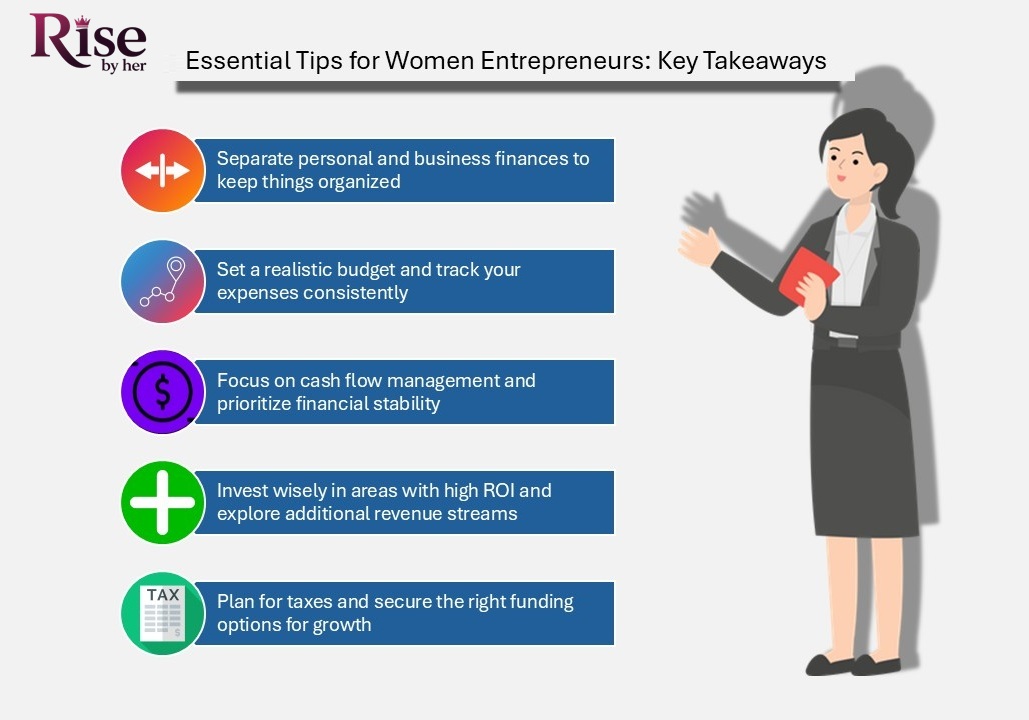
Key Takeaways:
- Separate personal and business finances to keep things organized.
- Set a realistic budget and track your expenses consistently.
- Focus on cash flow management and prioritize financial stability.
- Invest wisely in areas with high ROI and explore additional revenue streams for greater security.
- Plan for taxes and secure the right funding options for growth.
By taking charge of your finances today, you’re laying the groundwork for a successful future.
What financial tip helped you the most? Let me know in the comments below! Ready to take control of your business finances? Start implementing these strategies today!
By Aveline Lowell
Founder & Editor-in-Chief, RiseByHer
Aveline Lowell writes research-driven content covering women’s finance, entrepreneurship, STEM, technology, and career growth. Her work focuses on practical, well-researched information that helps women make informed decisions.
Editorial & Disclaimer: RiseByHer aims to provide accurate, well-researched, and up-to-date information. Articles are reviewed and updated when necessary and are intended for general informational and educational purposes, not personalized financial, legal, tax, or professional advice.