


As a woman entrepreneur, knowing which tax deductions you qualify for is key to protecting your profits and lowering your tax bill. In 2026, new opportunities and updated rules make the tax landscape more favorable, but it can still feel overwhelming if you are navigating it alone. Whether you run a small business, a fast-growing startup, or a side hustle, the right deductions can make a meaningful difference in your financial growth.
In this guide, you will find the most important tax deductions women entrepreneurs should know in 2026, along with practical tips on how to claim them correctly and stay fully compliant.
1. What Are Tax Deductions? (Simple Explanation for Women Entrepreneurs)
Tax deductions are business expenses you are allowed to subtract from your total income. This lowers your taxable income, which means you pay less in taxes.
If you’re a woman entrepreneur, understanding deductions is one of the easiest ways to keep more profit and avoid overpaying the government.
How Tax Deductions Reduce Your Tax Bill
Tax deductions reduce the amount of income you get taxed on.
For example:
- You earn $50,000 in business income
- You have $10,000 in deductible business expenses
- Your taxable income becomes $40,000
That means you pay taxes on a smaller amount, which can save you thousands each year.
The more legitimate deductions you track, the more money you keep in your business.
Tax Deduction vs Tax Credit (Quick Difference)
Many people confuse deductions and credits, but they are not the same.
- Tax deduction: reduces your taxable income
- Tax credit: reduces the actual tax you owe
A credit is usually more powerful because it directly lowers your final tax bill, but deductions are easier to qualify for as a business owner.
Both can help you save money, but deductions are the most common for women entrepreneurs.
What You Need to Claim Deductions (Receipts + Proof)
To claim tax deductions safely, you need proof that the expense was related to your business.
Here’s what you should keep:
- receipts (digital or paper)
- invoices and payment confirmations
- bank statements
- mileage logs (for vehicle deductions)
- business contracts (freelancers, services, rent)
- software subscription records
- proof of business use for phone and internet
A smart habit is to store everything in one place using a folder system or bookkeeping app.
If you track your expenses monthly, tax season becomes easier and you avoid missing valuable deductions.
2. Home Office Deduction (Rules, Examples, and How to Calculate It)
If you run your business from home, the home office deduction can help you reduce your taxable income and save money in 2026. Many women entrepreneurs miss this deduction because they assume they don’t qualify.
The key is proving that your workspace is used for business purposes.
Who Qualifies for the Home Office Deduction?
You can usually claim the home office deduction if your workspace is:
- used regularly for business activities
- used exclusively for business (not personal use)
- your primary place of business (where you manage, plan, or work)
You may qualify even if you don’t meet clients at home, as long as you do important business work there (emails, accounting, content creation, product prep, client calls, etc.).
Examples of women entrepreneurs who often qualify:
- freelancers and consultants
- online business owners
- Etsy sellers and product-based businesses
- coaches and service providers
- remote business owners
If you work from your kitchen table sometimes but the space is also used for personal activities, you may not qualify under strict rules.
Simplified Method vs Actual Expense Method
There are two common ways to calculate the home office deduction.
Simplified method (easier option)
This method is faster and requires less paperwork. You calculate your deduction based on the size of your office space.
Best for:
- small home offices
- beginners who want simple tax filing
- entrepreneurs who don’t want to track every expense
Actual expense method (bigger deduction for many businesses)
This method allows you to deduct a percentage of your real home expenses based on how much of your home is used for business.
Best for:
- larger home offices
- entrepreneurs with high rent or mortgage costs
- women business owners who want maximum tax savings
This method requires more documentation but can lead to a larger deduction.
Home Office Expenses You Can Deduct (Utilities, Rent, Internet)
If you qualify, here are common home office expenses you may be able to deduct:
- rent or mortgage interest (business portion)
- electricity, water, and heating
- home internet (business portion)
- phone bills (business portion)
- home insurance (business portion)
- repairs and maintenance related to the office
- office furniture (desk, chair, shelves)
- office supplies (printer ink, paper, storage items)
A simple way to stay organized is to track your monthly home costs and calculate the business-use percentage based on your office size.
3. Vehicle and Mileage Deduction (Car Expenses You Can Claim)
If you use your car for business purposes, you may be able to claim a vehicle or mileage deduction and lower your taxable income in 2026. This is one of the most common deductions women entrepreneurs miss, especially when they don’t track mileage properly.
Even if you only drive occasionally for business, those miles can add up fast.

Standard Mileage vs Actual Vehicle Expenses
There are two main ways to claim vehicle deductions. You only choose one method for the year.
Standard mileage method (simpler option)
This method is based on how many business miles you drive. It works best if you want easy tracking and fewer receipts.
Best for:
- service-based businesses
- entrepreneurs who drive often
- anyone who wants simple tax filing
Actual expense method (detailed option)
This method is based on your real vehicle costs. You deduct the business percentage of your total car expenses.
Best for:
- women entrepreneurs with high fuel or repair costs
- business owners who use their car heavily for work
- entrepreneurs with a newer vehicle or expensive maintenance
What Car Costs Count as Business Expenses?
If you claim actual vehicle expenses, these are common deductible costs:
- gas and fuel
- vehicle insurance
- repairs and maintenance
- oil changes and tires
- car registration and licensing fees
- parking fees and tolls
- car lease payments (business portion)
- interest on a car loan (business portion)
Business driving usually includes:
- meeting clients or customers
- driving to networking events
- going to suppliers or shipping locations
- business deliveries or errands
- travel between business locations
Best Apps to Track Mileage Automatically
Mileage tracking is what protects this deduction. Without proof, you risk losing the write-off during tax filing.
These apps make tracking fast and automatic:
- MileIQ (popular and simple to use)
- Everlance (great for entrepreneurs and freelancers)
- Stride (good free option)
- QuickBooks Self-Employed (useful if you already use QuickBooks)
4. Marketing and Advertising Costs You Can Deduct
Marketing and advertising expenses are some of the easiest tax deductions for women entrepreneurs because they are directly connected to business growth. If you spend money to promote your brand, attract customers, or increase sales, that expense is usually deductible.
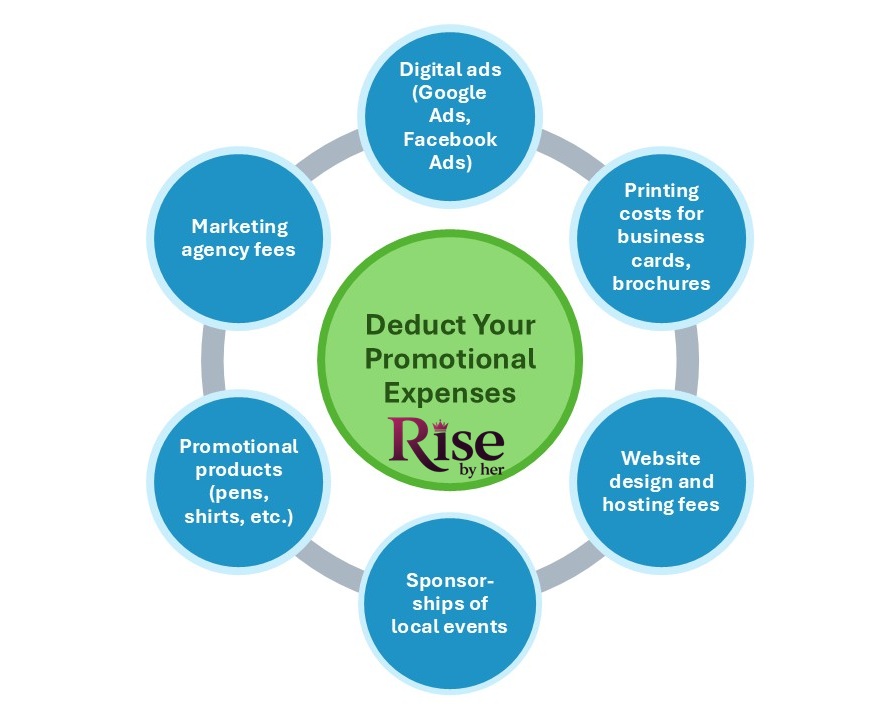
This includes both digital marketing and traditional offline advertising.
Common deductible marketing and advertising costs include:
- Digital ads (Google Ads, Facebook Ads, Instagram Ads, TikTok Ads)
- Printing costs for business cards, brochures, flyers, banners, and posters
- Website expenses such as website design, hosting fees, and domain registration
- Sponsorships of local events, business expos, or community programs
- Promotional products like branded pens, shirts, mugs, tote bags, and packaging
- Marketing agency fees or payments to freelancers (social media managers, SEO experts, designers)
To stay organized, keep receipts and invoices for every marketing expense. These costs can add up quickly, and tracking them properly helps you reduce your taxable income while reinvesting more into your business.
5. Business Software and Subscriptions (Common Tax Write-Off Women Miss)
Business software and subscriptions are one of the most overlooked tax deductions for women entrepreneurs. Many small monthly payments may seem minor, but together they can add up to hundreds or even thousands per year.
If the software helps you run, manage, or grow your business, it is usually a deductible business expense.
Tools You Can Deduct (Accounting, Design, CRM)
Many of the tools you use daily to manage your business can be deducted.
Common deductible tools include:
- accounting software (QuickBooks, Xero, FreshBooks)
- invoicing tools and payment systems
- design tools (Canva Pro, Adobe, CapCut Pro)
- CRM tools (HubSpot, Zoho, Salesforce)
- project management tools (Notion, Trello, ClickUp)
- scheduling tools (Calendly, Acuity Scheduling)
These tools are considered business operating expenses because they support your workflow and productivity.
Apps and Subscriptions That Qualify
Besides major software platforms, many small subscriptions are also deductible if used for business.
Examples include:
- website hosting and domain subscriptions
- email marketing platforms (Mailchimp, ConvertKit, Flodesk)
- cloud storage (Google Drive, Dropbox, iCloud)
- Zoom or video meeting tools
- online course platforms and memberships
- stock photo or video subscriptions
- SEO tools (Ahrefs, SEMrush, Ubersuggest)
- paid newsletter tools or blogging tools
A good habit is to review your subscriptions every 3 months and cancel anything you no longer use.
Phone and Internet Bills for Business Use
If you use your phone and internet for business, you may be able to deduct part of those bills.
Common deductible phone and internet expenses include:
- monthly mobile phone plan (business portion)
- home internet bill (business portion)
- business phone line or second SIM card
- Wi-Fi costs while traveling for business
If you use the same phone for personal and business use, you can usually deduct only the percentage that is business-related.
6. Business Meals and Travel Expenses (What’s Deductible in 2026)
Business meals and travel expenses can be valuable tax deductions, but they are also some of the most misunderstood. Many women entrepreneurs either forget to claim them or claim them incorrectly.
The most important rule is simple: the expense must be directly related to your business activities.
Business Meals Deduction Rules (What Qualifies?)
Business meals are usually deductible when the meal has a clear business purpose.
Examples of deductible business meals include:
- meeting a client or potential client
- meeting with a business partner
- meals during a business trip
- meals during a conference or networking event
To qualify, you should be able to explain:
- who the meal was with
- what business topic was discussed
- the date and location
What usually does not qualify:
- personal meals (even if you work while eating)
- meals with friends or family without business purpose
- luxury or excessive spending without clear business reason
Keeping receipts and adding a short note about the meeting makes this deduction much easier to claim.
Travel Expenses You Can Deduct (Flights, Hotels, Uber)
Travel expenses are deductible when the trip is primarily for business purposes.
Common deductible travel expenses include:
- flights and train tickets
- hotel stays
- taxis, Uber, and public transportation
- car rentals
- parking fees and tolls
- baggage fees
- business-related meals during the trip
- conference or event tickets
If you mix business and personal travel, you should only deduct the business-related portion.
A good habit is to keep all travel receipts in one folder and track expenses daily during the trip.
Common Mistakes That Get People Audited
Meals and travel deductions can raise red flags if they look unclear or exaggerated.
Here are common mistakes to avoid:
- claiming personal vacations as business trips
- deducting meals with no client or business purpose
- missing receipts and relying on estimates
- claiming 100% of mixed personal and business travel
- deducting entertainment costs incorrectly
- writing off luxury expenses that don’t match your business income
To stay safe, keep detailed records and only deduct expenses you can clearly justify as business-related.
7. Business Insurance Premiums (Deductible Coverage Types)
Business insurance is not just protection, it is also a tax-deductible expense for most women entrepreneurs. If you pay for insurance to protect your business, income, or assets, those premiums can usually be claimed as deductions.
This helps you stay protected while also reducing your taxable income.
Insurance Types That Qualify (Liability, Property, Professional)
Several types of business insurance are commonly deductible if they are directly related to your business operations.
Examples include:
- General liability insurance (protects against claims or lawsuits)
- Professional liability insurance (for service providers, coaches, consultants)
- Property insurance (covers office space, equipment, or inventory)
- Business interruption insurance (covers lost income during disruptions)
- Product liability insurance (for product-based businesses)
- Workers’ compensation insurance (if you have employees)
If the insurance is used to protect your business activities or assets, it is usually considered a deductible expense.
Where to Track Insurance Expenses
To make sure you don’t miss this deduction, you need to track insurance payments properly throughout the year.
Here’s how to stay organized:
- save all insurance invoices and payment confirmations
- record monthly or annual premium payments in your accounting system
- separate business insurance from personal insurance policies
- store documents in a dedicated “insurance” folder (digital or physical)
- use accounting tools like QuickBooks, Xero, or Wave to categorize expenses
A simple habit of logging payments when they happen ensures you never forget to claim this deduction during tax season.
8. Professional Services and Contractor Costs (Accountants, Lawyers, Freelancers)
Professional services are a normal part of running a business, and most of these costs are fully deductible. If you pay someone to help you operate, manage, or grow your business, that expense usually counts as a business write-off.
This category is especially important for women entrepreneurs who outsource work instead of hiring full-time staff.
Contractor Payments and Freelancers
Payments to freelancers and independent contractors are deductible business expenses as long as the work is related to your business.
Common examples include:
- virtual assistants
- graphic designers
- social media managers
- copywriters and content creators
- web developers
- marketing consultants
- photographers and videographers
To stay organized, always:
- keep invoices and contracts
- track payment dates and amounts
- label expenses by service type in your accounting tool
- use one platform for payments when possible
Legal and Accounting Fees
Professional support services like legal and accounting help are also tax-deductible.
Examples include:
- accountant or bookkeeper fees
- tax preparation services
- business registration or setup fees
- legal consultations or contracts
- trademark or intellectual property services
- financial advisory services
These services are considered essential business operating costs because they help you stay compliant and financially organized.
Payment Platforms and Transaction Fees (PayPal, Stripe)
Many women entrepreneurs forget that payment processing fees are also deductible.
Common deductible transaction fees include:
- PayPal fees
- Stripe fees
- Shopify Payments fees
- bank transfer fees for business payments
- credit card processing fees
- platform commission fees (Etsy, Fiverr, Upwork, etc.)
These small fees may seem insignificant, but they add up over time and directly reduce your profit, which is why tracking them is important for accurate tax reporting.
9. Office Supplies and Business Equipment Deductions
Office supplies and business equipment are essential for running your business, and many of these costs can be deducted from your taxes. These expenses help you operate daily and are often overlooked by women entrepreneurs, especially when they seem small or occasional.
The key difference is simple: supplies are usually small and used up quickly, while equipment is larger and used over time.
Supplies You Can Deduct (Packaging, Printer, Shipping)
Office supplies are everyday items you use to run your business.
Common deductible supplies include:
- packaging materials (boxes, envelopes, labels)
- printer ink and paper
- shipping supplies (tape, labels, padding)
- stationery (notebooks, pens, folders)
- office furniture under small-value limits (chairs, desk accessories)
- cleaning supplies for your workspace
These are usually fully deductible in the year you buy them because they are used quickly.
Equipment Purchases (Laptop, Phone, Camera)
Business equipment refers to larger items that help you run your business over time.
Examples include:
- laptops and computers
- smartphones used for business
- cameras and photography equipment
- printers and scanners
- office furniture (desk, chair, shelving)
- tablets or drawing devices
These items are more expensive and often used for several years, which is why they may be handled differently for tax purposes.
Depreciation vs Section 179 Deduction (Simple Explanation)
When you buy business equipment, you usually don’t deduct the full cost all at once (depending on your tax system). Instead, there are two common ways to handle it:
- Depreciation: spread the cost over several years
- Section 179 (or similar rules): deduct the full cost in the same year you buy it (if eligible)
Simple way to understand it:
- Depreciation = slow, spread-out tax savings
- Section 179 = faster, immediate tax savings
Many small business owners prefer faster deductions when allowed, because it improves cash flow and reduces taxes sooner.
10. Education and Training Expenses (Courses, Certifications, Coaching)
Education and training expenses are often tax-deductible when they help you improve your existing business skills. For women entrepreneurs, this is one of the most valuable deductions because investing in knowledge directly supports business growth.
The key rule is simple: the training must be related to your current business, not a completely new career.
What Education Expenses Qualify?
You can usually deduct education costs that improve your business skills or help you run your business better.
Common qualifying expenses include:
- online courses and training programs
- business certifications
- skill development workshops
- ebooks, business books, and paid learning materials
- software training programs
- industry-related webinars
If the education helps you increase income, improve services, or manage your business more effectively, it may qualify as a deductible expense.
Coaching and Mentorship Programs (Are They Deductible?)
Coaching and mentorship programs can often be deductible if they are directly related to your business growth.
Examples include:
- business coaching sessions
- marketing or sales coaching
- strategy or mindset coaching for entrepreneurs
- mentorship programs focused on your industry
To qualify, the coaching must support your current business activities, not personal hobbies or unrelated goals.
Conferences, Events, and Networking Costs
Attending business events is another important education-related deduction for women entrepreneurs.
Common deductible event expenses include:
- conference tickets and registration fees
- travel to and from events
- hotel stays during conferences
- networking event fees
- workshops and business seminars
- meals during business events
These events are valuable because they help you learn, build connections, and grow your business network through opportunities like Accelerate Your Career in 2026 with Women’s Professional Networks.
11. Health Insurance Premiums and Medical Coverage (Self-Employed Deduction)
Health insurance can be a significant expense for women entrepreneurs, but in many cases, it is also tax-deductible. If you pay for your own health coverage as a self-employed business owner, you may be able to reduce your taxable income.
This deduction helps you stay protected while lowering your overall tax burden.
Who Qualifies for the Self-Employed Health Insurance Deduction?
You may qualify for this deduction if:
- you are self-employed (freelancer, entrepreneur, or business owner)
- you are not eligible for employer-sponsored health insurance
- you pay your own health insurance premiums
- your business is generating taxable income
In most cases, this deduction applies to individuals who cover their own insurance without a traditional employer.
What Premiums Can Be Included?
You may be able to include several types of health-related insurance costs, such as:
- medical insurance premiums
- dental insurance premiums
- vision insurance premiums
- long-term care insurance (in some cases)
- coverage for your spouse or dependents (if eligible under tax rules)
The key requirement is that the insurance is paid directly by you and used for personal or family health coverage.
Common Health Deduction Mistakes
Many entrepreneurs miss out on this deduction or claim it incorrectly. Here are common mistakes to avoid:
- claiming insurance paid by another employer
- including expenses that are not insurance premiums (like out-of-pocket medical bills, unless allowed)
- forgetting to track monthly premium payments
- mixing personal and business payment records
- assuming you are not eligible without checking rules
To stay safe, always keep proof of payments and confirm eligibility based on your local tax regulations or a tax professional.
12. Retirement Contributions That Lower Taxes (SEP IRA, Solo 401(k), IRA)
Retirement contributions are one of the most powerful ways for women entrepreneurs to save on taxes while building long-term financial security. When you contribute to a retirement plan, you are not only investing in your future, but also reducing your taxable income for the year.
This makes retirement planning a smart tax strategy, not just a savings habit.
Best Retirement Plans for Women Entrepreneurs
There are several retirement plans designed for self-employed individuals and small business owners.
Common options include:
- SEP IRA: simple setup, flexible contributions, great for freelancers and small businesses
- Solo 401(k): higher contribution limits, ideal for solo entrepreneurs with higher income
- Traditional IRA: basic retirement savings option with tax advantages
Each plan has different contribution limits and rules, so the best choice depends on your income level and business structure.
How Retirement Contributions Reduce Taxable Income
Retirement contributions can lower your taxable income in a simple way.
Here’s how it works:
- money you contribute is deducted from your taxable income
- lower taxable income means lower taxes owed
- your savings grow over time inside the retirement account
For example, if you earn $60,000 and contribute $5,000 to a retirement plan, you may only be taxed on $55,000.
How to Choose the Right Plan
Choosing the right retirement plan depends on your business situation and financial goals.
Here’s a simple guide:
- choose SEP IRA if you want simplicity and flexible contributions
- choose Solo 401(k) if you want higher savings potential and higher income
- choose Traditional IRA if you are just starting or want basic retirement savings
A good approach is to start small and increase contributions as your business income grows.
Building long-term wealth starts with smart financial planning, and resources like Financial Independence and Early Retirement: The Ultimate Guide for Women can help you understand how to take control of your money and plan for the future.
13. Payroll, Employee Wages, and Contractor Payments
If you hire people to help run your business, their payments are usually fully tax-deductible. This includes both employees and independent contractors. For women entrepreneurs, this deduction can become one of the largest business expenses, especially as your business grows.
The key is to correctly classify workers and keep proper payment records.
Wages, Bonuses, and Benefits That Count
If you have employees, many types of compensation can be deducted as business expenses.
Common deductible payroll costs include:
- regular employee wages or salaries
- bonuses and commissions
- overtime payments
- paid training and onboarding costs
- employee benefits (health insurance, retirement contributions, if applicable)
- payroll taxes paid by the business
These costs are considered necessary operating expenses because they directly support your business operations.
Contractor vs Employee (Tax Difference)
It’s important to understand the difference between employees and independent contractors, because they are taxed and reported differently.
Independent contractors:
- self-employed individuals (freelancers, virtual assistants, designers)
- you pay them per project or invoice
- you usually do not handle their taxes
Employees:
- work under your control and schedule
- receive regular salary or hourly wages
- require payroll processing and tax withholding
Simple rule:
If you control how, when, and where the work is done, it is likely an employee. If they work independently on agreed tasks, they are usually contractors.
Payroll Software Expenses You Can Deduct
Managing payroll often requires software or tools, and these costs are also deductible business expenses.
Common deductible payroll-related tools include:
- payroll processing software (Gusto, QuickBooks Payroll, ADP)
- accounting software used for payroll tracking
- contractor payment platforms (PayPal, Wise Business, Payoneer)
- HR and scheduling tools (when used for employees)
These tools help you manage payments, stay compliant, and reduce manual work. Keeping track of them ensures you don’t miss important deductions at tax time.
14. Startup Costs and Business Registration Fees (Often Missed Deductions)
Startup costs are one of the most overlooked tax deductions for women entrepreneurs. Many business owners assume these early expenses are not deductible, but in most cases, they can be partially or fully written off depending on tax rules.
These are the costs you pay before and during the early stages of setting up your business.
What Startup Costs Qualify?
Startup costs are expenses you incur before your business officially begins operating or earning income.
Common deductible startup costs include:
- market research and business planning
- advertising before launch
- training or courses to start your business
- consulting fees (legal, accounting, business setup advice)
- travel costs related to starting the business
- software and tools purchased before launch
These costs are usually treated as business investments and may be deducted over time or partially in the first year, depending on your tax system.
LLC Formation, Licenses, Permits, and Filing Fees
Legal setup and registration costs are also commonly deductible business expenses.
Examples include:
- LLC or company formation fees
- business registration and incorporation costs
- local business licenses and permits
- trademark registration fees
- legal fees for setting up contracts or structure
These expenses are essential for making your business official and compliant, which is why they are typically deductible.
Bank Account and Business Credit Card Fees
Many small but recurring banking costs are also deductible, even though they are often ignored.
Common deductible banking expenses include:
- monthly business bank account fees
- business credit card annual fees
- overdraft or maintenance fees
- interest on business credit cards or loans
- payment processing or bank transfer fees
These costs may seem small individually, but they add up over time and directly reduce your business profit. Keeping them tracked ensures you don’t miss easy deductions.
15. Business Banking Fees and Interest Payments (Easy Write-Off)
Business banking costs are small but powerful tax deductions that many women entrepreneurs overlook. Any fees or interest directly related to running your business account are usually deductible and can reduce your taxable income.
These expenses may seem minor, but over time they can significantly impact your overall profit.
Business Loan Interest
If you borrow money to fund your business, the interest you pay is often tax-deductible.
Common deductible loan-related costs include:
- interest on business loans
- interest on equipment financing
- interest on business lines of credit
- interest on loans used for inventory or operations
Important note:
Only the interest portion is usually deductible, not the full loan repayment amount.
Bank Fees and Payment Processing Fees
Most banks and payment platforms charge small fees for business transactions. These are also deductible expenses.
Examples include:
- monthly business account fees
- wire transfer and transaction fees
- ATM or overdraft fees (business accounts)
- PayPal, Stripe, or payment gateway fees
- international transfer charges (Wise, Payoneer, etc.)
These costs directly reduce your revenue, so tracking them helps you understand your real profit more accurately.
Credit Card Interest (Business Use Only)
If you use a credit card for business expenses, the interest may be deductible in some cases.
Common deductible situations include:
- interest on a business credit card
- interest on purchases made for business operations
- fees linked to business-related credit usage
Important rule:
Only interest related to business spending can be deducted. If the card is used for personal expenses, you must separate those costs carefully.
Conclusion: Claim More Deductions and Keep More Profit in 2026
Managing your business taxes is not just about compliance, it is about keeping more of your profit and making smarter financial decisions as a woman entrepreneur. When you stay organized throughout the year, you reduce stress during tax season and avoid missing valuable deductions.
The goal is simple: track consistently, stay organized, and treat your business like a real financial system.
To stay on top of your taxes and maximize your deductions, focus on these key actions:
- separate your personal and business finances
- track expenses every week instead of waiting for tax season
- use accounting software to organize income and expenses
- save receipts, invoices, and payment records in one place
- consult a tax professional when needed for accuracy
- reinvest your tax savings back into business growth
Small habits done consistently create the biggest financial results over time. If you build a simple system now, you will save time, reduce errors, and keep more of what you earn as your business grows.
By Aveline Lowell
Founder & Editor-in-Chief, RiseByHer
Aveline Lowell writes research-driven content covering women’s finance, entrepreneurship, STEM, technology, and career growth. Her work focuses on practical, well-researched information that helps women make informed decisions.
Editorial & Disclaimer: RiseByHer aims to provide accurate, well-researched, and up-to-date information. Articles are reviewed and updated when necessary and are intended for general informational and educational purposes, not personalized financial, legal, tax, or professional advice.