


Success as a woman solopreneur doesn’t just happen overnight; it’s built on intentional daily habits that fuel productivity, confidence, and growth. Whether you’re running a coaching business, freelancing, or launching a digital brand, your everyday routines shape how far and fast you grow.
In a world where multitasking and burnout are all too common, the most successful women entrepreneurs know how to create structure, stay focused, and protect their energy. From powerful morning rituals to smart time management techniques, the right habits can help you work smarter and build a profitable business on your own terms.
Ready to boost your efficiency and reclaim your time? Let’s explore the daily habits of high-performing female solopreneurs that can transform your workflow and mindset.
1. Build a High-Performance Morning Ritual
For the woman solopreneur, the morning isn’t just about “getting ready”; it’s about cognitive priming. When you work for yourself, you are both the CEO and the employee. If the CEO starts the day in a reactive fog, the employee spends the rest of the day spinning wheels on low-value tasks. A high-performance ritual ensures your brain is chemically and environmentally prepared for “Deep Work.”

The Non-Negotiable Elements of a Focused Morning
A winning morning ritual isn’t about the length of the routine, but the quality of the inputs. To rank your productivity at the top 1%, focus on these three physiological and psychological pillars:
- Sunlight & Circadian Reset: View natural light within 30 minutes of waking. This triggers a timed release of cortisol (the “alertness” hormone) and sets a timer for melatonin production later that night, ensuring you don’t just start strong, but finish with better sleep.
- The “Decision-Free” Zone: Solopreneurs suffer from decision fatigue—the more choices you make early (what to wear, what to eat), the less “brain power” you have for business strategy. Top performers automate their mornings with pre-set uniforms or meal prep to save their mental energy for revenue-generating tasks.
- Somatic Grounding: Whether it’s five minutes of breathwork, a cold shower, or a quick stretch, moving from your “head” into your “body” lowers the baseline anxiety that often comes with running a business alone.
Overcoming “Urgency Addiction” Before You Check Email
Most solopreneurs suffer from Urgency Addiction: the dopamine hit we get from responding to “urgent” but “unimportant” notifications. Checking your inbox or Slack the moment you wake up puts your brain into a reactive state, effectively handing over your schedule to other people’s priorities.
To break the cycle, implement these three expert strategies:
- The 90-Minute Lockdown: Commit to 90 minutes of “Creation over Consumption.” Do not open an app that requires a response (Email, LinkedIn, IG DMs) until you have completed your most difficult task of the day.
- The “Eat the Frog” Micro-Task: Identify the one thing you are procrastinating on because it feels “heavy.” Do just 10 minutes of it before you check your phone. Once the seal is broken, the “urgency” of your inbox loses its power over your focus.
- Digital Physicality: Keep your phone in a separate room overnight. Replacing the “scroll” with a physical planner or a book prevents the immediate spike in cortisol that comes from seeing a stressful subject line before your feet even hit the floor.
Expert Tip: High-performance isn’t about doing more in the morning; it’s about protecting your brain’s most creative window from the noise of the outside world.
2. Master Time-Blocking & Lean Productivity Frameworks
Time is a solopreneur’s only finite asset. While corporate employees can hide behind long meetings, a solopreneur’s income is directly tied to output. To scale your business without working 14-hour days, you must transition from a reactive “to-do list” to an aggressive, framework-driven calendar.
How to Layer the Eisenhower Matrix with Time-Blocking
Most business owners fail at time-blocking because they block out time for vague tasks like “work on marketing” without qualifying the task’s true leverage. To fix this, you must run your tasks through the Eisenhower Matrix before they touch your calendar.
The Eisenhower Matrix splits your tasks into four distinct quadrants based on Urgency and Importance. Here is exactly how to translate those quadrants into your daily time blocks:
- Quadrant 1 (Urgent & Important): The Reactive Block. These are client emergencies or system outages. Assign a fixed 30-minute buffer block in the late afternoon to handle these, preventing them from bleeding into your morning.
- Quadrant 2 (Not Urgent but Important): The CEO Deep Work Block. This is where your business grows—offer creation, content strategy, and pipeline building. Guard this with 90-to-120-minute uninterrupted blocks during your peak energy hours.
- Quadrant 3 (Urgent but Not Important): The Batch Block. Administrative tasks, basic invoicing, or generic email sorting. Batch these into a single 45-minute “Administrative Sprint” at the end of the day.
- Quadrant 4 (Not Urgent & Not Important): The Delete Zone. If a task lands here, drop it entirely. It does not earn a spot on your calendar.
The Solopreneur Pomodoro: Adapting Energy to Deep Work
The classic Pomodoro Technique (25 minutes of work, 5 minutes of rest) works well for factory lines or rote data entry. However, for a woman solopreneur doing heavy cognitive lifting—like writing sales copy or coding a product—25 minutes is barely enough time to enter a state of flow (the mental state of operating at high productivity).
Instead, adopt the Ultradian Rhythm Pomodoro, which aligns with your brain’s natural hardwired energy cycles:
- The Focus Sprint: Work intensely for 90 minutes straight. Studies show the human brain can sustain high-level focus for up to 90 minutes before performance begins to decay.
- The True Recovery: Take a 20-minute break. Crucially, this break must involve zero cognitive strain. Checking Instagram or reading an article does not count as a break; your brain is still processing data. Instead, walk away from your desk, stretch, or grab a glass of water.
By aligning your time blocks with your biological energy drops, you prevent the mid-afternoon crash and maintain a high creative output all week long.
The Minimalist Digital Tool Stack for Daily Planning
Software paralysis is a major productivity killer. Many solopreneurs spend more time formatting their project management tools than actually doing the work. To maintain maximum speed, adopt a lean, three-tiered stack where every tool has a strict, single utility:
| Tool Tier | Primary Function | Expert Recommendation |
|---|---|---|
| The Brain Dump | Capturing raw ideas, quick notes, and content outlines before they clutter your mind. | Notion or Apple Notes |
| The Command Center | Tracking active client projects, deadlines, and multi-step business goals. | Asana or Trello |
| The Executioner | Setting the literal boundaries of your day. If it isn’t scheduled here, it doesn’t exist. | Google Calendar or Cron/Notion Calendar |
The Golden Rule of Tool Stacks: If a digital tool takes more than 10 minutes of daily maintenance to look “pretty,” it is no longer a tool—it is an administrative burden. Keep it lean, keep it automated, and let your calendar do the heavy lifting.
3. Track Daily Revenue-Generating Activities (RGAs)
The most dangerous trap of solo entrepreneurship is the “busywork illusion.” It is entirely possible to work a grueling 10-hour day—tweaking your website fonts, cleaning your inbox, and organizing your digital files—while contributing absolutely nothing to your bottom line. To build a profitable business, you must ruthlessly prioritize Revenue-Generating Activities (RGAs) every single day.
Moving from “Busywork” to High-Impact Income Actions
Busywork makes you feel productive because it keeps your hands moving and carries low emotional risk. True RGAs, on the other hand, often feel uncomfortable because they involve putting yourself out there, pitching, or risking rejection.
To rank your tasks effectively, you must learn to instantly distinguish between the two:
- The Busywork Mirage (Low-Impact): Redesigning your logo, rewriting your “About Me” page for the fourth time, scrolling social media under the guise of “competitor research,” or over-editing a blog post that has already been proofread.
- The RGA Reality (High-Impact): Directly pitching a warm lead, sending a sales email to your newsletter list, following up on outstanding proposals, optimizing a high-traffic page for conversions, or booking discovery calls.
If you don’t intentionally schedule your RGAs first, the noise of daily operations will swallow your calendar, leaving your pipeline empty.
5 Examples of High-Yield RGAs You Can Do in 30 Minutes
You do not need an entire afternoon to drive revenue. If you are strapped for time, you can maintain your business momentum by executing just one of these high-yield, 30-minute RGAs during your daily deep-work block:
- The “Warm-Lead” Follow-Up: Open your project pipeline and identify three past leads who paused or hesitated. Send a personalized, low-pressure message: “Hey [Name], I remember you were looking to scale your [Goal] this quarter. I have one opening left for next month—are you still looking for support with this?”
- The High-Conversion SEO Audit: Pick your top three blog posts that already rank on page one or two of Google. Spend 30 minutes inserting explicit, bolded call-to-actions (CTAs), lead magnets, or direct links to your booking page right within the body text.
- The Strategic Pitch Sprint: Identify two non-competing businesses that serve your exact target audience. Pitch them a mutually beneficial collaboration, such as a guest training for their community or a joint webinar.
- The Inbound LinkedIn/Social Lever: Instead of mindlessly posting and logging off, spend 30 minutes leaving deeply insightful, high-value comments on the posts of 5 to 10 dream clients or industry peers. This positions your profile as an authority where your audience already looks.
- The Flash Value Offer: Write a short, punchy email to your newsletter list addressing a highly specific, immediate pain point your audience is facing, and close with a direct invitation to book a paid strategy session to solve it.
Compound Growth: How Tiny Daily Wins Prevent Cash-Flow Slumps
Most solopreneurs live on a painful financial roller coaster: the feast-or-famine cycle. When they need clients, they hustle and pitch aggressively. Once they book the clients, they stop pitching entirely to focus on client delivery. A month later, the projects end, the pipeline is completely dry, and they plunge straight back into a financial panic.
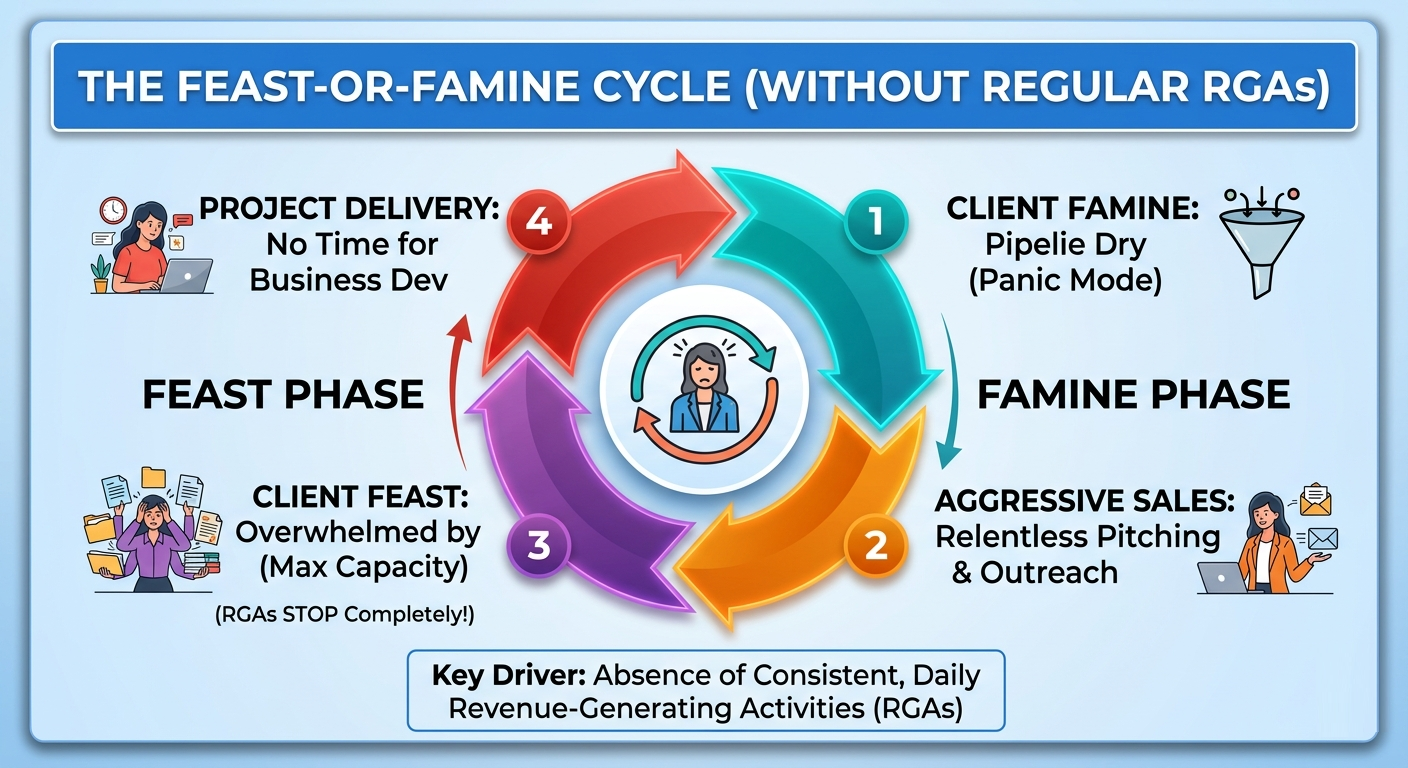
The only way to break this cycle is through the law of compound growth. By committing to just one small RGA every single day—even when you are completely booked with client work—you keep your pipeline consistently warm.
A single daily win might feel minor today, but over a quarter, 60 small revenue actions compound into an unstoppable engine that completely eliminates income dips and gives you true financial predictability.
The Solopreneur Golden Rule: Never let client delivery completely overwrite your business development. Your future income depends on the seeds you plant today.
4. Manage Energy, Not Just Time: Strategic Burnout Prevention
Time management is a flawed concept for a solo business owner. You can have a perfectly time-blocked eight-hour day, but if your mental energy is entirely depleted by hour three, your productivity drops to zero. Time is fixed, but energy is expandable. Managing your business longevity means treating your energy as a critical infrastructure asset that requires active maintenance, not a luxury to fix after a crash.
The Science of Micro-Breaks: Restoring Cognitive Focus
Many solopreneurs wear long hours like a badge of honor, working for four or five hours straight without stepping away from their desks. However, cognitive psychology reveals that prolonged attention to a single task causes the brain’s performance to systematically decline—a phenomenon known as vigilance decrement.
To maintain peak mental sharpness, you must integrate structured micro-breaks into your workday.
- The 20-20-20 Rule for Digital Fatigue: Every 20 minutes, stare at an object at least 20 feet away for at least 20 seconds. This relaxes the ciliary muscles in your eyes, reducing the physical strain and headaches associated with intense screen work.
- The Attention Restoration Theory (ART): True cognitive restoration happens when your brain shifts from directed attention (highly focused work) to involuntary attention (effortless processing). Spending just three to five minutes looking at plants, stepping outside into natural light, or listening to ambient sounds allows your prefrontal cortex to completely recharge.
- The Non-Cognitive Movement Burst: A micro-break should never involve reading, checking messages, or consuming information. Instead, stand up, do a quick physical stretch, or walk to the window. Physical movement circulates oxygenated blood back to the brain, clearing out mental fog instantly.
Real Self-Care vs. Aesthetic Self-Care for Business Longevity
The digital space has commercialized wellness, turning it into “aesthetic self-care.” While buying a luxury candle, treating yourself to a mid-day iced coffee, or organizing a beautiful desk setup can feel nice in the moment, they are temporary mood boosters—not sustainable business strategies.
To survive the long game of entrepreneurship, you must practice real self-care, which is often unglamorous, highly disciplined, and deeply protective of your business operations.
| Aesthetic Self-Care (Surface Level) | Real Self-Care (Business Longevity) |
|---|---|
| Buying expensive planners or aesthetic notebooks. | Setting uncompromising boundaries on client communication times and expectations. |
| Taking a long bubble bath to decompress after a 12-hour panic sprint. | Building operational systems that prevent the 12-hour panic sprint from happening in the first place. |
| Treating yourself to online shopping rewards when stressed. | Auditing your client list and firing a high-maintenance, low-margin client who drains your mental bandwidth. |
| Indulging in a mid-day nap because you are too overwhelmed to work. | Automating administrative tasks to clear your schedule of low-leverage stressors. |
The Reality Check: Real self-care means building a solopreneur life and business system that you don’t constantly feel the need to escape from. It is about creating sustainable frameworks today so you can still run your empire ten years from now.
5. The 15-Minute Evening Wrap-Up and Reflection
How you end your workday entirely dictates how you begin the next. Most solopreneurs work until they are completely exhausted, slam their laptops shut, and walk away. This leaves their brains running background cognitive processes all night long—a psychological phenomenon known as the Zeigarnik Effect, where incomplete tasks create persistent mental tension. To achieve true psychological detachment and a peaceful evening, you must implement a structured, 15-minute evening wrap-up routine.
Clear the Mental Clutter: Questions to Ask Yourself Tonight
The first five minutes of your wrap-up should focus on a cognitive brain dump. When you run a solo business, your mind is constantly juggling unresolved ideas, client requests, and administrative tasks. Leaving these floating in your short-term memory ruins your sleep and spikes morning anxiety.
To clear the mental clutter, open your daily log or digital notepad and answer these three specific, high-leverage reflection questions:
- “What went right today, and what triggered that success?” Documenting wins—even small ones—rewires your brain to recognize progress. This combats the common solopreneur trap of feeling like you “didn’t do enough,” building sustainable entrepreneurial momentum.
- “Where did I lose focus or experience friction?” Identify if a specific client, a messy administrative process, or social media scrolling derailed your schedule. Identifying friction points allows you to optimize your systems for the future.
- “What is currently sitting open in my mind that needs to be externalized?” Write down every single half-formed thought, outstanding email reply, or random idea. Once it is safely written down in your trusted system, your brain can officially stop processing it.
Proactive Planning: Setting Up Tomorrow’s “One Big Thing”
The remaining ten minutes of your routine are dedicated to proactive scheduling. If you wake up in the morning and look at a massive, unranked list of 20 tasks, decision fatigue sets in immediately. You will naturally drift toward the easiest, lowest-impact tasks just to cross them off.
Instead, use the power of the “One Big Thing” (OBT) methodology to script your next day in advance:
- Select Your OBT: Scan your master project list and select the one activity that will move your business forward the most if you accomplish nothing else tomorrow. This is almost always a High-Impact Revenue-Generating Activity (RGA) or a critical client deliverable.
- Create the Frictionless Path: Do the preparation work tonight. If your OBT tomorrow morning is to write a sales email, open the Google Doc and type out the outline tonight. If it is to review your financial metrics, open the specific analytics dashboard before you close your laptop. By removing the initial friction of getting started, you guarantee immediate execution tomorrow morning.
- Time-Block the Execution: Explicitly block out the first 90 to 120 minutes of tomorrow’s calendar for this single task. Treat this block as an unmovable appointment with your business’s future self.
The Evening Rule: Do not leave your desk until your tomorrow self has a clear, unambiguous marching order. A successful morning is entirely engineered the night before.
6. Protect Your Boundaries and Prevent “Hustle Culture” Leakage
When your living room is your office, your business doesn’t just occupy your physical space—it threatens to consume your entire life. Without deliberate intervention, “hustle culture” leaks into your evenings, weekends, and family time. For a woman solopreneur, setting boundaries isn’t about being unavailable; it is a vital operational strategy to protect your most valuable asset: your cognitive capacity and long-term creativity.

Defining Hard Stop Times in a Home Office
The greatest lie of the home office is that flexibility means working all the time. Without a physical commute to signal the end of the day, work time naturally stretches to fill every available hour. To stop this leakage, you must transition from a soft boundary (“I’ll finish up around 6 PM”) to an uncompromising Hard Stop Time.
To successfully implement a hard stop time in a home office, use these three structural cues:
- The Environmental Shift: Human brains are highly sensitive to environmental cues. If you work at a specific desk, your brain associates that space with high focus. When your hard stop time arrives, physically close your laptop, put it out of sight, and change your physical environment. Moving to a different room or stepping outside for a brief walk can simulate the psychological closure of a classic evening commute.
- The Digital Shutdown Ritual: Set automated boundaries on your devices. Program your phone to automatically enter a strict “Do Not Disturb” or “Work-Life Focus” mode at your designated hard stop time. Hide work-related communication apps like Slack, Gmail, or your project management tools from your home screen so you aren’t tempted by casual notification badges.
- The “Hard Out” Accountability: Schedule a non-negotiable personal commitment right at your hard stop time. Whether it’s an exercise class, cooking dinner with family, or a hard rule to meet a friend, having an external appointment forces you to close your laptop. It stops the infinite loop of “just one more email.”
The Sunday Digital Detox: Reclaiming Mental Real Estate
True business strategy requires high-level thinking, but you cannot think strategically if your mind is constantly reacting to notifications. The weekend should be a period of deep mental reset, yet many solopreneurs spend their Sundays casually checking metrics, answering non-urgent DMs, or drafting content out of pure habit.
To reclaim your mental real estate and prevent burnout, implement a Sunday Digital Detox:
- The 24-Hour Offline Window: Choose a fixed 24-hour window every weekend—typically from Saturday evening to Sunday evening—where you completely step away from business networks, analytics, and professional social channels.
- Replace Consumption with Creation or Connection: When you remove digital noise, your brain will naturally seek a dopamine replacement. Instead of scrolling, fill that mental space with analog activities that restore your energy: reading physical books, engaging in a creative hobby, spending time in nature, or connecting face-to-face with people who have nothing to do with your industry.
- The Monday Buffer Strategy: The main reason entrepreneurs break their weekend detox is the fear of walking into a chaotic Monday morning. To counter this, ensure your Friday afternoon or evening wrap-up routine includes setting your exact priorities for Monday. Knowing your upcoming week is already mapped out allows your brain to fully relax and enjoy the weekend without lingering anxiety.
The Boundary Rule: If you don’t design the boundaries of your digital workspace, your clients and your phone will gladly design them for you. True freedom in solopreneuership requires the discipline to log off.
7. Design Your Solo Accountability Ecosystem
Operating as a solo founder is inherently isolating. Without a corporate structure, a team, or a manager to provide feedback, you are entirely responsible for keeping your own momentum alive. However, isolation is the fastest path to stagnation. To sustain high-velocity growth, a winning solopreneur must intentionally build an external Accountability Ecosystem—a curated network of peers, systems, and inputs that simulate the strategic pressure of a boardroom while preserving your complete independence.
Peer-Led Masterminds vs. Business Buddies: Which Do You Need?
Many business owners confuse casual professional friendships with true strategic alignment. To optimize your network for rapid growth, you need to recognize the sharp operational difference between a Business Buddy and a Peer-Led Mastermind. Both are essential, but they serve completely different functions in your ecosystem.
- The Business Buddy (Emotional Support & Daily Sanity): This is a peer at a similar stage of entrepreneurship with whom you swap daily text messages, share industry memes, and vent about client frustrations. The primary value here is psychological safety and empathy. A business buddy keeps you from feeling isolated in the day-to-day grind, but they rarely challenge your business model or push you out of your comfort zone.
- The Peer-Led Mastermind (Strategic Pressure & Financial Growth): This is a highly structured, recurring meeting with a curated group of 3 to 5 non-competing founders who are at your level or slightly ahead of you. These meetings run on a strict agenda: reviewing hard metrics, auditing conversion rates, analyzing search impressions, and mapping out long-term monetization goals. In a mastermind, you step out of the daily operations and enter the “Hot Seat,” where your peers actively critique your strategy, spot your operational blind spots, and hold you ruthlessly accountable to your quarterly growth milestones.
The Expert Recommendation: If you are feeling lonely or emotionally exhausted, seek out a business buddy. If your traffic has plateaued, your revenue has stalled, or you are struggling to scale your monetization strategy, design or join a structured mastermind immediately.
Curating Your Inputs: Podcasts and Communities That Drive Growth
Your creative and strategic output is a direct reflection of your daily digital inputs. If your feeds are filled with surface-level lifestyle content, your business strategy will remain superficial. To rank among the top performers in your niche, you must aggressively curate your media diet, focusing on high-signal, data-driven platforms.
- The High-Signal Audio Feed: Shift your podcast consumption away from generic motivational shows and toward hyper-tactical, deep-dive business audio. Prioritize episodes that interview technical experts on advanced SEO architecture, conversion rate optimization (CRO), financial engineering for micro-businesses, and data-driven marketing frameworks. Treat podcast time as an active learning session rather than passive entertainment.
- The Value-First Digital Community: Exit large, noisy, unmoderated social media groups where the primary activity is self-promotion. Instead, embed yourself in lean, high-utility digital communities focused on specialized technical execution—such as dedicated search console optimization forums, technical analytics networks, or niche business platforms that empower women to scale their economic independence.
- The Ruthless Content Filter: Audit your digital spaces every quarter. Unfollow or mute any account that promotes unrealistic “overnight success” narratives or toxic hustle metrics. Replace them with technical data sources, case studies, and transparent creators who share real analytics, true experiment failures, and verifiable business growth strategies.
The Ecosystem Rule: You do not have to build your business in a vacuum. Surround yourself with inputs that sharpen your intellect, and a peer network that refuses to let you play small.
8. Action Plan: Transitioning from Overwhelmed to Systemized
Information without execution is just a recipe for digital clutter. You do not need to overhaul your entire business ecosystem by tomorrow morning; doing so is a fast track to operational shock and early abandonment. Instead, systemic change requires a phased, intentional approach. By breaking down your transformation into a structured weekly timeline, you drastically lower the cognitive friction of building new habits.
The 7-Day Solopreneur Habit Audit
This data-driven, week-long framework is designed to transition you from a reactive worker to a proactive systems architect. Follow these daily marching orders to audit your current output and seamlessly implement high-performance habits:
Days 1–2: The Friction & Input Baseline
- The Objective: Identify exactly where your energy and time are leaking.
- The Action: Do not alter your current behavior. Simply keep a notepad or a digital document open next to your workspace. Every time you switch tasks prematurely, check email out of habit, or spend 20 minutes tweaking a graphic that was already finished, write it down. Note the trigger: Were you bored? Avoidance-profiling a heavy task? Overwhelmed?
Days 3–4: Environmental Hard Stops & Decompression
- The Objective: Establish firm operational boundaries to stop hustle culture leakage.
- The Action: Introduce your strict Hard Stop Time. If you work from home, choose a physical cue—such as shutting your laptop and sliding it completely out of sight into a drawer. For these two days, commit to running your 15-minute evening wrap-up routine before that hard stop. Explicitly define your “One Big Thing” (OBT) for the next morning so your brain can fully detach over the evening.
Days 5–7: Aggressive Revenue-Generating Isolation
- The Objective: Protect your peak cognitive hours for high-yield activities.
- The Action: Implement the 90-Minute Lockdown immediately upon waking or sitting at your desk. Do not open email, check site metrics, or look at social media platforms until that block is complete. Spend this entire block executing one specific Revenue-Generating Activity (RGA), such as cold pitches, warm follow-ups, or optimizing a high-traffic page for sales conversions.
Downloadable Asset: The Ultimate Daily Win Tracker
Stop tracking arbitrary vanity metrics like “hours spent sitting at the desk.” To maintain accurate business momentum, your daily success should be evaluated through a binary scoring system.
Copy and paste this clean, high-performance tracking matrix into your digital workspace (Notion, Google Sheets, or Apple Notes) to track your daily execution:
| High-Performance Habit Pillar | Success Metric | Binary Score (0 or 1) |
|---|---|---|
| The Morning Prime | Completed a 90-minute morning block dedicated solely to creation before consuming external digital inputs. | |
| The Daily RGA | Spent at least 30 to 45 minutes on an explicit Revenue-Generating Activity (e.g., pitching, follow-ups, conversion optimization). | |
| Energy Maintenance | Integrated at least two deliberate micro-breaks (non-cognitive, away from screens) to protect focus. | |
| The Hard Boundary | Honored the pre-set Hard Stop Time and physically shifted out of the home-office working environment. | |
| The Evening Close | Conducted a 15-minute wrap-up, cleared mental clutter, and prepared the workspace for tomorrow’s OBT. | |
| TOTAL DAILY SCORE | Aim for a minimum score of 4/5 daily to compound long-term business growth. | /5 |
Systems Over Motivation: A business does not scale based on how motivated the founder feels on a Tuesday morning. It scales based on the consistency of the underlying habits. Run this audit, track your scores, and let the data optimize your path to financial independence.
Frequently Asked Questions (FAQ)
How many hours a day should a solopreneur work?
There is no universal number, but data-driven productivity models suggest that 4 hours of true, uninterrupted Deep Work yields higher economic output than 10 hours of fragmented, distracted “hustle.” Focus entirely on the depth and leverage of your hours, not the sheer volume of time spent sitting at your desk.
What is the highest-leverage revenue-generating activity?
The highest-leverage action is direct offer optimization and conversion positioning. Instead of chasing new traffic endlessly, spend time refining your core packages, adjusting your pricing to match your true value, and placing explicit, high-conversion calls-to-action (CTAs) directly onto your highest-performing search traffic pages.
How do I handle burnout if I can’t afford to take time off?
If a week-long vacation is financially impossible, you must rely on micro-recovery and systematic elimination. Audit your current task list and ruthlessly eliminate or automate low-leverage administrative tasks. Scale back your social media consumption and introduce the 90-minute ultradian energy rhythm to recharge your brain while working.
What is the difference between a time block and a standard to-do list?
A to-do list tells you what to do, but it ignores your most finite resource: time. This leads to over-commitment and frustration. Time-blocking forces you to assign a specific, realistic container of time to a single task on your actual calendar. If a task doesn’t fit into a time block, it cannot fit into your day.
How do I stop checking my phone and email first thing in the morning?
Break the mechanical habit by introducing digital friction. Keep your phone in a separate room overnight and replace it with a traditional alarm clock. Create a rule where your email tab and messaging apps remain closed until your morning deep work block is finished. If you don’t see the notifications, your brain won’t trigger the reactive state.
How do I know if an activity is “busywork” or an actual RGA?
Ask yourself one qualifying question before starting a task: “Will completing this task directly bring capital into my business, follow up on a sales pipeline, or optimize an active conversion funnel within the next 30 days?” If the answer is no—even if the task feels important, like reorganizing a folder—it is busywork.
Can I build a successful business without joining a mastermind group?
You can build a business alone, but you cannot scale it efficiently without external feedback. Without an accountability ecosystem, your growth relies entirely on your own perspective, which makes you vulnerable to operational blind spots. If you don’t join a formal mastermind, you must still seek out structured peer review to stress-test your strategy.
What is the best digital tool for a solopreneur’s daily planning?
The “best” tool is the simplest one you will actually use consistently. Avoid software paralysis by maintaining a highly minimalist stack: use an agile text app like Notion or Apple Notes for raw ideas, a simple board like Asana for project milestones, and a clean calendar tool like Google Calendar for time-blocking execution.
Conclusion: Step Into Your Authority
Winning as a solo business owner is not the result of a single stroke of genius, a sudden windfall of luck, or a random viral moment. It is the natural, predictable byproduct of structured, daily operational discipline.
When you protect your morning attention from reactive noise, ruthlessly prioritize revenue-generating activities, manage your cognitive energy reserves instead of just staring at a clock, and build a high-level peer ecosystem, you stop playing defense against your schedule. You step out of the frantic, reactive grind and into the role of a true strategic founder who controls her business growth.
Your Next High-Impact Move
Pick one single framework from this guide to implement tonight. Whether it is scripting your tomorrow self’s One Big Thing (OBT) before closing your laptop, scheduling a 30-minute high-yield revenue sprint, or setting an uncompromising digital boundary at 6:00 PM, choose immediate action over passive consumption. Your business equity and financial independence scale when your daily habits do.
If you’re still deciding which business path aligns best with your goals, Solopreneur vs Entrepreneur: The Ultimate Decision Guide for Women 2026 breaks down the key differences to help you make an informed choice.
By Aveline Lowell
Founder & Editor-in-Chief, RiseByHer
Aveline Lowell writes research-driven content covering women’s finance, entrepreneurship, STEM, technology, and career growth. Her work focuses on practical, well-researched information that helps women make informed decisions.
Editorial & Disclaimer: RiseByHer aims to provide accurate, well-researched, and up-to-date information. Articles are reviewed and updated when necessary and are intended for general informational and educational purposes, not personalized financial, legal, tax, or professional advice.