


Why Angel Investment Matters for Women-Led Startups
Struggling to fund your startup? Angel investors could be the game-changer you need.
Women-led startups often face more challenges securing capital compared to their male counterparts. According to Crunchbase, in 2023, startups founded solely by women received less than 3% of total venture capital funding, highlighting the urgent need for alternative financing options.
How Angel Funding Helps Women Entrepreneurs Scale Faster
Unlike traditional loans or venture capital, angel investors provide early-stage funding, mentorship, and industry connections—without requiring immediate repayment. This makes angel funding a powerful tool for women entrepreneurs looking to scale without giving up too much control.
Key Funding Barriers Women Founders Still Face in 2026
- Gender Bias in Funding: Many women founders struggle to gain the same financial trust as men.
- Limited Access to Investor Networks: Women often lack the same industry connections as male entrepreneurs.
- Risk Aversion in Pitching: Studies show women tend to ask for less funding than men, impacting their ability to secure larger investments.
Want to overcome these challenges and attract the right angel investor?
Let’s dive into the steps to help you secure funding in 2026!
How Angel Investors Evaluate Startups in 2026
Angel investors assess startups based on traction, market potential, team strength, and scalability. For women founders, understanding how investors evaluate risk and opportunity is essential to position a startup effectively and improve funding success rates in 2026.
What Angel Investors Are and How They Work
Angel investors are high-net-worth individuals who invest in early-stage startups in exchange for equity. Unlike venture capitalists (VCs), who manage pooled funds, angels use their own money and often provide mentorship, industry connections, and strategic advice.
Angel Investors vs Venture Capital: Key Differences
| Factor | Angel Investors | Venture Capitalists (VCs) |
| Funding Source | Personal wealth | Managed investment funds |
| Investment Stage | Early-stage startups | Growth-stage & scaling startups |
| Involvement | Hands-on mentorship | High-level strategic guidance |
| Risk Appetite | Higher risk, long-term returns | Moderate risk, scalable returns |
What Makes a Startup Attractive to Angel Investors
- Market Potential: Is there strong demand and growth opportunity?
- Traction & Revenue Model: Are there early customers, sales, or proof of concept?
- Founder Credibility: Do you have the skills, experience, and vision to lead the business?
- Scalability: Can the business grow rapidly and generate high returns?
Examples of Successful Women-Led Startups Funded by Angels
- Rent the Runway: Early-stage funding from angels helped scale the fashion rental platform.
- The Muse: A career platform founded by Kathryn Minshew, backed by angel investors.
- Glossier: Emily Weiss secured angel funding before growing into a beauty giant.
Want to attract the right angel investor? Let’s explore how to craft the perfect pitch!
How to Prepare Your Startup for Angel Investment
Preparing for angel investment requires a strong business model, validated market demand, and clear financial planning. Women entrepreneurs must demonstrate traction, scalability, and legal readiness to build investor confidence and secure early-stage funding.
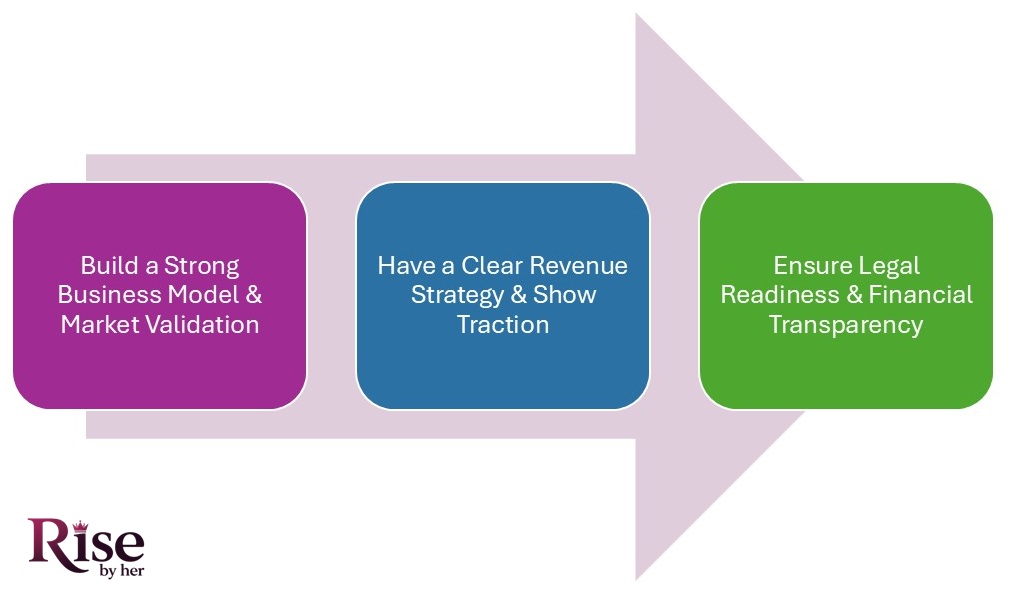
Build a Validated Business Model That Investors Trust
Before approaching angel investors, ensure your startup has a solid foundation:
- Clear Value Proposition: What problem does your business solve?
- Market Validation: Do you have customer interest, pre-orders, or initial sales?
- Competitive Edge: How does your startup stand out in the market?
- Pro Tip: Conduct surveys, run pilot programs, and gather testimonials to showcase demand.
Show Traction, Revenue Signals, or Early Growth Metrics
Angel investors want to see how your startup will generate profit and grow sustainably:
- Revenue Model: Subscription, one-time sales, freemium-to-premium?
- Traction Metrics: Active users, sales growth, customer retention rates.
- Financial Projections: Where will your revenue be in 6-12 months?
- Use tools like Google Analytics, Stripe, and QuickBooks to track performance.
Get Your Legal, Financial, and Cap Table Ready
Investors need legal security before funding a startup:
- Business Registration: LLC, Corporation, or Sole Proprietorship?
- Equity Structure: Who owns what? Have a cap table ready.
- Financial Reports: Profit & Loss (P&L), balance sheets, cash flow statements.
- Pro Tip: Use legal platforms like LegalZoom, Clerky, or Stripe Atlas to formalize business structures.
With these foundations, you’re ready to pitch and impress angel investors! Next, let’s craft the perfect pitch.
How to Create a Winning Pitch Deck for Angel Investors
A strong pitch deck is essential to attract angel investors. It should clearly communicate your problem, solution, market opportunity, traction, and financial projections. Women founders must focus on clarity, storytelling, and data-driven slides to stand out.
Must-Have Slides in an Investor-Ready Pitch Deck
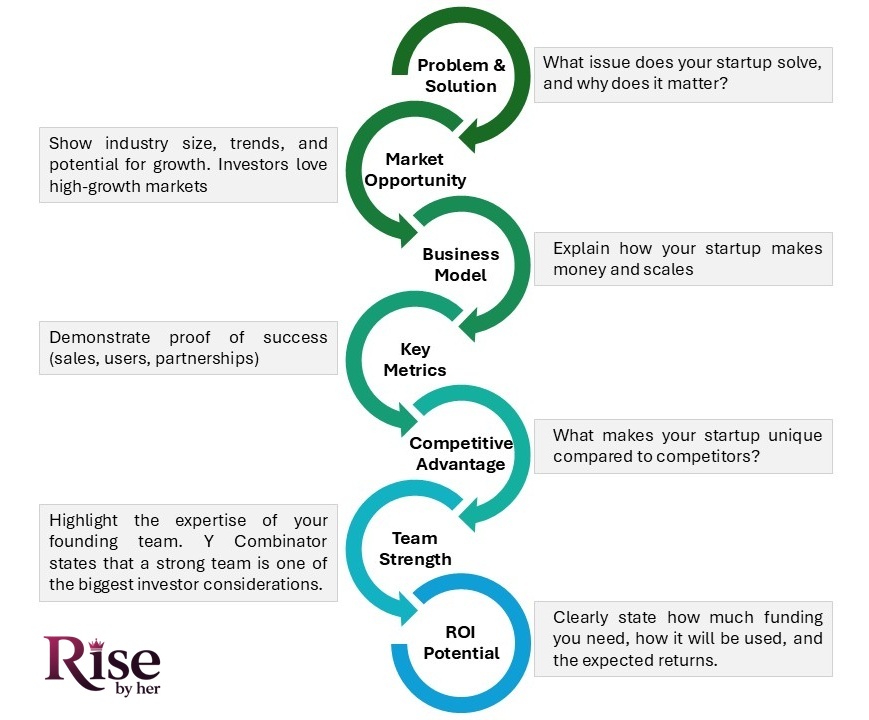
Angel investors hear hundreds of pitches yours needs to stand out by being clear, data-driven, and opportunity-focused. Here’s what your pitch should include:
- Problem & Solution: What issue does your startup solve, and why does it matter?
- Market Opportunity: Show industry size, trends, and potential for growth. Investors love high-growth markets (CB Insights ranks this as a top reason investors fund startups).
- Business Model & Revenue Strategy: Explain how your startup makes money and scales.
- Traction & Key Metrics: Demonstrate proof of success (sales, users, partnerships).
- Competitive Advantage: What makes your startup unique compared to competitors?
- Team Strength: Highlight the expertise of your founding team. Y Combinator states that a strong team is one of the biggest investor considerations.
- Investment Ask & ROI Potential: Clearly state how much funding you need, how it will be used, and the expected returns.
How to Pitch Your Startup to Angel Investors Effectively
- Keep It Concise: Your pitch should be 10-15 slides max (according to Sequoia Capital’s pitch deck guide).
- Tell a Story: Make an emotional connection by presenting a real-world problem and solution.
- Use Data, Not Just Hype: Investors want numbers: Market size, CAC (customer acquisition cost), LTV (lifetime value).
- Showcase Exit Strategy: Investors want to know how they’ll make a return (IPO, acquisition, etc.).
Best Free Tools to Design a Professional Pitch Deck
- Canva: User-friendly templates for professional pitch decks.
- Slidebean: AI-powered pitch deck generator with investor-friendly templates.
- Visme: Great for creating data-driven, visually appealing presentations.
With a well-crafted pitch, you’ll boost your chances of securing angel investment. Next, let’s explore where to find the right investors!
Where to Find Angel Investors for Women Founders
Women entrepreneurs can find angel investors through online platforms, startup networks, and industry-specific investor groups. Strategic networking, warm introductions, and visibility in entrepreneurial ecosystems significantly increase chances of securing funding.
Top Angel Investor Platforms and Networks in 2026
These platforms connect startups with angel investors actively funding women entrepreneurs:
- AngelList: One of the largest platforms to find and pitch to angel investors globally.
- Golden Seeds: A premier investment network focused on women-led startups.
- 37 Angels: A network of female investors funding diverse, high-growth startups.
- Pipeline Angels: A network investing in women and non-binary entrepreneurs.
Industry-Specific Angel Groups That Fund Women-Led Startups
Certain angel networks specialize in funding startups in specific industries:
- Tech Startups → Tech Coast Angels
- Healthcare & Biotech → Life Science Angels
- Sustainability & Green Businesses → Elemental Excelerator
Smart Networking Strategies to Get Investor Introductions
- Attend Startup & Investment Events: TechCrunch Disrupt, Women’s Startup Lab, SheEO Summits.
- Leverage LinkedIn Outreach: Search for angel investors, engage with their content, and send personalized messages.
- Join Startup Incubators & Accelerators: Programs like Y Combinator, Seedcamp, and Female Founders Alliance provide investor connections.
Finding the right angel investors requires strategy, persistence, and leveraging the right platforms. Ready to approach investors? Next, let’s talk about negotiating a successful deal!
The Angel Investment Process Explained Step by Step
The angel investment process includes pitching, due diligence, negotiation, and funding. Understanding each stage helps women founders prepare for investor scrutiny, avoid common deal pitfalls, and secure fair valuation and long-term investor relationships.
What Happens From First Meeting to Term Sheet in Angel Investment
The process usually begins with an introduction or pitch meeting, where the founder presents the startup idea, business model, and growth potential. If the angel investor shows interest, they may schedule follow-up meetings to dive deeper into the product, market, and team.
At this stage, investors focus heavily on traction, clarity of vision, and founder capability. If everything aligns, they move into due diligence, reviewing financials, legal structure, customer data, and market validation. Once satisfied, the investor issues a term sheet outlining the proposed investment structure, valuation, and key conditions before funding is finalized.
Key Angel Investment Deal Terms Every Founder Must Understand
Before accepting any investment, founders must understand the core deal terms.
Valuation refers to how much the startup is worth before and after investment. It directly affects how much equity the investor receives.
Equity is the percentage of ownership the founder gives to the investor in exchange for capital.
Dilution happens when new shares are issued, reducing the founder’s ownership percentage over time.
Other important terms include liquidation preference, board rights, and investor protections. These terms define control, payout structure, and decision-making power, so understanding them is critical before signing any agreement.
Common Red Flags That Cause Angel Investors to Reject Startups
Angel investors often reject startups not because of the idea, but because of execution risks or unclear fundamentals. Common red flags include:
- Lack of market validation or customer demand
- Weak or inconsistent revenue model
- Overestimated valuation without traction
- Unclear business strategy or unrealistic projections
- Founder disagreements or weak team structure
Investors also avoid startups that cannot clearly explain how they will scale or achieve profitability. A strong pitch removes confusion and builds trust early.
Alternative Funding Options for Women Entrepreneurs
Beyond angel investment, women entrepreneurs can access grants, crowdfunding, and government-backed funding programs. These alternatives provide flexible capital sources for startups that are not yet ready for equity investment or seeking non-dilutive funding options.
Best Grants for Women-Owned Businesses in 2026
- Amber Grant: $10,000 monthly grants for women entrepreneurs, plus a $25,000 annual grant. (Apply at: ambergrantsforwomen.com)
- Cartier Women’s Initiative: Supports impact-driven women founders with funding and mentorship.
- Fearless Strivers Grant: Focuses on Black women-owned businesses, offering capital and resources.
- See more on this article: Best Small Business Grants for Women Entrepreneurs in 2026 (How to Apply)
Pro Tip: Check out Grants.gov for government-backed grants and funding programs.
Crowdfunding Platforms That Work for Startups
- IFundWomen: A top crowdfunding platform specifically for women-led startups. Offers coaching and grants alongside funding campaigns.
- Kiva: Provides 0% interest microloans up to $15,000 with community-backed lending.
- Kickstarter & Indiegogo: Best for product-based businesses looking for pre-sales funding.
- See more Crowdfunding Platforms: 10 Best Crowdfunding Platforms for Women Entrepreneurs in 2026
Success Tip: Create a compelling campaign with a strong story, clear goals, and engaging visuals to attract backers.
Government and Low-Interest Financing Options
- Small Business Administration (SBA) Loans: Low-interest loans available for women entrepreneurs in the U.S.
- Microloans & Peer Lending: Platforms like Accion Opportunity Fund and SheEO offer small business loans tailored for women.
- Corporate & Nonprofit Grants: Companies like FedEx and Visa run business grant competitions for female founders.
Combining angel investment with grants and crowdfunding can give your startup the financial boost it needs—without giving away ownership!
Conclusion: Your First Step Toward Securing Angel Investment
Women entrepreneurs, the path to securing angel investment starts with action—take your first step today!
Recap Key Strategies for Funding Success:
- Refine Your Pitch: Craft a compelling, clear, and concise pitch that highlights your startup’s potential and ROI.
- Build a Strong Business Model: Ensure your business model is validated with market data and has a clear revenue strategy in place.
- Network and Outreach: Tap into angel investor networks like AngelList, Golden Seeds, and 37 Angels. Attend networking events and utilize LinkedIn to connect with investors.
- Explore Non-Equity Funding: Don’t forget about grants and crowdfunding platforms that can complement your angel investment efforts.
Encourage Action: “Start by refining your pitch and reaching out to investors today!”
Acting is the key to attracting angel investors. Keep refining your pitch, reach out to networks, and be persistent. Your next funding opportunity could be just a conversation away!
Have you tried securing angel investment for your women-led startup? Share your experience and tips with us in the comments below!
By Aveline Lowell
Founder & Editor-in-Chief, RiseByHer
Aveline Lowell writes research-driven content covering women’s finance, entrepreneurship, STEM, technology, and career growth. Her work focuses on practical, well-researched information that helps women make informed decisions.
Editorial & Disclaimer: RiseByHer aims to provide accurate, well-researched, and up-to-date information. Articles are reviewed and updated when necessary and are intended for general informational and educational purposes, not personalized financial, legal, tax, or professional advice.