
Women entrepreneurs are on the rise, contributing significantly to the global economy. However, accessing funding remains a significant challenge. Studies show that women-led startups receive considerably less investment than male-led businesses. In this article, we will explore different funding options for women entrepreneurs, highlight real statistics on funding gaps, and provide actionable resources to help women secure financial support for their businesses.
The Gender Funding Gap: Key Statistics Women Entrepreneurs Need to Know
Women are starting businesses at record levels, yet access to capital remains unequal. Whether applying for venture capital, loans, or investment programs, women entrepreneurs still face major barriers that limit growth and expansion.

Women Receive a Small Share of Venture Capital Funding
Even though women-led startups are growing globally, they still receive a very limited portion of Venture Capital investment.
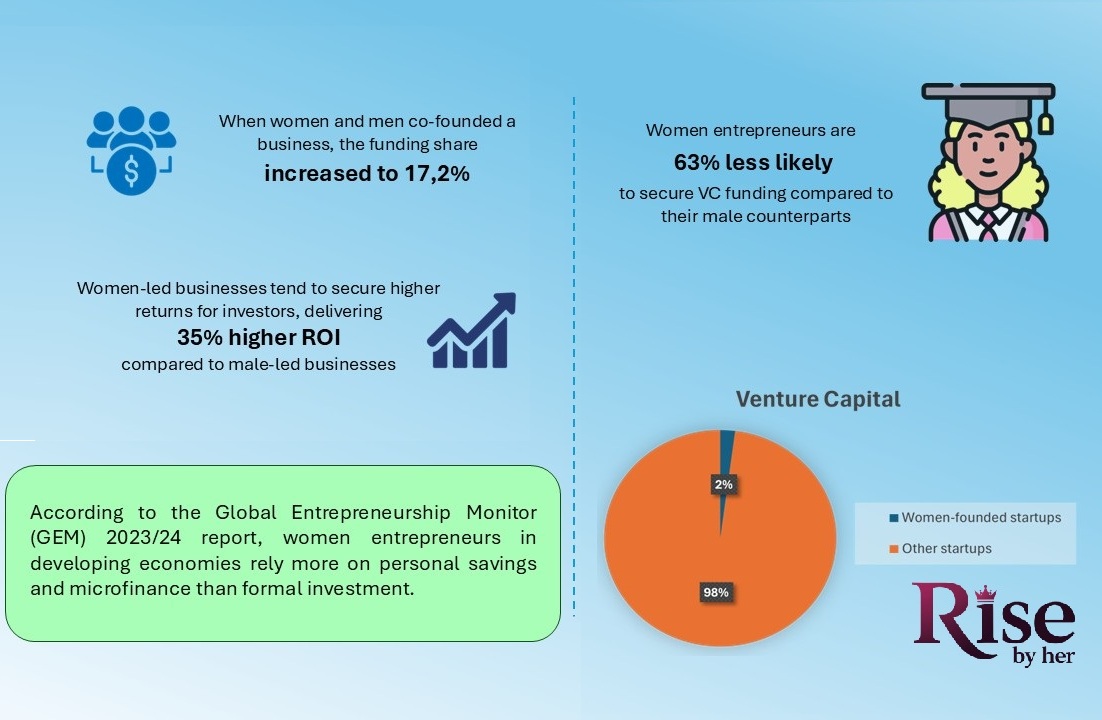
- Women-founded startups received only 2.1% of total venture capital funding in 2023 (World Economic Forum, 2024).
- When businesses were founded by both women and men, the share of funding increased to 17.2% (Pitch, 2023).
This highlights how gender diversity within founding teams significantly impacts investor decisions.
Women Entrepreneurs Are Less Likely to Secure Investor Backing
Beyond total funding percentages, the probability of actually receiving VC funding is also lower for women.
- Women entrepreneurs are 63% less likely to secure venture capital funding compared to men (Heritage Wealth, 2024).
This gap often reflects limited access to investor networks, fewer introductions, and persistent bias in high-growth funding spaces.
Women Rely More on Personal Savings and Microfinance
In many countries, especially developing economies, women founders often build businesses without institutional support.
- The Global Entrepreneurship Monitor (GEM) 2023/24 report shows that women entrepreneurs are more likely to rely on personal savings, family support, and microfinance, rather than traditional bank loans or formal investment.
This limits scalability and forces many women to grow slower than their male competitors.
Women-Led Businesses Deliver Stronger Returns
One of the biggest contradictions in entrepreneurship funding is that women-led companies often outperform financially.
- Women-led businesses deliver up to 35% higher ROI for investors compared to male-led businesses (Forbes, 2019).
This proves that the funding gap is not based on performance, but on structural challenges in the investment ecosystem.
What These Statistics Mean for Women Entrepreneurs
These numbers show a clear pattern: women are underfunded, not underqualified.
To overcome this gap, women entrepreneurs often need to:
- diversify funding sources (grants, crowdfunding, microloans, angel networks)
- build strong financial projections early
- target women-focused investors and programs
- strengthen networking and visibility in funding communities
The good news is that more initiatives than ever are now designed to support women founders, making it possible to close this gap with the right strategy.
Funding Options for Women Entrepreneurs (Grants, Loans, VC + More)
Funding your business as a woman entrepreneur is not about picking one “best” option. The smartest founders build a funding mix that matches their stage, cash flow, and growth plan. From grants and loans to venture capital, angel investors, and alternative financing, these are the most powerful funding options women-owned businesses use to launch, scale, and expand faster.
1. Venture Capital and Angel Investors (Best for High-Growth Startups)
Venture capital and angel investors are ideal for startups that can scale quickly and have strong market potential. While women have historically been overlooked in VC, many investment firms and angel networks are now focused on funding women-led businesses.
Top venture capital firms and angel networks supporting women founders include:
- Female Founders Fund – Invests in women-led startups in tech, healthcare, and consumer brands.
- Golden Seeds – One of the largest angel investor networks focused on women entrepreneurs.
- Astia Angels – Supports high-growth ventures led by women with strong global potential.
- BBG Ventures – Early-stage investment firm focused on women-led companies.
- Pipeline Angels – A women-led investor network funding diverse female founders.
- Halogen Ventures – Focuses on early-stage consumer technology startups founded by women.
- Portfolia – Invests in companies that serve women’s markets and women-driven innovation.
Best for: tech startups, scalable online businesses, high-growth brands
What you’ll need: pitch deck, traction, strong business model, clear revenue potential
2. Small Business Loans and Lines of Credit (Best for Revenue-Based Businesses)
For women entrepreneurs with consistent sales, small business loans and business credit can provide fast access to capital without giving away equity. This is one of the most common funding paths for service businesses, ecommerce stores, and local companies.
Popular financing options include:
- traditional bank loans
- SBA-backed loans (often easier to access than standard business loans)
- business lines of credit for flexible cash flow
- equipment financing for product-based businesses
Loans are especially useful for covering inventory, hiring, marketing, and business expansion costs.
Best for: businesses with stable revenue and predictable expenses
What you’ll need: financial statements, credit history, business plan, cash flow proof
If you’re looking for non-repayable funding, explore this full list of Best Small Business Grants for Women (2026 Guide) to find programs that match your business stage and industry.
3. Government Grants and Public Funding Programs (Non-Dilutive Funding Opportunities)
Government programs are some of the best funding sources because many offer grants or low-interest financing designed specifically for women-owned businesses. Some programs also provide mentorship, business training, and contracting opportunities.
Top government funding programs for women entrepreneurs include:
- SBA Women-Owned Business Federal Contracting Program (USA) – Helps women-owned businesses win federal contracts.
- Innovate UK Women in Innovation Awards (UK) – Provides funding plus coaching and mentoring support.
- IFC Banking on Women (Global) – Supports women-led enterprises in emerging markets.
- Canada’s Women Entrepreneurship Strategy (WES) – Multi-billion-dollar initiative supporting women-owned businesses.
- European Investment Bank (EIB) SheInvest Initiative – Supports female entrepreneurs in Africa and Europe.
- Australia’s Boosting Female Founders Initiative – Grants for early-stage women-led startups.
Best for: startups, local businesses, women-owned brands needing non-equity funding
Pro tip: government grants are competitive, so apply early and apply often.
4. Crowdfunding and Community Funding Platforms (Best for Product Launches)
Crowdfunding allows women entrepreneurs to raise capital from supporters, customers, and investors without relying on traditional banks or venture capital. Many women perform strongly on crowdfunding platforms because community engagement and storytelling often drive campaign success.
Best crowdfunding platforms for women entrepreneurs include:
- Kickstarter – Ideal for creative products, tech, and physical product launches.
- Indiegogo – Flexible platform for startups across many industries.
- IFundWomen – Crowdfunding + coaching platform built specifically for women-led businesses.
- GoFundMe – Best for community fundraising and flexible business support.
- Crowdfunder – Helps entrepreneurs connect with equity investors.
Crowdfunding works best when paired with a strong marketing strategy, social media visibility, and clear product messaging.
Best for: ecommerce brands, product-based startups, creative businesses
What you’ll need: campaign page, marketing plan, strong visuals, community audience
If you want to raise capital directly from your audience, check out Best Crowdfunding Sites to Empower Women Entrepreneurs 2026 to find the right platform for your business and funding goals.
5. Microfinance and Peer-to-Peer Lending (Best for Small Capital Needs)
Microfinance and peer-to-peer lending are powerful solutions for women entrepreneurs who need smaller loans or do not qualify for traditional financing. These platforms often offer more flexible requirements, making them ideal for early-stage businesses.
Top microfinance and lending platforms include:
- Kiva – Offers 0% interest microloans for women entrepreneurs globally.
- Grameen America – Provides microloans to low-income women in the U.S.
- Accion – A nonprofit network offering small business loans and financial support.
- LendHer Capital – Lending platform designed to support women-owned businesses.
- SheEO – A global community of women funding women-led ventures through collective support.
This option is especially useful for business owners who need funding for inventory, equipment, or marketing but want simpler approval processes.
Best for: early-stage entrepreneurs, small businesses, low-collateral funding needs
Key benefit: easier access and faster approval compared to traditional loans
If you need a smaller loan with flexible requirements, Microloans for Women Entrepreneurs: The Complete 2026 Guide breaks down the best options and how to qualify quickly.
6. Corporate Grants, Accelerators, and Pitch Competitions (Best for Visibility + Funding)
Corporate grants and startup competitions can provide funding, mentorship, and major brand exposure. Many of these programs are specifically designed to support women entrepreneurs, especially in innovation, sustainability, and consumer markets.
Top corporate grant programs and pitch competitions include:
- Cartier Women’s Initiative – Offers up to $100,000 and global recognition for women-led businesses.
- Visa She’s Next Grant Program – Provides funding and mentorship opportunities.
- Tory Burch Foundation – Offers capital access, mentorship, and networking support.
- Amber Grant – Awards $10,000 monthly to women entrepreneurs in the U.S.
- Women Founders Network Fast Pitch Competition – Funding and visibility for women-led startups.
- Eileen Fisher Women-Owned Business Grant – Supports women-owned businesses focused on sustainability.
These programs are excellent for building credibility, especially if you want to attract future investors or media attention.
Best for: women founders seeking funding + brand exposure
Pro tip: competitions can also attract investors even if you don’t win.
How to Choose the Best Funding Option for Your Business Stage
Choosing the right funding strategy depends on your business maturity and your goals.
- Idea stage or early launch: grants, microloans, crowdfunding
- Early revenue stage: business loans, lines of credit, crowdfunding
- Scaling stage: angel investors, VC, accelerators
- Established business expansion: SBA loans, business credit, corporate grants
The smartest approach is to build a funding plan that combines short-term capital (loans, microfinance) with long-term growth opportunities (grants, investors, accelerators).
The more diversified your funding strategy is, the faster and safer your business can grow.
Quick Comparison: Best Funding Options for Women Entrepreneurs
| Funding Type | Best For | Pros | Cons |
|---|---|---|---|
| Venture Capital & Angel Investors | High-growth startups and scalable businesses | Large funding amounts, mentorship, investor connections | Competitive, requires giving up equity |
| Small Business Loans & Lines of Credit | Businesses with steady revenue | No equity loss, predictable funding, supports expansion | Requires good credit and proof of income |
| Government Grants & Public Programs | Early-stage founders and women-owned businesses | Free funding (non-dilutive), credibility boost | Competitive, slow application process |
| Crowdfunding Platforms | Product launches and community-driven brands | No debt, strong marketing benefits, customer validation | Requires audience + promotion, not guaranteed |
| Microfinance & Peer-to-Peer Lending | Small funding needs or low credit access | Easier approval, accessible for beginners | Smaller loan amounts, repayment required |
| Corporate Grants & Pitch Competitions | Women-led startups seeking exposure | Funding + media visibility + mentorship | Time-consuming applications, limited winners |
How to Increase Your Chances of Getting Funding as a Woman Entrepreneur
Getting funding is not just about having a great business idea. Investors and grant organizations want proof that your business is viable, scalable, and financially prepared. With the right strategy, you can dramatically increase your chances of securing grants, loans, crowdfunding support, or venture capital.
Below are the most effective ways to improve your funding success.
Build a Strong Business Plan with Clear Financials
A well-structured business plan is often the first thing lenders, grant reviewers, and investors evaluate. Your plan should clearly explain what you sell, who your customers are, and how your business will grow.
Make sure your business plan includes:
- a clear business model and revenue strategy
- realistic financial projections (12 to 36 months)
- market research and competitor analysis
- pricing strategy and profit margins
- a clear plan for how the funding will be used
A strong business plan signals professionalism and reduces investor risk.
If you’re preparing to apply for funding, How to Write a Business Plan for Women Entrepreneurs That Gets Funded shows you how to structure a plan that attracts investors and lenders.
Create a Winning Pitch Deck That Highlights Growth Potential
Your pitch deck is your business story in investor language. It should be simple, data-backed, and focused on growth.
A strong pitch deck typically includes:
- the problem and your solution
- target market size and opportunity
- product or service overview
- business model and pricing
- traction (sales, users, partnerships, growth metrics)
- marketing and growth strategy
- financial forecasts
- funding ask and how you will use the money
Investors fund businesses that show momentum, not just potential.
Improve Your Networking Strategy and Get Warm Introductions
Many women entrepreneurs miss funding opportunities simply because they are not connected to the right people. Networking is one of the fastest ways to access investors, grant programs, and accelerators.
Ways to build strong funding connections:
- join organizations like WBENC and NAWBO
- attend women founder events and pitch competitions
- participate in accelerator programs and incubators
- connect with angel networks focused on women-led startups
- build relationships with mentors who can introduce you to funders
Warm introductions consistently outperform cold applications.
To expand your opportunities and funding connections, Accelerate Your Career in 2026 with Women’s Professional Networks highlights key communities that can help you grow faster.
Apply to Multiple Funding Sources Instead of Relying on One Option
One of the smartest funding strategies is diversification. Many successful women founders combine multiple funding sources to reduce risk and increase speed.
A strong funding mix may include:
- government grants for early-stage growth
- microloans for startup expenses
- crowdfunding to validate demand
- small business loans for expansion
- angel investors for scaling
This approach increases your chances of securing capital and protects your business from delays.
Strengthen Your Online Presence and Build Business Credibility
In today’s market, funders research you online before making decisions. A strong digital presence can increase trust and help you stand out.
Focus on building credibility through:
- a professional website with clear messaging
- active LinkedIn presence with consistent updates
- business visibility on platforms like AngelList
- customer reviews and testimonials
- media mentions, podcasts, and press features
- clear branding across your social media platforms
Visibility increases trust, and trust increases funding opportunities.
Know Your Numbers Before Talking to Investors or Lenders
Many women entrepreneurs lose funding opportunities because they cannot confidently explain their business metrics. Funders want clarity, not uncertainty.
Be prepared to answer:
- monthly revenue and profit margins
- customer acquisition cost (CAC)
- customer lifetime value (LTV)
- monthly expenses and burn rate
- break-even point
- how long the funding will last
When you know your numbers, you communicate like a CEO, not just a founder.
Position Your Business as a Low-Risk Investment
Investors fund businesses that look stable, scalable, and strategic. The goal is to show that funding your business is not a gamble.
To reduce perceived risk:
- show traction and customer demand
- highlight repeat sales or contracts
- demonstrate strong leadership and experience
- prove market need with data
- show partnerships or industry validation
The more you reduce uncertainty, the easier it becomes to secure funding.
If you’re still choosing your business path, 10 Small Business Ideas for Women in 2026 (Low Investment) can help you find profitable ideas you can start with minimal capital.
Common Mistakes Women Entrepreneurs Should Avoid When Seeking Funding
Many women entrepreneurs don’t lose funding because their ideas are weak, but because of avoidable strategy and preparation mistakes. Fixing these issues can significantly improve approval rates for grants, loans, and investor funding.
- Relying on only one funding source
Depending on a single option like grants or investors creates unnecessary risk. Grants are competitive, loans can be restrictive, and investors may take time. A stronger approach is to combine funding sources such as crowdfunding, microfinance, grants, and equity investment depending on your stage. - Weak or unrealistic financial projections
Many applications fail because financial planning is unclear or overly optimistic. Missing revenue forecasts, vague expense breakdowns, or inflated growth expectations reduce credibility. Investors want realistic, data-backed projections that show a clear path to profitability. - Unclear or unstructured pitch narrative
A strong business can still lose funding if the story is confusing. Common issues include focusing too much on the product instead of the problem, lacking a clear value proposition, or failing to explain market opportunity. A strong pitch should clearly follow: problem, solution, market, traction, and growth plan. - Poor targeting of investors or funding programs
Applying randomly reduces your chances of success. Many entrepreneurs pitch to investors outside their industry or apply for grants they are not eligible for. Targeting the right funding sources, especially women-focused programs and relevant industry investors, significantly improves outcomes. - Limited networking and weak professional connections
Funding is often relationship-driven. Many opportunities come through referrals, not cold applications. Missing out on founder communities, mentorship networks, and investor events reduces visibility and access to capital. Building strong connections can open doors to warm introductions and faster funding decisions.
Conclusion: Take the Next Step Toward Funding Success
Women entrepreneurs continue to reshape industries and create meaningful economic impact. While funding challenges still exist, more opportunities than ever are available through venture capital, government grants, crowdfunding, and corporate initiatives.
Success comes from combining the right funding strategies with strong positioning, networking, and persistence.
Now it’s your turn!
- What challenges have you faced in securing funding?
- Which funding option are you planning to explore first?
Share your experience in the comments and join the conversation.
For more ways to strengthen your funding strategy, Unlock Success 7 Funding Boosts for Women in Business outlines practical steps to increase your chances of securing capital.
By Aveline Lowell
Founder & Editor-in-Chief, RiseByHer
Aveline Lowell writes research-driven content covering women’s finance, entrepreneurship, STEM, technology, and career growth. Her work focuses on practical, well-researched information that helps women make informed decisions.
Editorial & Disclaimer: RiseByHer aims to provide accurate, well-researched, and up-to-date information. Articles are reviewed and updated when necessary and are intended for general informational and educational purposes, not personalized financial, legal, tax, or professional advice.
hello there and thank you for your info ? I?ve certainly picked up something new from right here. I did however expertise a few technical points using this website, as I experienced to reload the website many times previous to I could get it to load properly. I had been wondering if your hosting is OK? Not that I am complaining, but slow loading instances times will often affect your placement in google and can damage your quality score if advertising and marketing with Adwords. Anyway I am adding this RSS to my email and can look out for a lot more of your respective interesting content. Make sure you update this again very soon..
I just added this site to my feed reader, great stuff. Can’t get enough!
You made some respectable factors there. I regarded on the internet for the difficulty and located most individuals will associate with along with your website.
This article is absolutely incredible! The author has done a fantastic job of delivering the information in an captivating and enlightening manner. I can’t thank her enough for sharing such precious insights that have definitely enlightened my awareness in this subject area. Hats off to him for producing such a gem!
Nice weblog here! Additionally your site lots up fast! What web host are you the use of? Can I get your affiliate link in your host? I desire my website loaded up as fast as yours lol
Thanks for the sensible critique. Me & my neighbor were just preparing to do some research about this. We got a grab a book from our area library but I think I learned more clear from this post. I am very glad to see such magnificent info being shared freely out there.
Hmm is anyone else encountering problems with the pictures on this blog loading? I’m trying to find out if its a problem on my end or if it’s the blog. Any responses would be greatly appreciated.
Thanks for the sensible critique. Me & my neighbor were just preparing to do a little research about this. We got a grab a book from our area library but I think I learned more from this post. I am very glad to see such excellent information being shared freely out there.