

TikTok side hustles can be a smart wealth strategy, but only when treated like a small business. Most beginners earn little at first, and costs, taxes, and unpredictable income can turn a viral idea into a financial trap. The deciding factors are your niche, your net profit, and whether you diversify beyond TikTok.
Below, you’ll see how TikTok income really works, how five popular side hustles compare, and how to build a lower-risk strategy.
The Viral Promise vs. Financial Reality of TikTok Side Hustles
TikTok side hustles look easy in a 30-second clip: film a video, watch the views climb, collect the money. In practice, the income is real for some people but uneven for most, and what you keep depends on where the money comes from and what it costs you to earn it.
How to Make Money on TikTok: How Monetization Actually Works
TikTok doesn’t pay through one channel. Creators typically earn through a mix of these:
- Platform payouts: Programs like the Creator Rewards Program pay for qualifying videos, but they require minimum follower and view thresholds.
- Commissions: TikTok Shop and affiliate links pay a percentage only when a viewer buys.
- Brand work: UGC creators and sponsored creators are paid per video or campaign, often regardless of follower count.
- Virtual gifts: Viewers send gifts during LIVE streams, and TikTok keeps a share before payout.
- Your own products: Templates, guides, or services let you keep more revenue but add work.
Most steady earners combine two or more of these instead of relying on one.
Gross Revenue vs. Net Profit: Calculating Your True Hourly Earnings
Gross revenue is everything you receive. Net profit is what remains after expenses like editing tools, props, product samples, ads, and fees.
Net profit = Gross revenue − Expenses
True hourly earnings = Net profit ÷ Total hours worked
Count every hour, including scripting, editing, and replying to comments. If you earn $600 in a month, spend $150 on costs, and work 60 hours, your net profit is $450 and your true hourly rate is $7.50.
How We Calculated These Numbers (Methodology)
The figures in this guide are illustrative scenarios, not averages or guarantees. They draw on public program terms, common expense categories, and realistic time estimates.
Each example shows gross revenue first, then net profit, with all working hours included. Taxes and fees are noted separately because they vary by country and income type.
TikTok changes payout rules and eligibility often, so check its current terms before making financial decisions.
5 TikTok Side Hustles Compared: Earnings, Costs, and Risks
Not every TikTok side hustle works the same way. Some cost almost nothing but pay slowly, while others pay sooner but demand more time or upfront spending. Here is how the five most common options compare for beginners.
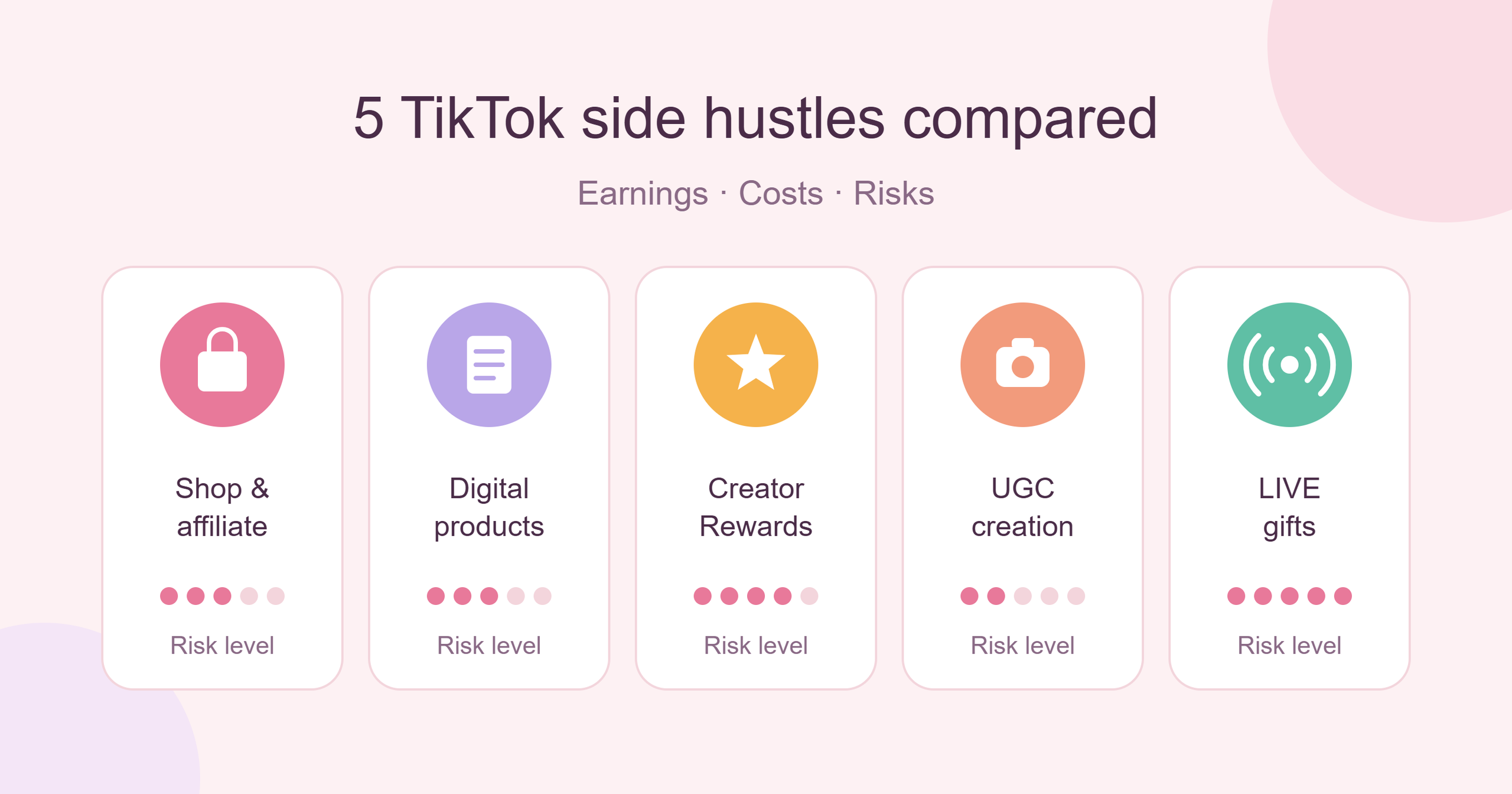
| Side hustle | Startup cost | Realistic beginner income | Time needed | Risk level |
|---|---|---|---|---|
| TikTok Shop and affiliate marketing | $0-$100 | $0-$300/month early on | 8-15 hrs/week | Medium |
| Digital products and faceless content | $0-$200 | $0-$200/month early on | 10-15 hrs/week | Medium |
| Creator Rewards Program | $0-$50 | Often under $100/month at first | 10+ hrs/week | Medium-High |
| UGC creation | $0-$150 | $100-$500/month with a few clients | 5-10 hrs/week | Low-Medium |
| LIVE and virtual gifts | $0-$100 | $0-$100/month | 5-10+ hrs/week | High |
These ranges are illustrative estimates, not guarantees. Results vary by niche, consistency, and country.
TikTok Shop and Affiliate Marketing: How Much Can You Earn?
You earn a commission each time someone buys through your video, so income depends on trust and conversion, not views alone. Commission rates vary by product category, and many beginners see little in the first one to three months.
Costs stay low, but samples, props, and returned orders can cut into profit. If you drive $1,000 in sales at a 10% commission, you earn $100 before expenses.
Digital Products and Faceless Niche Content
Faceless accounts use voiceovers, screen recordings, or stock footage to promote templates, planners, or guides. You keep most of each sale, which makes margins attractive.
The catch is that you need a product people actually want, and building an audience can take months. If one account drives all your sales, a sudden drop in reach can stop your income overnight.
TikTok Creator Rewards Program: How Much Does It Actually Pay?
This program pays for qualifying videos based on engagement and viewer quality, not raw view counts. Eligibility has required minimum follower and view thresholds, plus a minimum video length, so brand-new accounts often can’t join yet.
Payouts per 1,000 views vary widely by niche, audience location, and content quality. That makes monthly income hard to predict, and it is better treated as a bonus than a paycheck.
UGC Creation: Getting Paid by Brands Without Going Viral
UGC creators film product videos for brands, which often publish them on their own channels. You are paid for the content, so a large following isn’t required.
Most beginners charge a flat fee per video and build a small portfolio first. Startup costs are modest, and income becomes steadier once you land repeat clients, though pitching and follow-ups take real time.
TikTok LIVE and Virtual Gifts: Is It Worth the Time?
Viewers send virtual gifts during live streams, and these convert into earnings after TikTok takes its share. It can work well for creators with an engaged community.
Beginners, however, often spend hours live for small returns. Income depends on how many people show up each session, so LIVE works best as an extra income stream rather than your main one.
Are TikTok Side Hustles Worth It? Pros and Cons
TikTok side hustles can be worth it if you have realistic expectations and treat them as a slow-building project. They offer real advantages, along with risks that are easy to overlook when you only see the success stories.
The Benefits: Low Entry Barriers, Reach, and Growth Potential
The biggest draw is how little it takes to start. A smartphone, free editing tools, and an account are enough to test an idea, so your upfront financial risk stays small.
Reach is the second advantage. TikTok’s recommendation system can show a video to people who don’t follow you, which means a new account can get noticed without an existing audience. Few other platforms make that possible.
There is also room to grow. A side hustle that starts with a few brand deals or affiliate sales can turn into a steady income stream, a portfolio, or a small business if you stay consistent.
The Risks: Unpredictable Income, Burnout, and Platform Dependency
The downsides are just as real:
| Risk | What it looks like in practice |
|---|---|
| Unpredictable income | A video that performs well one month may be followed by weeks of low earnings. |
| Burnout | Posting often, tracking trends, and replying to comments adds up fast alongside a day job. |
| Platform dependency | Algorithm changes, policy updates, or an account restriction can cut your reach and income overnight. |
Platform dependency deserves the most attention. If all your income runs through one account you don’t own, a single change can end it, which is why many creators build an email list or sell through their own site as a backup.
TikTok vs. Traditional Side Hustles: Which Lasts Longer?
Traditional side hustles, like freelancing, tutoring, reselling, or driving for a delivery app, tend to pay sooner and more predictably. TikTok side hustles usually start slower but can scale further. Which one lasts longer depends on how much control you have over the income.
Income Potential, Startup Costs, and Time Commitment
Traditional side hustles often pay from the first job. A freelance writer or tutor can charge an hourly or per-project rate right away, so income is easier to forecast. The ceiling is lower, though, because you are mostly trading hours for money.
TikTok works the other way. Early income is often small or zero, but a single piece of content can keep earning through affiliate links, product sales, or brand deals long after you post it.
| Factor | TikTok side hustles | Traditional side hustles |
|---|---|---|
| Startup cost | Low, usually $0-$200 | Varies: low for freelancing, higher for reselling or equipment-based work |
| Time to first income | Weeks to months | Days to weeks |
| Income stability | Uneven month to month | More predictable |
| Scaling potential | High, not tied to hours | Limited by time available |
Time commitment is similar on paper, but TikTok demands more unpaid hours up front. Filming, editing, and testing ideas all happen before you see a return.
Audience Ownership and Long-Term Business Value
This is where the two models differ most. On TikTok, your followers live on a platform you don’t control. If your account is restricted or reach drops, you can’t take that audience with you.
A freelancer, by contrast, owns their client relationships, and those clients can keep paying through any platform change. That said, a traditional side hustle rarely becomes something you can sell or step away from.
TikTok can build lasting value when it feeds an asset you own, such as an email list, a website, or a product line. Creators who move followers onto those channels get the reach of TikTok and the stability of a traditional business.
Used that way, TikTok works best as a way to attract customers, not as the business itself.
How to Build a Lower-Risk TikTok Income Strategy
You can’t remove the risk from TikTok side hustles, but you can reduce it. The creators who last tend to treat their account like a small business: they pick a niche people pay for, test before spending, spread their income, and keep clean records.
Choose a Niche With Commercial Demand
Views don’t pay the bills; buyers do. A funny video can reach millions without earning a cent, while a video about a niche with paying customers can earn from a modest audience.
Look for topics where people already spend money, such as personal finance tools, home organization, fitness gear, productivity templates, or beauty products. A quick check helps: do brands in this niche sell on TikTok Shop, run ads, or hire UGC creators? If yes, demand exists.
Test Your Idea Before Investing Significant Money
Start with free or low-cost versions of your idea. Post 15 to 20 videos in your niche and watch which ones bring comments, saves, and link clicks, not just views.
If you plan to sell a digital product, ask your audience what they’d want before building it. If you’re considering inventory, order a small batch or use a dropship or affiliate model first.
Set a spending limit before you begin, such as $100 over 60 days, and stick to it. If the numbers don’t improve by then, change the approach instead of spending more.
Diversify Your Income Beyond TikTok
Relying on one platform means one algorithm change can stop your income. Spread the risk with a few simple steps:
- Repost your best videos to Instagram Reels and YouTube Shorts.
- Collect emails through a free guide or checklist linked in your bio.
- Combine two or more income types, such as affiliate commissions and UGC work.
An email list is especially valuable because it belongs to you, whatever happens to your account.
Track Expenses, Understand Taxes, and Manage Risk
Record every dollar that comes in and goes out, using a basic spreadsheet or accounting app. This lets you calculate net profit and see which hustle is worth your time.
In most countries, TikTok income counts as taxable income, even when it comes from gifts, brand deals, or commissions. Set aside a portion of each payout for taxes, and check the rules in your country or speak with a qualified tax professional, since requirements vary.
Finally, avoid putting money you can’t afford to lose into equipment, ads, or inventory until a side hustle has proven it can pay for itself.
TikTok Side Hustles for Beginners: Frequently Asked Questions
Can You Make Money on TikTok Without Showing Your Face?
Yes. Faceless accounts earn through voiceovers, screen recordings, stock footage, and product demos. Digital products, affiliate marketing, and UGC (where you film products rather than yourself) all work without appearing on camera. Your content still needs a clear niche and a reason for viewers to trust your recommendations.
How Much Can Beginners Realistically Earn on TikTok?
Most beginners earn little or nothing in the first one to three months. After that, many see somewhere between $0 and a few hundred dollars a month, depending on the side hustle and niche. Earnings are uneven and not guaranteed, so judge results by net profit and hourly return, not by view counts.
Do You Have to Pay Taxes on TikTok Income?
In most countries, yes. Payouts, brand deals, affiliate commissions, and often virtual gift earnings count as taxable income, whether or not you receive a tax form. Rules differ by country and by how your income is classified, so keep records of everything and consult a qualified tax professional.
Can You Make Money on TikTok With Few Followers?
Yes, though some options are closed to small accounts. TikTok’s Creator Rewards Program and LIVE gifting have follower or activity requirements. UGC creation, affiliate marketing, and selling your own products don’t depend on a large audience. A small, engaged following in a niche with buyers can outearn a bigger, unfocused one.
How Much Do TikTok Creators Make per 1,000 Views?
There is no fixed rate. Payouts through the Creator Rewards Program vary by niche, audience location, video length, and viewer engagement, and TikTok adjusts its terms over time. Income from affiliate sales or brand deals is tied to buyer actions, not views, so two videos with equal views can earn very different amounts.
Are TikTok Side Hustles Legitimate?
TikTok side hustles are legitimate when the income comes from real sources: platform programs, commissions, brand payments, or products you sell. Be cautious of anyone selling expensive courses with guaranteed results, “get paid to like videos” offers, or schemes asking for upfront fees. Real opportunities don’t require you to pay to get started.
Conclusion: Are TikTok Side Hustles a Smart Wealth Strategy?
TikTok side hustles can be a smart wealth strategy, but only when treated like a small business. Early income is usually modest and uneven, and costs and taxes reduce what you keep. The creators who come out ahead pick niches where people already buy, track net profit, and spend only what they can afford to lose.
The safest approach is to use TikTok to attract an audience, then move followers to an email list, website, or product you own. Start small, set a 60-day test, and add a second income source before scaling.
Approached with realistic expectations, TikTok can be a useful side income. Approached as a shortcut to quick money, it rarely delivers what the viral clips promise.
By Aveline Lowell
Founder & Editor-in-Chief, RiseByHer
Aveline Lowell writes research-driven content covering women’s finance, entrepreneurship, STEM, technology, and career growth. Her work focuses on practical, well-researched information that helps women make informed decisions.
Editorial & Disclaimer: RiseByHer aims to provide accurate, well-researched, and up-to-date information. Articles are reviewed and updated when necessary and are intended for general informational and educational purposes, not personalized financial, legal, tax, or professional advice.