
Landing a leadership role is a career milestone, but for many women, the interview process comes with a unique set of challenges. While female representation in leadership is growing, progress remains uneven. According to McKinsey’s Women in the Workplace report, women hold only 28% of senior leadership roles, despite making up nearly half the workforce.
Why the gap? It’s not always about skill or experience. Many women leaders face unconscious bias, confidence hurdles, or simply aren’t coached for high-stakes leadership interviews in the same way their male counterparts are. From being interrupted more often to having leadership traits like assertiveness unfairly questioned, the interview room can feel more like a proving ground than a fair opportunity.
But here’s the truth: You absolutely deserve to lead, and you can learn to navigate leadership interviews with confidence and strategy.
In this guide, you’ll learn how to:
- Prepare for tough, executive-level interview questions
- Present your leadership achievements with clarity and power
- Overcome common biases and show up with executive presence
- Ask smart questions that position you as a forward-thinking leader
Let’s turn the interview table in your favor. This post will show you how to stand out (and get hired) on your own terms.
Understanding the Leadership Interview Format and What to Expect
Executive-level interviews are a different playing field compared to traditional job interviews and knowing what to expect can be the difference between a good impression and a powerful one.
Unlike entry-level or mid-career roles, leadership interviews often follow a multi-stage format, including:
- Panel interviews with directors, board members, or cross-functional teams
- Strategic case questions or scenario-based discussions to evaluate decision-making
- Behavioral assessments to gauge your leadership style, emotional intelligence, and culture fit
- Presentations where you may be asked to pitch ideas or solve a mock business problem
What Hiring Managers Are Really Looking For
When interviewing women for leadership roles, hiring managers are looking beyond technical skills. They want someone who can:
- Lead teams through uncertainty with confidence
- Communicate a compelling vision
- Demonstrate empathy and resilience
- Drive results while inspiring others
For women, this often means striking a balance between assertiveness and collaboration; a balance that can be unfairly scrutinized but is entirely navigable with the right preparation.
How to Prepare Strategically
To prepare effectively for a leadership interview:
- Practice storytelling using the STAR method (Situation, Task, Action, Result)
- Research the company’s leadership challenges and tailor your answers to show alignment
- Rehearse speaking about your leadership achievements with clarity, metrics, and impact
- Conduct mock interviews (preferably with someone in a senior or executive role)
Leadership interviews test your readiness to step into a high-stakes role. The good news? With preparation, you won’t just be ready; you’ll be memorable.
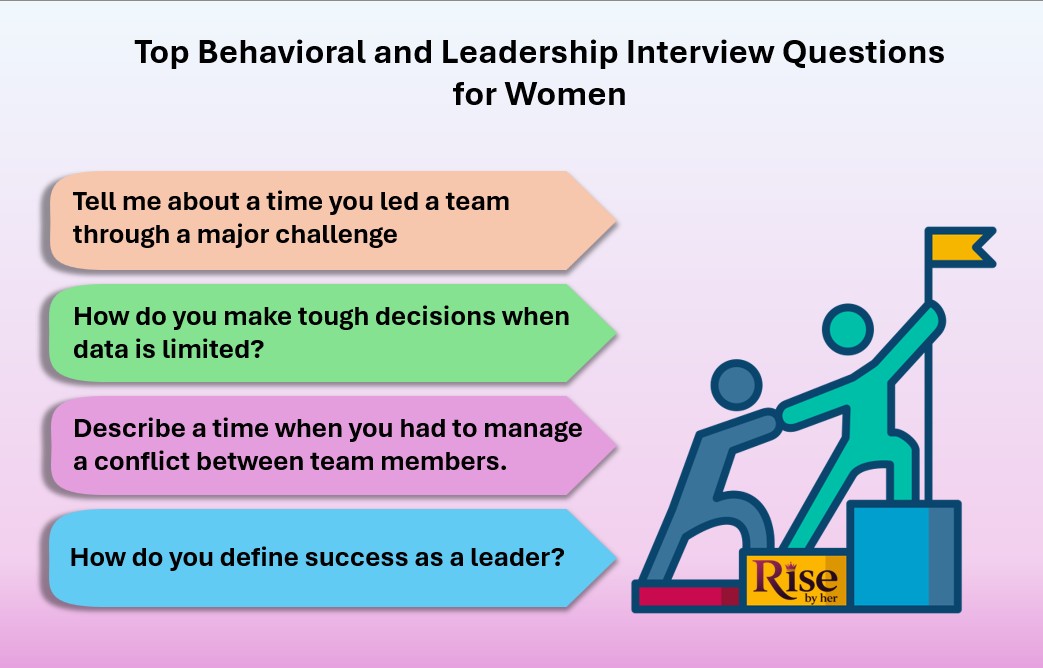
Top Behavioral and Leadership Interview Questions for Women Leaders
When it comes to leadership roles, interviewers aren’t just hiring a resume, they’re hiring mindset, strategy, and influence. Behavioral and strategic questions are designed to dig deep into how you lead, respond under pressure, and make decisions that move teams forward.

Sample Questions You’ll Likely Face
These are some of the most common (and critical) leadership interview questions:
- “Tell me about a time you led a team through a major challenge.”
Use the STAR method: clearly define the Situation, your Task, the Action you took, and the Result. - “How do you make tough decisions when data is limited?”
Highlight your ability to balance instinct, collaboration, and calculated risk. - “Describe a time when you had to manage a conflict between team members.”
Demonstrate emotional intelligence, neutrality, and a commitment to team cohesion. - “How do you define success as a leader?”
Speak to both outcomes and people, metrics and morale.
What These Questions Are Really Testing
These questions evaluate:
- Strategic thinking and foresight
- Your communication and influence style
- Team management and conflict resolution
- Self-awareness and ability to grow from failure
As a woman in leadership, your ability to answer these with clarity and confidence helps counteract biases and reinforce your readiness to lead.
How to Communicate Your Leadership Impact with Confidence
It’s not enough to say you’ve led teams or driven results; you need to make your leadership visible through strategic storytelling and measurable outcomes.
Hiring managers want to know not just what you did, but how you did it and what changed because of your leadership. Unfortunately, many women leaders tend to undersell their impact or feel the need to overexplain to validate their authority. This section will help you strike the right balance.
How to Quantify Your Leadership Results
Use numbers to bring your leadership stories to life. Even if you’re not in sales or finance, you can still track:
- Team performance improvements (e.g., “increased team productivity by 30%”)
- Retention rates (“reduced turnover by 20% in under 12 months”)
- Efficiency gains (“streamlined onboarding process, cutting training time by 40%”)
- Revenue/impact metrics tied to your initiatives
When possible, link your actions to measurable outcomes.
Use Storytelling to Show, Not Tell
Structure your examples using the STAR method:
- Situation: What was the challenge?
- Task: What were you responsible for?
- Action: What did you do and why?
- Result: What changed or improved?
Then layer in your leadership style:
“I led by empowering team members to take ownership, which not only improved output but also morale.”
Avoid Common Pitfalls
- Don’t diminish your role with qualifiers like “just” or “we were lucky.”
- Avoid long-winded backstories (keep it tight and relevant).
- Don’t wait until the end to share your impact (lead with it)!
Own your accomplishments without apology. Confidence paired with clarity is a powerful combination and it’s exactly what decision-makers are looking for in a leader.
Building Confidence, Executive Presence, and Navigating Gender Bias
Walking into a leadership interview isn’t just about qualifications; it’s about how you carry yourself. As a woman in leadership, you might be navigating more than just tough questions. You’re also navigating expectations, biases, and the need to show up with authentic confidence.

Let’s break it down.
Own the Room: Executive Presence for Women
Executive presence is your mix of confidence, communication, and composure. Here’s how to make it work for you:
- Voice: Speak with clarity and purpose. Practice avoiding filler words and rushing.
- Posture: Sit tall, shoulders relaxed but strong. This alone can boost your confidence.
- Energy: Bring calm authority. A confident smile and steady tone go a long way.
Pro tip: Do a 2-minute “power pose” before the interview, hands on hips, chin up. It boosts confidence (yes, science backs it!).
What to Do When Bias Shows Up
Unfortunately, biased questions still arise, even at the executive level:
- “How will you manage your time with a family?”
- “Can you handle a male-dominated team?”
Here’s how to flip the script:
“I’ve successfully led diverse teams by focusing on outcomes and collaboration. That’s how I approach any challenge.”
Stay composed. Redirect to your strengths.
Confidence Is Built Before the Interview
Try these pre-interview rituals:
- Affirmations: “I am qualified. I am ready. I am capable.”
- Visualization: Picture yourself speaking with impact and clarity.
- Deep breathing: Settle nerves and get grounded in your message.
Smart Questions Women Leaders Should Ask in an Interview
One of the most underrated ways to stand out in a leadership interview? Ask sharp, intentional questions that reflect your values and vision.
The best interviewers aren’t just evaluating you; you should be evaluating them, too.
What to Ask in a Leadership Interview
Here are 6 high-impact questions that signal executive thinking, strategic alignment, and cultural awareness:
- “What leadership qualities are most valued on your executive team?“
→ Shows you’re ready to align with leadership expectations. - “How does the company support diversity, equity, and inclusion at the leadership level?”
→ Demonstrates your commitment to DEI and your awareness of systemic gaps. - “How are key decisions typically made, and who is involved?”
→ Reveals how collaboration and authority are structured. - “What major goals or challenges is this department focusing on in the next 6–12 months?”
→ Indicates you’re thinking ahead and ready to contribute strategically. - “How would you describe the company’s leadership culture?”
→ Opens the door to understanding how leaders are supported or not. - “What’s one thing you wish someone in this role would’ve done differently before?”
→ Gives insight into expectations and areas where you can shine. - “How does the company invest in leadership development?”
→ Suggests you value growth; for yourself and others.
Red Flags to Watch For
Be cautious if:
- They dodge questions about DEI or leadership support.
- There’s tension around collaboration or a history of high turnover.
- They seem unclear about strategic direction or values.
Post-Interview Strategy: How to Follow Up Like a Leader
The interview isn’t over when you leave the room or end the Zoom call. What you do next can reinforce your executive presence and keep you top of mind in a competitive field.
Let’s make sure your follow-up stands out.
Send a Strategic Thank-You Email (Within 24 Hours)
A well-crafted thank-you note isn’t just polite, it’s professional branding. Reinforce your interest, your value, and your leadership mindset.
Template:
Subject: Thank You — [Your Name], [Position Title] Interview
Hi [Interviewer’s Name],
Thank you for the opportunity to speak about the [Position Title] role at [Company Name]. I enjoyed learning more about your team and the company’s strategic goals—especially [insert something discussed in the interview].
Our conversation reinforced my excitement about the possibility of contributing to [mention a challenge or goal they highlighted] with my experience in [insert relevant leadership skill or project].
Please don’t hesitate to reach out if you need any additional information.
Warm regards,
[Your Full Name]
[Phone / LinkedIn link if appropriate]
Stay Proactive Without Being Pushy
If you haven’t heard back within 7–10 business days:
- Send a brief follow-up to reaffirm your interest
- Mention any relevant updates (a recent speaking engagement, published work, etc.)
Keep Momentum While You Wait
- Reflect on what went well (or what to improve)
- Keep networking don’t pause your momentum
- Apply to other high-fit leadership roles
Step Into Leadership with Confidence and Authority
You’ve done the work. You’ve built the skills, earned the experience, and prepared with purpose. Now, it’s time to own your seat at the table or create your own.
Women in leadership are no longer the exception; they are shaping the future of business, innovation, and change. Leadership interviews may feel daunting but remember you’re not here to prove you belong you’re here because you do.
Whether it’s your first executive role or your next bold career move, you have what it takes to lead with strength, vision, and authenticity.
Your Next Step:
comment below: What’s one leadership lesson you’ve learned from past interviews?
Explore more articles on:

By Aveline Lowell
Founder & Editor-in-Chief, RisebyHer
Aveline Lowell is the Founder and Editor-in-Chief of Rise by Her, where she publishes research-driven content focused on women’s entrepreneurship, financial independence, and scalable income strategies. Her work covers profitable business models, grant opportunities, digital income growth, and strategic career advancement for modern women building sustainable wealth.
She is committed to providing structured, practical guidance that helps women make informed financial and business decisions.