
If you are a woman looking to advance your education in Science, Technology, Engineering, or Mathematics, the biggest barrier isn’t your ambition—it’s the skyrocketing cost of tuition. That is where fully funded STEM scholarships for women in 2026 come in, offering a direct path to elite global institutions completely debt-free.
But here is the catch: many articles promise “full funding” only to hand you a partial $2,000 grant that barely covers textbooks.
We did the heavy lifting for you. This guide cuts through the noise to deliver 7 verified, high-value women in tech scholarships 2026 and global STEM grants for women that offer substantial financial coverage, living stipends, and elite mentorship networks.
Use the quick-reference comparison below to check your eligibility, track upcoming deadlines, and secure the funding your future deserves.
What Does a “Fully Funded” STEM Scholarship Cover?
Not all academic funding is created equal. Before spending dozens of hours tailoring your personal statements, you need to know exactly what you are applying for. In the world of higher education, there is a massive structural difference between a partial grant and a fully funded scholarship.
A partial scholarship typically provides a one-time cash award or a percentage off your tuition. While helpful, it still leaves you to foot the bill for high-cost tech textbooks, international relocation, and daily living expenses.
Conversely, a true, gold-standard fully funded STEM scholarship eliminates the financial burden entirely, allowing you to focus 100% of your energy on your research, lab work, and coding.
The Three Pillars of Full Funding
To ensure you are targetting genuine fully funded tracks, check the guidelines for these three non-negotiable pillars:
- 100% Tuition & Fees Waiver: This is the baseline. The awarding body pays your university’s registrar directly, covering every credit hour, laboratory fee, and mandatory campus service fee for the duration of your degree.
- Monthly Living Stipend: A designated allowance deposited directly into your bank account each month. Depending on your destination country and degree level (Master’s vs. Ph.D.), this typically ranges from $1,000 to $2,500 per month to cover housing, groceries, and basic needs.
- Travel & Relocation Allowances: True full funding recognizes that STEM talent is global. Elite programs cover your round-trip economy airfare from your home country, initial student visa application fees, and occasionally an upfront arrival allowance to help you set up your new home.
Expert Insider Tip: Always read the fine print regarding health insurance. Top-tier programs like the British Council or the Fulbright Program include comprehensive medical coverage as part of the package—saving you thousands of dollars in out-of-pocket emergency costs while abroad.
Comparison at a Glance: Full Ride vs. Partial Aid
| Financial Component | Fully Funded Scholarship | Partial Grant / Award |
|---|---|---|
| Tuition Coverage | 100% completely covered | Fixed amount (e.g., $2,000–$5,000) or partial percentage |
| Living Expenses | Guaranteed monthly stipend | None (Out-of-pocket or student loans required) |
| International Travel | Airfare & Visa fees included | Rarely covered |
| Academic Perks | Often includes research grants or conference allowances | Limited to the monetary value of the prize |
Top 7 STEM Scholarships for Women to Apply for in 2026
Securing elite academic funding requires mapping your research goals to the exact criteria selection committees look for. Below is the verified breakdown of the premier international awards accepting applications for the 2026 academic cycle. Use this data to target the tracks that match your degree level, region, and financial needs.
1. British Council Scholarships for Women in STEM
- Coverage: 100% Tuition, monthly stipend, travel, visa fees, and health insurance.
- Degree Level: One-year Master’s programs.
- Eligible Regions: South Asia, Southeast Asia, and the Americas.
This flagship program is explicitly designed to dismantle financial barriers for women from socioeconomically disadvantaged backgrounds. Partnering with top-tier UK institutions, the British Council covers every structural expense, making each award worth over £40,000.
Expert Strategy to Win: Selection panels prioritize candidates who demonstrate an actionable, long-term plan to mentor, teach, or inspire young girls in STEM within their home countries upon graduation.
2. SI Scholarship Pioneering Women in STEM (Sweden)
- Coverage: Full tuition, monthly living stipend (SEK 12,000), and a SEK 15,000 travel grant.
- Degree Level: 1 or 2-year Master’s degrees.
- Eligible Regions: 10 designated countries in Africa and Asia (including Nigeria, Kenya, and Indonesia).
Administered by the Swedish Institute, this hyper-competitive award targets high-potential leadership talent. It allows you to study at world-renowned, innovation-driven Swedish universities completely debt-free while granting you automatic entry into the prestigious SI Network for Global Professionals.
Expert Strategy to Win: This application process requires hard data. You must prove at least 3,000 hours of documented work, research, or community leadership experience to pass the initial screening round.
3. Schlumberger Foundation Faculty for the Future
- Coverage: Up to $50,000 per year for PhDs; up to $40,000 for Postdocs.
- Degree Level: Ph.D. research or Postdoctoral fellowships.
- Eligible Regions: Women from developing and emerging economies.
If your goal is to conduct cutting-edge research at a premier global lab outside your home nation, this fellowship provides massive financial backing. The award is renewable annually based on academic performance and is designed to build STEM research capacity in developing nations.
Expert Strategy to Win: Applications open every September. To stand out, your research proposal must clearly state how your findings will directly accelerate the socio-economic development of your home region.
4. AAUW Selected Professions Fellowships
- Coverage: High-value partial to full tuition coverage ($5,000 to $20,000).
- Degree Level: Master’s and professional degrees.
- Eligible Regions: United States (U.S. citizens or permanent residents).
The American Association of University Women (AAUW) focuses heavily on closing the gender equity gap in high-tech corporate sectors. This funding helps offset steep graduate tuition costs within the United States for fields with severe female underrepresentation.
Expert Strategy to Win: Priority is given to applicants entering fields like Computer Science or Aerospace Engineering who show a strong history of civic engagement and advocacy for women.
5. Amelia Earhart Fellowship
- Coverage: Fixed $10,000 global award.
- Degree Level: Ph.D. or doctoral degrees.
- Eligible Regions: Open to women of any nationality globally.
Established by Zonta International, this globally recognized fellowship awards $10,000 annually to talented researchers. It can be used to cover tuition, specialized lab equipment, or living expenses at any university worldwide.
Expert Strategy to Win: Ensure your research abstract directly references aerospace applications or space-related sciences. Pure generalized mechanical or civil engineering tracks are rarely selected.
6. Google Women Techmakers Scholarship
- Coverage: High-value cash award (Typically $10,000 USD / €7,000) + Elite Tech Retreat.
- Degree Level: Undergraduate or Graduate degrees.
- Eligible Regions: Global availability.
Google’s program combines crucial financial aid with unparalleled corporate access. Aside from the cash prize, winners are invited to an exclusive tech retreat featuring technical workshops, career coaching, and direct mentorship from Google engineers.
Expert Strategy to Win: Focus heavily on the supplemental essay questions. Google looks for active community impact, technical passion, and a history of supporting diversity in tech rather than just perfect grades.
7. MPOWER Women in STEM Scholarship
Standard international funding options often exclude students studying on visas. MPOWER specifically addresses this gap by offering dedicated grants to international and DACA female students entering competitive STEM programs at supported North American universities.
- Coverage: Targeted financial aid (Grand prize up to $6,000).
- Degree Level: Undergraduate or Graduate degrees.
- Eligible Regions: International and DACA students in the U.S. or Canada.
Expert Strategy to Win: Since this program does not require a U.S. citizen co-signer, it serves as a perfect stackable grant to combine with other funding sources to bridge your remaining tuition gaps.
Step-by-Step Strategy to Win Competitive STEM Grants for Women
Securing a high-value or fully funded award requires more than a stellar GPA. Because selection committees review thousands of academically flawless applications, your strategy must focus on positioning. To stand out, you need to treat your application like a high-level funding proposal—proving that you are an investment worth making.
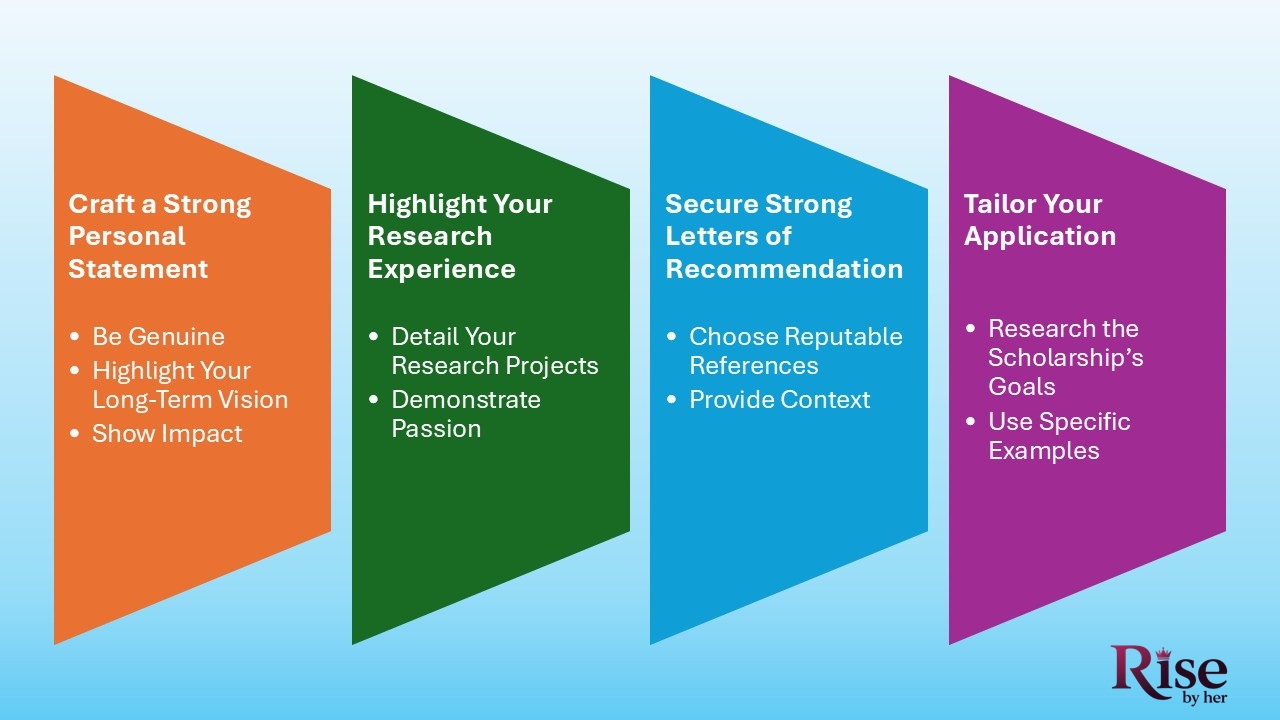
Step 1. Align Your Essay with the Grantor’s Core Mission
Many applicants make the mistake of submitting a generic personal statement to every committee. To win, you must decode the organization’s specific philanthropic or corporate goals. If you are applying to a corporate tech grant like Google’s, your essay should emphasize digital innovation, community building, and open-source collaboration. If you are targeting an academic body like the AAUW, your focus must shift toward systematic equity, advocacy, and research policy.
Expert Strategy: Go to the grantor’s website and analyze their “About Us” page or past press releases. Identify their core keywords—such as sustainability, disruptive technology, or grassroots leadership—and naturally weave those concepts into your narrative framework.
Step 2. Quantify Your Research and Academic Impact
In STEM, data speaks louder than adjectives. Vague statements like “I spent a lot of time in the chemistry lab” or “I am passionate about coding” do not move the needle. Review committees consist of scientists, engineers, and researchers who look for quantifiable impact and analytical precision.
To build immediate credibility, structure your academic achievements using concrete metrics:
- Instead of: “Assisted with a machine learning project.”
- Write: “Co-developed an XGBoost predictive model that improved data classification accuracy by 14% over a three-month library study.”
- Instead of: “I have a lot of leadership experience in tech.”
- Write: “Organized a regional university hackathon, securing $5,000 in corporate sponsorship and hosting 120+ female participants.”
Step 3. Secure Recommendations That Validate Your Leadership Potential
A weak, boilerplate letter of recommendation can instantly stall a top-tier application. Do not simply ask a professor for a letter because you received an “A” in their class. You need advocates who can explicitly speak to your technical problem-solving abilities, your resilience under pressure, and your long-term potential as a leader in your field.
Expert Strategy: When requesting a letter, provide your recommender with a brief “Brag Sheet.” Include a bulleted list of the specific projects you completed under their supervision, your current resume, and the core criteria of the scholarship. This gives them the exact talking points needed to write a highly customized, authoritative evaluation of your work.
Frequently Asked Questions About Women in Tech Scholarships 2026
Navigating the landscape of international graduate funding can raise critical procedural questions. To ensure your applications comply with current 2026 guidelines, review these authoritative answers to the most common queries regarding STEM grants for women and technical fellowships.
Can international or DACA students apply for fully funded STEM awards?
Yes, but eligibility depends entirely on the specific grantor’s funding pool. While federal or state-level domestic programs within the United States require citizenship or permanent residency, major global programs are designed explicitly for international talent.
Awards like the SI Scholarship Pioneering Women in STEM or the Schlumberger Foundation Faculty for the Future exclusively target international citizens from emerging economies. Additionally, organizations like MPOWER Financing offer dedicated, non-cosigner grants tailored specifically to DACA and international scholars enrolled in North American universities.
Are undergraduate students eligible for fully funded STEM scholarships?
The vast majority of 100% “fully funded” packages—meaning those covering complete tuition, a monthly salary/stipend, and international flights—are strictly reserved for postgraduate, Ph.D., or postdoctoral research tracks.
However, undergraduate female students can access substantial financial relief by pairing multi-year corporate awards (such as the Google Women Techmakers Scholarship) with institutional need-based grants or smaller, stackable regional diversity awards.
Can I apply for a STEM scholarship if I am transitioning from a non-technical background?
Absolutely, provided you can demonstrate technical aptitude and a clear professional bridge to your target field. Selection committees value diverse perspectives, but you must validate your career pivot with concrete evidence.
Before applying, ensure your profile features completed bootcamps, certified technical coursework (such as advanced data visualization or programming certifications), or a portfolio of open-source project contributions. Your personal statement must clearly articulate why your unique background combined with new STEM skills will solve a specific industry problem.
Do these 2026 scholarships require a return to my home country after graduation?
Certain government-backed, fully funded options carry a mandatory residency requirement. For instance, the British Council Scholarships for Women in STEM are designed as capacity-building initiatives, meaning recipients are expected to return home to apply their skills and foster local diversity.
Conversely, corporate-sponsored foundation grants and specific university fellowship endowments do not enforce return-home clauses, allowing recipients to pursue global corporate placement or post-grad tech opportunities immediately upon graduation. Always verify the specific visa stipulations attached to your award package.
Final Action Plan: Navigating Your Graduate Funding Journey
Securing a fully funded seat in a competitive STEM program is a game of strategy, timing, and precision. With deadlines for the 2026–2027 academic cycle approaching, the worst thing you can do is wait until the last minute to assemble your application materials.
To maximize your chances of success, use this actionable, step-by-step roadmap to guide your next moves.
Your 4-Step Application Roadmap
- Step 1: Audit and Select Your Top 3 Awards Do not dilute your focus by applying to dozens of programs simultaneously. Select three awards from our list above that perfectly align with your current degree level, geographic region, and career goals.
- Step 2: Launch an Application Master Tracker Create a spreadsheet to log your target programs. Include dedicated columns for application deadlines, specific essay prompt word counts, referee names, and mandatory document checklists (such as certified transcripts or English proficiency scores).
- Step 3: Secure Your Recommenders Immediately Reach out to your prospective professors or industry supervisors at least six weeks before the submission deadline. Provide them with your updated resume, academic transcript, and a brief summary of the scholarship’s mission.
- Step 4: Draft, Refine, and Tailor Your Narrative Write your core personal statement, then rigorously edit it using the strategy we discussed: swap vague adjectives for quantifiable data and metrics. Tailor the final version to reflect the exact cultural values and philanthropic priorities of each individual grantor.
Essential Resources & Official Portals
Before submitting your documentation, always cross-reference your application materials with the absolute latest eligibility criteria, regional updates, and portal instructions listed on the official organization sites:
- For European & UK Tracks: Monitor active application dates and country lists directly on the British Council Women in STEM Portal and the Swedish Institute Scholarships Hub.
- For Research, Ph.D., & Specialized Fellowships: Review technical submission guidelines and field restrictions via the Schlumberger Foundation and the Zonta International Amelia Earhart Fellowship Page.
- For High-Tech & North American Funding: Access corporate application forms, essay prompts, and community network details through the Google Women Techmakers Portal and the AAUW Fellowships Application Center.
By Aveline Lowell
Founder & Editor-in-Chief, RiseByHer
Aveline Lowell writes research-driven content covering women’s finance, entrepreneurship, STEM, technology, and career growth. Her work focuses on practical, well-researched information that helps women make informed decisions.
Editorial & Disclaimer: RiseByHer aims to provide accurate, well-researched, and up-to-date information. Articles are reviewed and updated when necessary and are intended for general informational and educational purposes, not personalized financial, legal, tax, or professional advice.