


Securing non-dilutive funding remains one of the most powerful strategies for female founders aiming to scale in 2026 without sacrificing equity. Yet, navigating complex eligibility criteria and intense competition makes knowing how to apply for business grants as a woman entrepreneur a crucial skill.
While millions of dollars in corporate and government funding go unclaimed or heavily contested every year, winning a grant requires more than a compelling story—it demands a strategic, audit-ready application.
This guide breaks down the exact framework to find high-probability opportunities, organize your financial documentation, and write a high-converting proposal.
Read on to discover how to transform your grant strategy and secure the capital your business deserves.
What Are Business Grants for Women?
Business grants for women are targeted financial awards provided by government agencies, corporations, or non-profit foundations to help female founders launch or scale a business. Unlike traditional financing, grant capital does not require giving up equity or personal collateral.
What Is a Business Grant and How Does It Differ From a Loan?
The fundamental difference between a business grant and a business loan comes down to repayment and ownership. A loan is borrowed capital that must be repaid over time with interest. A grant is non-dilutive capital—essentially a cash award that you do not pay back, provided you adhere to the grant provider’s terms.
| Feature | Business Grant | Business Loan | Equity Investment |
|---|---|---|---|
| Repayment | None required | Monthly principal + interest | None (profits shared) |
| Equity Loss | 0% (You keep 100% ownership) | 0% | 10% – 30%+ ownership given away |
| Primary Requirement | Mission alignment & proposal | Credit score & cash flow | Scalability & high ROI potential |
While loans focus on your ability to service debt, grant providers evaluate how your business creates economic impact, solves a market problem, or aligns with their social mission.
How Women’s Business Grants Can Fund Your Business
Understanding how to apply for business grants as a woman entrepreneur starts with knowing where grant funds can be deployed. Grant makers typically specify allowed uses in their application guidelines, which often include:
- Equipment & Technology: Upgrading software, purchasing manufacturing tools, or acquiring hardware to streamline operations.
- Product Development & R&D: Testing prototypes, securing patents, or conducting market validation.
- Marketing & Customer Acquisition: Funding digital ad campaigns, hiring SEO specialists, or launching rebranding initiatives.
- Working Capital & Hiring: Covering initial payroll for key hires or expanding inventory to meet growing demand.
Because grant funds carry strict reporting guidelines, keeping itemized records ensures your business remains compliant for future funding opportunities.
Do You Qualify for a Women’s Business Grant?
Before investing time in an application, you must verify that your enterprise meets specific grantor criteria. Qualifying for a grant depends heavily on your ownership structure, business stage, and organizational transparency.
Common Eligibility Requirements for Female Founders
While each funding provider sets its own guidelines, most grant makers evaluate applicants against core baseline standards:
- 51% Ownership and Control: The business must be at least 51% owned, managed, and daily-operated by one or more women. [Professional Grant Writers]
- Entity Type & Location: Many programs require a legally registered for-profit business (such as an LLC, S-Corp, or C-Corp) operating within the provider’s eligible regions.
- Business Stage: Requirements vary by funder. Micro-grants often accept early-stage startups, while government or corporate awards may require 1–3 years of active operating history and demonstrated revenue. [Professional Grant Writers]
- Industry & Impact: Specialized grants prioritize ventures addressing specific social, technological, or environmental challenges.
Documents You May Need to Prove Eligibility
To streamline the verification process, grant reviewers expect clear, audit-ready documentation.
| Category | Required Documents |
|---|---|
| Legal & Ownership | Articles of Organization, Operating Agreement, and official WOSB or WBENC certificates (if applicable). |
| Tax & Business ID | Federal Employer Identification Number (EIN) or Unique Entity ID (UEI) via SAM.gov for federal funding. |
| Financial History | Recent business bank statements, Profit & Loss (P&L) statements, and 1–2 years of business tax returns. |
| Operational Plans | A detailed executive summary, pitch deck, and an itemized allocation breakdown for the requested funds. |
Organizing these materials in advance allows you to submit accurate applications quickly when funding windows open.
Where to Find Business Grants for Women
Knowing where to search for funding is just as crucial as knowing how to apply for business grants as a woman entrepreneur. Grant opportunities generally fall into three main categories, each with distinct application requirements, funding amounts, and competition levels.

Government and Federal Grant Programs
Federal and state agencies offer some of the largest non-dilutive funding packages. While these programs involve rigorous reporting and compliance standards, they provide significant capital for research, technology, and social impact projects.
- Grants.gov: The central database for federal funding opportunities across U.S. government agencies.
- SBIR/STTR Programs: Federal grants for women-led ventures in technology, science, and research and development (R&D). [Entreprenista]
- State Economic Development Offices: Regional agencies offering localized micro-grants and growth incentives to stimulate local economies.
Private and Corporate Grants
Corporate foundations and private networks frequently offer targeted grant funding aimed specifically at female founders. These applications typically focus more on your business narrative, market traction, and community impact.
| Grant Provider | Target Business Stage | Typical Award |
|---|---|---|
| Amber Grant (WomensNet) | Early-stage & startups | $10,000 monthly / $25,000 annual |
| Tory Burch Foundation | Early-stage for-profit businesses | $5,000 + 1-year fellowship |
| Cartier Women’s Initiative | Early-stage impact entrepreneurs | $30,000 – $100,000 |
Local and Regional Funding Opportunities
Local funding sources often yield higher success rates due to smaller applicant pools. Connect with local business ecosystems to identify community-specific awards:
- Women’s Business Centers (WBCs): SBA-backed centers providing local grant directories and technical assistance.
- Community Development Financial Institutions (CDFIs): Regional organizations providing micro-grants and low-interest capital combinations.
- Local Chambers of Commerce: Municipal groups that fund local small business grants and community initiatives.
For an up-to-date directory of funding sources, review our full guide on the Best Small Business Grants for Women (2026 Guide).
How to Apply for a Business Grant Step by Step
Mastering how to apply for business grants as a woman entrepreneur requires an organized, strategic approach. Because review committees evaluate hundreds of competing files, following a structured workflow ensures your submission stands out on merit and compliance.
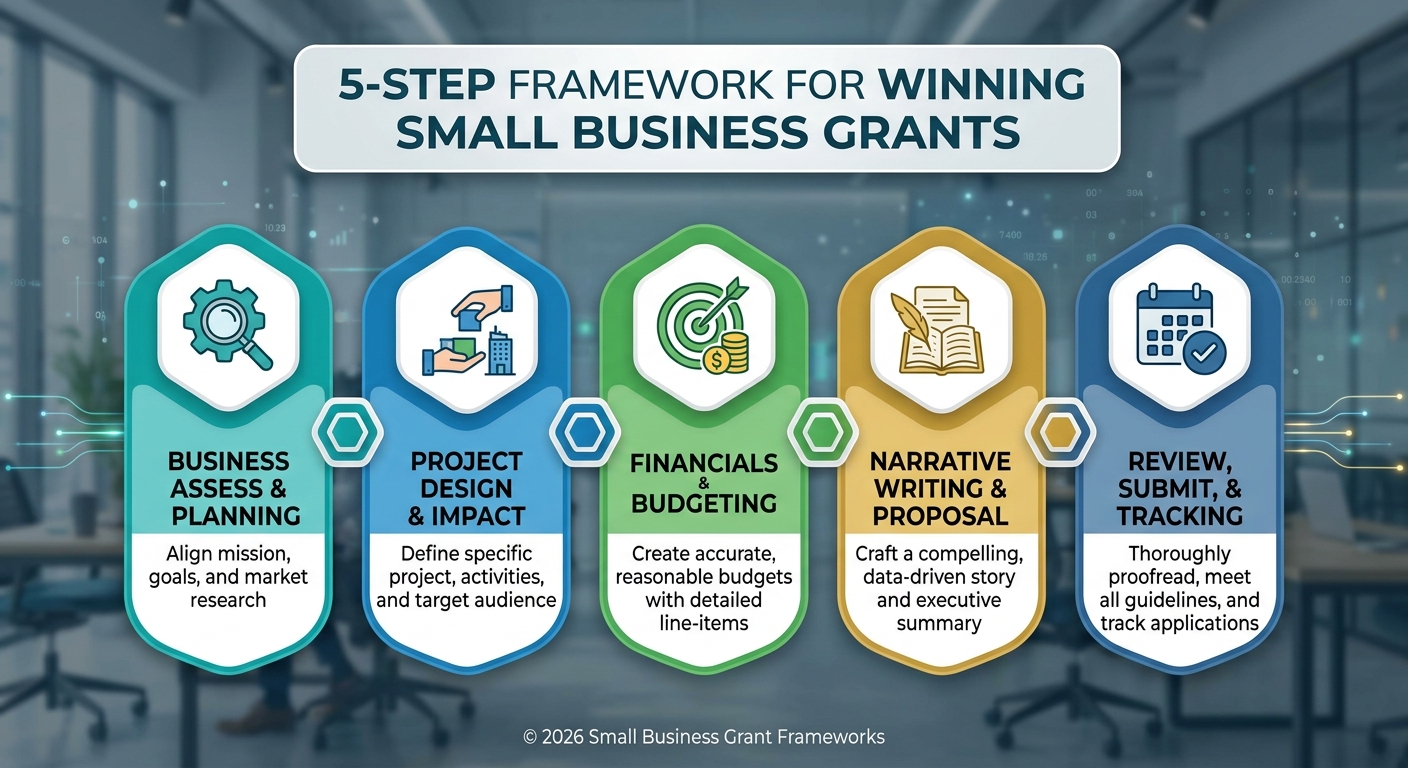
Step 1: Gather Your Business and Financial Documents
Prepare an audit-ready repository.
Before starting an application, centralize core operational files in a cloud folder. Having updated tax returns, balance sheets, entity registration certificates, and an executive summary ready prevents last-minute delays and ensures baseline verification requirements are met immediately.
Step 2: Find and Evaluate the Right Grants
Focus on alignment over volume
Filter opportunities by funding stage, industry focus, and regional eligibility. Rather than applying everywhere, focus on programs where your company’s core mission mirrors the grantor’s specific target outcomes—such as technology innovation, job creation, or social impact.
Step 3: Write a Compelling Grant Proposal
Connect data with measurable outcomes
Structure your narrative around the specific problem your business solves, your current traction, and expected results. Focus on quantifiable metrics rather than vague ambitions; demonstrate exactly how the funding solves a market need or accelerates community growth.
Step 4: Create a Clear Grant Budget
Account for every dollar requested
Present a transparent, itemized line-item budget explaining how grant capital will be deployed. Reviewers prioritize applications showing clear capital efficiency, where funds directly fuel operational milestones like tool acquisition, R&D, or customer acquisition.
Step 5: Review, Submit, and Track Your Application
Eliminate avoidable administrative rejections
Audit your submission against the explicit scoring rubric and formatting requirements (word limits, file types, required attachments). Once submitted, log the notification timeline in an application tracker to prepare for follow-ups or reporting requirements.
Grant Application Checklist
A structured submission pipeline prevents last-minute delays and eliminates avoidable compliance errors. Using a grant application checklist ensures your file is audit-ready and aligns with evaluator expectations before hitting submit.
Essential Documents to Prepare
Having core operational files updated and centralized allows you to act quickly when competitive funding windows open.
| Category | Key Files to Have Ready |
|---|---|
| Legal & Entity Verification | Articles of Organization, Operating Agreement, WOSB or WBENC certification letters. |
| Financial Records | Year-to-date Profit & Loss (P&L) statements, balance sheets, and 2 years of business tax returns. |
| Identification & Tax Details | Federal Employer Identification Number (EIN) letter, state registration, and active SAM.gov UEI. |
| Business Narrative | A 1-page executive summary, detailed pitch deck, and an itemized project budget template. |
Common Grant Application Mistakes to Avoid
Even strong business proposals face rejection due to administrative oversights. Reviewers often eliminate candidates over straightforward compliance mistakes:
- Ignoring Eligibility Thresholds: Applying for funding restricted to specific industries, revenue benchmarks, or geographic regions where your company does not qualify.
- Vague Fund Allocations: Requesting round totals without line-item justifications or breaking down exact operational costs (e.g., equipment, hiring, software).
- Missing Formatting Guidelines: Overlooking strict character limits, required file types (
.pdfvs..docx), or mandatory attachments. - Failing Funder Mission Alignment: Submitting generic company descriptions instead of tailoring your pitch to match the grant maker’s core social or economic goals.
- Unclear Impact Metrics: Stating abstract growth ambitions rather than tracking specific, measurable milestones like job creation, revenue scale, or market expansion.
Frequently Asked Questions About Women’s Business Grants
Are Business Grants for Women Taxable?
Yes, in most cases, business grants are considered taxable gross income by government tax agencies, including the IRS. Unless the funding program specifically falls under a statutory tax exemption or non-profit exemption, grant money must be reported on your business tax return for the year it was received.
Can I Get a Business Grant If My Business Is New?
While many government programs require an established operating history, brand-new businesses can still qualify for early-stage and micro-grant programs. Opportunities like the Amber Grant, regional pitch competitions, and community micro-funding specifically target early-stage startups and ideation-phase female entrepreneurs.
How Long Does It Take to Receive Grant Funding?
Timeline expectations depend heavily on the type of grantor managing the review process. Private and corporate programs (such as corporate foundation awards) generally announce decisions within 30 to 60 days, whereas state and federal government grants can take anywhere from 3 to 9 months due to extensive administrative review requirements.
Can I Apply for Multiple Business Grants?
Yes, you can apply for multiple business grants simultaneously to maximize your funding potential, provided you meet each grantor’s specific eligibility criteria. However, ensure you do not allocate the exact same operational expense line item to two separate grants if prohibited by funding terms.
Frequently Asked Questions About Women’s Business Grants
Securing non-dilutive capital requires persistence, strategic planning, and meticulous organization. By proactively building your document vault, selecting grants closely aligned with your mission, and delivering a clear, data-driven proposal, you position your business to stand out in a competitive funding landscape. Start by preparing your core materials today, track open application deadlines closely, and systematically apply to build a reliable capital pipeline for your enterprise.
By Aveline Lowell
Founder & Editor-in-Chief, RiseByHer
Aveline Lowell writes research-driven content covering women’s finance, entrepreneurship, STEM, technology, and career growth. Her work focuses on practical, well-researched information that helps women make informed decisions.
Editorial & Disclaimer: RiseByHer aims to provide accurate, well-researched, and up-to-date information. Articles are reviewed and updated when necessary and are intended for general informational and educational purposes, not personalized financial, legal, tax, or professional advice.