

How healthy is your money? Just like regular health checkups keep your body in shape, a financial health check is essential to keep your finances strong and secure. Whether you’re saving for your first home, planning for retirement, or simply trying to get out of debt, regularly reviewing your financial status can help you catch problems early and stay on track toward your goals.
In this ultimate guide, we’ll walk you through every step of a financial health check from reviewing your savings and assessing your credit score to optimizing your investments and updating your insurance coverage. This isn’t just about tracking numbers. It’s about empowering you to take control of your money, reduce financial stress, and build long-term financial security.
Ready to take charge?
Let’s dive into the key areas every woman should evaluate to ensure her financial life is as healthy as possible.
How to Assess Your Financial Situation (Income, Expenses, and Net Worth)
A proper financial health check for women begins with understanding exactly where your money stands today. Before setting goals or adjusting strategies, it’s essential to get a clear picture of your current financial reality. Knowing how to assess personal finances helps you make smarter decisions and avoid unnecessary stress about money.
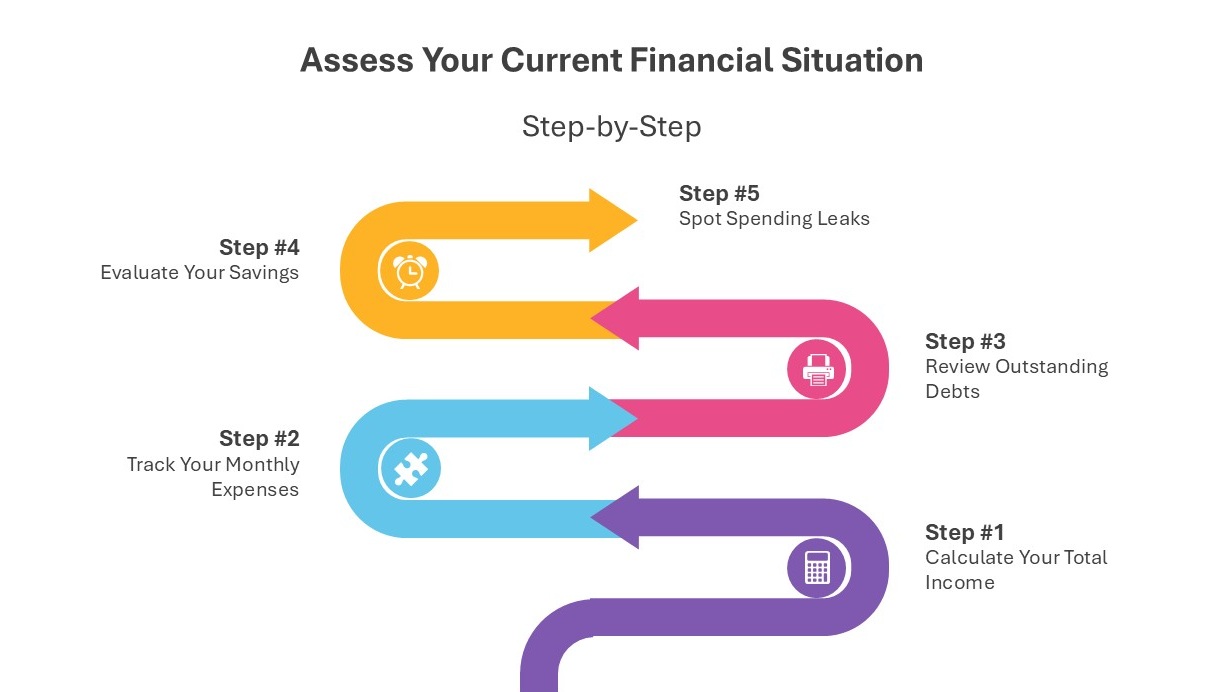
1. How to calculate your total monthly income
Start by reviewing all your monthly income sources. This includes your salary, freelance work, side hustles, rental income, or any government benefits. Knowing your total, consistent income sets the foundation for evaluating spending and savings.
2. How to track and categorize your monthly expenses
Review your bank and credit card statements from the past three months. Categorize your spending into needs (housing, utilities, groceries) and wants (shopping, entertainment). Identifying where your money goes each month helps reveal spending leaks, unnecessary purchases that add up over time.
3. How to review and understand your outstanding debts
List all debts, including credit card balances, student loans, personal loans, and mortgages. Calculate your debt-to-income ratio (DTI) by dividing your total monthly debt payments by your gross monthly income. A high DTI indicates you may be over-leveraged, signaling a need to focus on debt reduction.
4. How to evaluate your savings and liquid assets
Assess your current savings across all accounts:
- Emergency fund (ideally 3–6 months of living expenses)
- Short-term goals (vacations, car purchases)
- Long-term savings (retirement accounts, investment portfolios)
Knowing your total savings helps you identify gaps in your financial safety net.
5. How to identify spending leaks and unnecessary expenses
Look for non-essential recurring expenses that quietly drain your money, such as unused subscriptions, frequent takeout, or impulse purchases. Eliminating these leaks can free up funds for debt repayment or savings.
By following these steps, you’ll gain a clear, honest overview of your financial life. A thorough financial health check for women isn’t about judgment, it’s about awareness and control. Once you know where you stand, you can confidently move forward toward stronger financial health.
If you want fast, practical tips, check out 5 Quick Ways Women Can Save Money Today.
Financial Health Score: How to Measure Your Money Situation
Your financial health score is a simple way to understand how stable and strong your finances are. It combines four key metrics: net worth, savings rate, debt-to-income ratio, and emergency fund coverage. Each one highlights a different part of your financial life.
1. How to calculate your net worth (assets vs liabilities)
Look for non-essential recurring expenses that quietly drain your money, such as unused subscriptions, frequent takeout, or impulse purchases. Eliminating these leaks can free up funds for debt repayment or savings.
What it is:
Net worth shows your overall financial position by comparing what you own versus what you owe.
Formula:
Net Worth = Total Assets − Total Liabilities
How to calculate it:
Add up all your assets, including savings, investments, retirement accounts, property, and valuable possessions. Then subtract all debts such as loans, credit cards, and mortgages.
How to interpret it:
- Positive net worth: You own more than you owe
- Negative net worth: Debt is higher than assets
Why it matters:
Net worth is the clearest snapshot of your long-term financial progress.
2. How to measure your savings rate (income vs savings percentage)
What it is:
Your savings rate shows how much of your income you are keeping instead of spending.
Formula:
Savings Rate = (Monthly Savings ÷ Monthly Income) × 100
How to calculate it:
Take your total monthly savings and divide it by your total monthly income, then multiply by 100.
How to interpret it:
- 0–10%: Low savings rate
- 10–20%: Healthy baseline
- 20%+: Strong wealth-building position
Why it matters:
Your savings rate directly determines how fast you build financial freedom.
3. How to calculate your debt-to-income ratio (DTI benchmark)
What it is:
Debt-to-income ratio measures how much of your income goes toward debt payments.
Formula:
DTI = (Monthly Debt Payments ÷ Monthly Income) × 100
How to calculate it:
Add all monthly debt payments (loans, credit cards, etc.) and divide by your monthly income.
How to interpret it:
- Below 36%: Healthy range
- 36–50%: Moderate risk
- Above 50%: High financial pressure
Why it matters:
A lower DTI means more flexibility and less financial stress.
4. How to evaluate your emergency fund coverage (months of expenses saved)
What it is:
Emergency fund coverage shows how long you can survive without income.
Formula:
Emergency Fund Coverage = Total Emergency Savings ÷ Monthly Essential Expenses
How to calculate it:
Divide your total emergency savings by your monthly essential expenses (rent, food, bills, transport).
How to interpret it:
- 0–3 months: Weak safety buffer
- 3–6 months: Standard protection
- 6–12 months: Strong financial security
Why it matters:
It protects you from job loss, emergencies, and unexpected financial shocks.
How Much You Should Have in Savings and Emergency Fund (Financial Benchmarks)
Once you understand your current financial situation, the next step in your financial health check for women is evaluating your savings strength. Savings are your financial safety net and growth engine, giving you protection against emergencies and resources for future goals. This step focuses on both your emergency fund checkup and a thorough saving goals financial health review.
Step 1: Check Your Emergency Fund
An emergency fund is essential to handle unexpected expenses like job loss, medical bills, or home repairs without resorting to credit cards or loans. Ideally, you should have three to six months’ worth of essential living expenses saved in a liquid account.
Ask yourself:
- Do I have at least three months of expenses saved?
- If not, how much more do I need to save to build that cushion?
If your emergency fund falls short, prioritize regular contributions, even small amounts, until you reach your target.
Step 2: Evaluate Short-Term Saving Goals
Short-term savings help you cover planned expenses without derailing your budget. Review your progress toward:
- Vacation funds
- Home down payment
- Car purchase
- Education or training costs
Track how close you are to meeting these goals and adjust your savings rate if needed.
Step 3: Review Long-Term Savings and Retirement Goals
Your long-term savings, especially retirement accounts like IRAs or 401(k)s, are critical for future security. Perform a quick saving goals financial health review by asking:
- Am I contributing consistently to retirement accounts?
- Is my contribution rate aligned with my target retirement age?
- Do I need to increase contributions to meet my goals?
Consider using retirement calculators to estimate whether you’re on track based on your age, savings rate, and projected needs.
If you’re ready to strengthen your savings, don’t miss 3 Simple Steps for Women to Build a Strong Emergency Fund.
How to Check Your Debt and Improve Your Credit Health
A critical part of any financial health check for women is understanding your debt and credit status. Debt can weigh down your financial progress, while your credit score opens (or closes) doors to future financial opportunities. A focused debt and credit health assessment ensures you’re managing both effectively.

Start by listing all your current debts: credit cards, student loans, personal loans, car loans, and mortgages. Knowing your total outstanding balances gives you a clear picture of how much you owe. Pay attention to interest rates as well, high-interest debts like credit cards should typically be your top priority for repayment.
If you’re struggling with payments, check out Easy Debt Payoff Hacks That Save You Money for simple strategies that actually work.
Next, evaluate your credit utilization ratio, which compares your total credit card balances to your total available credit. Ideally, this should stay below 30%, as high utilization can negatively affect your credit score.
Speaking of your score, it’s time to check your credit score for a full financial health review. Many women overlook their credit score until applying for a loan or mortgage, but reviewing it regularly gives you the chance to correct errors and improve your financial standing. A healthy score (usually 700 or above) helps you secure better interest rates, saving you money over time.
Review your credit reports from major bureaus to:
- Spot inaccuracies that could hurt your score
- Identify unauthorized accounts (potential fraud)
- Ensure your payment history is positive and up-to-date
Finally, consider setting debt reduction priorities. Focus on paying down high-interest or revolving debt first, while maintaining minimum payments on lower-priority accounts. Whether you choose the snowball or avalanche method, consistent, intentional repayment moves you toward debt freedom.
Regular debt and credit health assessments not only improve your financial resilience but also help you build a stronger foundation for future wealth-building activities like investing or home ownership.
If improving your credit is a priority, check out Boost Your Credit Score Quick: A Woman’s Guide.
How to Review Your Investments and Adjust Your Strategy
Investing is one of the most powerful ways to build long-term wealth, but your portfolio should never be a “set it and forget it” plan. A regular investment checkup for women helps you stay on track, avoid unnecessary risk, and make sure your money is aligned with your goals. As part of your financial health check, reviewing your investments can reveal what’s working, what’s underperforming, and where you may need to adjust your strategy.
1. Review Your Investment Portfolio Allocation
Start by looking at your full portfolio, not just one account. Many women invest across multiple places (retirement accounts, brokerage accounts, employer plans), and the full picture matters.
Ask yourself:
- What percentage is in stocks, bonds, ETFs, mutual funds, or real estate?
- Are you too heavily invested in one sector or company?
- Are you holding too much cash that could be growing?
2. Check Diversification to Reduce Risk
One of the most important parts of a portfolio review for women is diversification. If your investments are concentrated in one area (like tech stocks or one employer stock), you may be taking more risk than you realize.
A diversified portfolio often includes:
- U.S. and international stocks
- Bonds or bond funds
- Index funds and ETFs
- Real estate exposure (REITs or property)
- Cash or cash equivalents for stability
3. Analyze Investment Performance Over Time
Next, review your investment performance over 1 year, 3 years, and 5 years. Short-term losses don’t always mean something is wrong, but consistent underperformance may be a red flag.
Look for:
- Investments with high fees but low returns
- Funds that consistently lag behind the market
- Stocks you bought emotionally rather than strategically
4. Rebalance Your Portfolio Based on Your Goals
Over time, your investments can drift out of balance. For example, if stocks grow faster than bonds, your portfolio may become riskier than you intended. This is where rebalancing your investment portfolio becomes essential.
Rebalancing may include:
- Selling a portion of overperforming assets
- Buying more of underweighted categories
- Adjusting allocations to match your target strategy
5. Align Your Risk Tolerance with Your Life Stage
A strong investment strategy financial health review means making sure your risk level matches your lifestyle and future plans. What made sense at 25 may not make sense at 45.
General guideline:
- 20s–30s: higher growth, more stock exposure
- 40s: balanced strategy, building stability
- 50s+: more conservative, income and capital protection focus
6. Review Fees and Hidden Investment Costs
Fees matter more than most people realize. Even a 1% fee can cost you thousands over the years. During your investment checkup, look for:
- High mutual fund expense ratios
- Advisory fees
- Trading fees
- Account management charges
7. Improve Tax Efficiency and Use Tax-Advantaged Accounts
A smart investor doesn’t just focus on returns, she focuses on what she keeps. Reviewing tax-efficient investing strategies for women can help you protect your gains.
Check if you’re maximizing:
- 401(k) or employer retirement plans
- IRA or Roth IRA accounts
- HSA (Health Savings Account) if available
8. Update Your Investment Strategy for Long-Term Wealth
Your investments should match your goals, whether that’s buying a home, building passive income, starting a business, or retiring early. A regular review ensures your strategy grows with you, not behind you.
Quick investment review checklist:
- Are you diversified properly?
- Are you paying unnecessary fees?
- Is your portfolio aligned with your risk level?
- Have you rebalanced in the last 12 months?
- Are you investing consistently each month?
Regular investment reviews help women build confidence, reduce financial stress, and create long-term wealth with a clear strategy.
For a deeper dive, check out this Smart Investing Guide for Women to Build Generational Wealth to learn how to grow your portfolio with confidence.
Insurance, Taxes, and Estate Planning: What to Review Annually
A comprehensive financial health check for women isn’t complete without reviewing the protective elements of your finances. Insurance, tax planning, and estate documents often get overlooked, yet they’re essential for safeguarding your wealth and supporting your family in the long term. Performing an insurance and tax check financial health review help you avoid costly surprises down the road.

1. Review Your Insurance Coverage
Insurance acts as a safety net against financial disasters. Make sure you have adequate:
- Health insurance to cover medical costs.
- Life insurance if you have dependents relying on your income.
- Disability insurance to protect against loss of income due to illness or injury.
- Home, renters, and auto insurance for property protection.
Reassess coverage amounts to ensure they match your current life stage and financial needs. Underinsured? It’s time to update policies.
2. Optimize Your Tax Strategy
Tax planning isn’t just for accountants. Reviewing your tax strategy helps you retain more of your income:
- Maximize contributions to tax-advantaged accounts like IRAs, 401(k)s, or HSAs.
- Look for eligible deductions (education, business expenses, childcare).
- Consider charitable giving for additional tax benefits.
A proactive tax plan helps reduce your taxable income and can improve your long-term savings.
3. Update Estate Planning Documents
Even if you’re young or single, estate planning matters. Use this estate planning review checklist:
- Ensure your will is current and accurately reflects your wishes.
- Set up or review trusts to manage wealth transfer.
- Update beneficiary designations on retirement accounts and insurance policies.
- Ensure you have a power of attorney and healthcare directive in place.
By keeping your estate plan updated, you protect your assets and ease the burden on your loved ones.
If you want to diversify beyond stocks, read How to Use Real Estate and Investing to Create Generational Wealth to learn how to build long-term assets.
Conclusion
A financial health check isn’t just a one-time task, it’s a lifelong habit that empowers you to take control of your money and your future. By regularly reviewing your income, expenses, savings, debt, investments, insurance, tax strategies, and estate plans, you’re building a clear, realistic roadmap toward financial security.
For women, especially, staying proactive about finances can help close wealth gaps, reduce financial stress, and ensure long-term independence. Whether you’re saving for retirement, paying off debt, or protecting your family’s future, each step in your financial review strengthens your ability to make informed, confident decisions.
Remember: financial wellness isn’t about perfectionists about progress. Prioritize regular financial checkups and adjust your strategies as life changes. Over time, these small, consistent actions can help you build lasting wealth, greater security, and true financial peace of mind.
If you want to take it even further, check out Generational Wealth for Women Starts with Financial Education.
By Aveline Lowell
Founder & Editor-in-Chief, RiseByHer
Aveline Lowell writes research-driven content covering women’s finance, entrepreneurship, STEM, technology, and career growth. Her work focuses on practical, well-researched information that helps women make informed decisions.
Editorial & Disclaimer: RiseByHer aims to provide accurate, well-researched, and up-to-date information. Articles are reviewed and updated when necessary and are intended for general informational and educational purposes, not personalized financial, legal, tax, or professional advice.