


Index fund investing does not have to be complicated or intimidating. In 2026, more women entrepreneurs are using index funds as a simple, low-stress way to build wealth while focusing on growing their businesses. With low effort, lower risk than individual stocks, and strong long-term growth potential, it is a smart option for busy women who want financial progress without constant market tracking.
In simple terms, an index fund is an investment that tracks a group of companies, like the S&P 500. Instead of picking individual stocks, you invest in hundreds of companies at once. This gives you instant diversification, reduces risk, and keeps investing simple and hands-off.
For women entrepreneurs, this matters because your money should grow even when you are focused on your business. Index funds offer:
- Low fees and simple setup
- Long-term, steady market growth
- Minimal time and effort required
- Less stress compared to active investing
In this guide, you will learn how index funds work, why they fit women in business, which ones to consider in 2026, and how to start investing step by step.
Ready to build wealth the simple way? Let’s get started.
What Is Index Fund Investing and Why It’s Perfect for Beginner Women Entrepreneurs
If you’re a female entrepreneur looking for a simple, stress-free way to grow your money, index fund investing might be your new best friend. It’s one of the smartest and most beginner-friendly ways to build wealth without needing to study the stock market every day.
1. What Is an Index Fund and How Does It Work?
An index fund is a type of investment that tracks the performance of a specific market index, such as the S&P 500, Nasdaq 100, or Dow Jones. Instead of trying to pick individual stocks, you’re buying into an entire collection of companies; automatically.
Think of it like buying a fruit basket instead of picking out individual apples, bananas, and oranges. You get a little bit of everything, which reduces your risk and increases your potential for long-term gains.
2. Index Funds vs Mutual Funds vs Stock Picking (Simple Breakdown)
- Index Funds are passively managed and follow the market. This keeps fees low and performance consistent.
- Mutual Funds are often actively managed, meaning someone is choosing stocks for you (usually at a higher cost).
- Stock Picking involves selecting individual companies to invest in. It can be exciting, but it’s risky, time-consuming, and often requires deep knowledge.
3. Why Index Funds Fit a Busy Entrepreneur Lifestyle
Index funds are ideal for women entrepreneurs because they build wealth without taking up your time. Instead of tracking markets or picking stocks, you invest once and let it grow in the background.
They require very little management, which is important when your focus is already on running and growing a business.
Index funds also help remove emotional decision-making during market ups and downs. You stay consistent instead of reacting to short-term changes.
In short, they work well because they:
- Save time with a hands-off approach
- Reduce stress and decision fatigue
- Allow automatic, consistent investing
- Support long-term wealth while you focus on your business
4. Key Benefits of Index Fund Investing (Low Risk, Low Effort, Long-Term Growth)
- Low fees: More of your money stays invested.
- Instant diversification: Spread across hundreds of companies to lower your risk.
- Long-term growth: Historically strong performance when held over time.
- Set it and forget it: Perfect for entrepreneurs juggling multiple responsibilities.
Whether you’re saving for retirement, financial independence, or your next big idea, index fund investing for women entrepreneurs is a smart, low-stress way to start building real wealth.
Why Index Fund Investing Is a Smart Wealth Strategy for Women in 2026
In 2026, more women than ever are building businesses, growing wealth, and taking control of their financial futures. If you’re a female entrepreneur, investing in index funds is one of the smartest financial moves you can make, especially if you’re aiming for long-term stability and financial freedom.
The Rise of Women Building Independent Wealth in 2026
In 2026, more women entrepreneurs are actively shifting from relying only on business income to building independent wealth through investing. This shift is driven by a stronger focus on financial security, flexibility, and long-term freedom. Instead of depending solely on business cash flow, many are now creating parallel wealth systems that continue to grow regardless of business cycles.
Why Passive Investing Works Better for Business Owners
Index fund investing is low-maintenance, reliable, and perfectly suited to the demands of entrepreneurial life.
Here’s why more female founders are turning to index funds:
- Build retirement savings: Contribute to an IRA or solo 401(k) and let your money grow passively.
- Emergency fund booster: Earn higher returns than a regular savings account without taking huge risks.
- Generational wealth creation: Diversify early and watch your investments grow over time for your children or future goals.
- No need to actively trade: Forget trying to time the market or analyze stock-index funds do the work for you.
- Time-efficient: As a busy entrepreneur, you can invest once a month and let compound interest do the rest.
How Index Funds Support Long-Term Financial Freedom
Index funds are built around one core advantage: steady, long-term compounding.
By spreading your investment across hundreds or even thousands of companies, they reduce the impact of individual market volatility while capturing overall market growth. For women entrepreneurs, this creates a powerful financial foundation that grows quietly in the background.
Instead of chasing short-term gains, index funds align with long-term goals such as:
- Building financial independence beyond business income
- Creating stability during unpredictable business cycles
- Reinvesting profits into future opportunities without pressure
- Supporting long-term goals like retirement, real estate, or legacy wealth
Over time, consistency matters more than timing. Index funds reward patience, discipline, and long-term thinking, which aligns well with how successful entrepreneurs already build their businesses.
Best Index Funds for Long-Term Wealth Growth in 2026
Choosing the right index funds is key to building a strong, passive income portfolio. Whether you’re a busy female entrepreneur or just starting your investment journey, these top-performing index funds offer a balance of growth, stability, and long-term potential. Below are some of the best index funds for women to consider in 2026, including their fees, performance trends, risk levels, and ideal use cases.
S&P 500 Index Funds (e.g., VOO, SPY)
- What it is: Tracks the top 500 U.S. companies (think Apple, Amazon, Microsoft).
- Popular choices: Vanguard S&P 500 ETF (VOO), SPDR S&P 500 ETF Trust (SPY)
- Why it’s great: Diversified exposure to large-cap U.S. stocks.
- Fees: Low expense ratios (VOO – 0.03%, SPY – 0.09%)
- Risk Level: Moderate
- Perfect for: Long-term wealth building, retirement portfolios
Total Stock Market Funds (e.g., VTI)
- What it is: Covers the entire U.S. stock market (large-cap, mid-cap, small-cap).
- Popular choice: Vanguard Total Stock Market ETF (VTI)
- Why it’s great: Broader exposure than the S&P 500.
- Fees: 0.03% expense ratio
- Risk Level: Moderate
- Perfect for: Entrepreneurs looking for long-term, all-market exposure
International Index Funds (e.g., VXUS)
- What it is: Invests in companies outside the U.S.
- Popular choice: Vanguard Total International Stock ETF (VXUS)
- Why it’s great: Adds global diversification to your portfolio.
- Fees: 0.07% expense ratio
- Risk Level: Medium to high (based on global markets)
- Perfect for: Women seeking global growth opportunities
ESG & Women-Focused Index Funds (e.g., SHE by SPDR)
- What it is: Funds focused on environmental, social, and governance (ESG) principles or gender diversity.
- Popular choice: SPDR SSGA Gender Diversity Index ETF (SHE)
- Why it’s great: Supports companies with strong female leadership.
- Fees: 0.20% expense ratio
- Risk Level: Moderate
- Perfect for: Values-based investors, socially conscious women
How to Start Investing in Index Funds (Step-by-Step Beginner Guide)
If you’re ready to build wealth on autopilot, index fund investing is one of the smartest moves you can make. And the good news? Getting started is simpler than you might think, even if you’ve never invested a dollar before. Here’s a step-by-step guide tailored for female entrepreneurs and beginners looking to grow their money passively.
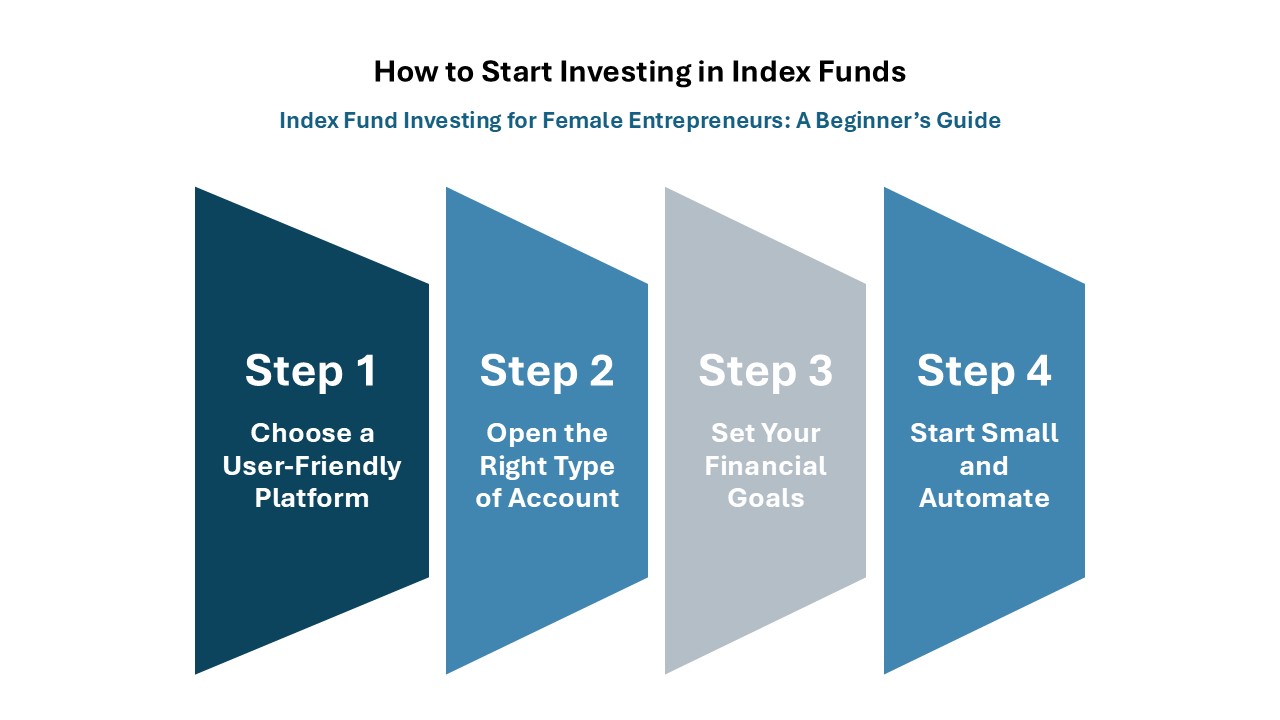
Step 1: Choose a User-Friendly Brokerage Platform
Start by picking a trusted investment platform. Most are free to open and easy to use:
- Vanguard: Great for long-term investors with low fees.
- Fidelity: Offers zero-commission trading and lots of educational tools.
- Charles Schwab: Ideal for beginners with excellent customer support.
- Robinhood: User-friendly app for mobile investing on the go.
Step 2: Open the Right Type of Account
Depending on your financial goals, you’ll want to choose the appropriate account:
- Roth IRA or Traditional IRA: Best for retirement savings with tax benefits.
- Individual/Taxable Account: More flexible and perfect for long-term wealth outside retirement.
Step 3: Set Your Financial Goals
Ask yourself:
- Are you saving for retirement?
- Building an emergency fund?
- Looking for long-term passive income?
Knowing your “why” helps determine how much to invest and which funds to choose.
Step 4: Start Small and Automate
You don’t need a fortune to begin. Start with what you can, $50, $100, or more. Set up automatic monthly contributions and let compound growth do the heavy lifting.
Common Index Fund Investing Mistakes Women Should Avoid
Even though index fund investing is one of the simplest and most beginner-friendly ways to build wealth, there are still some common pitfalls that can slow down your financial progress, especially for busy female entrepreneurs.
Let’s walk through the biggest mistakes to avoid so your money works for you, not against you.
Trying to Time the Market Instead of Staying Consistent
One of the most common mistakes is trying to “buy low and sell high.” Sounds easy in theory, but in practice, even professional investors get it wrong.
Why it’s risky: The market is unpredictable. Waiting for the “perfect” moment often means you stay out too long and miss out on gains.
Better strategy: Stay consistent. Invest regularly and let compound growth take the wheel.
Ignoring Fees, Expense Ratios, and Taxes
Low fees are one reason index funds are so powerful, but not all platforms or fund types are equal.
- Watch for: High expense ratios or hidden brokerage fees.
- Tax traps: Selling index funds too soon may lead to capital gains taxes.
Investing Without a Long-Term Contribution Plan
You don’t need a lump sum to start. Inconsistent investing is one of the biggest growth blockers.
Solution: Automate monthly contributions, even small ones add up over time.
Overcomplicating Instead of Staying Diversified
While index funds are naturally diversified, make sure you’re not putting all your money into one type (like just the S&P 500).
Consider: Adding international or sector-specific funds for better balance.
Avoiding these mistakes can help you stay confident, consistent, and on track toward financial freedom, without all the stress.
Tools and Resources to Help Women Invest in Index Funds Confidently
Starting your index fund investing journey doesn’t have to feel overwhelming, especially when there are so many helpful tools and communities designed just for women. Whether you’re a busy entrepreneur, side hustler, or full-time mompreneur, these platforms and groups can guide your next smart money move.
Best Beginner-Friendly Investment Apps and Platforms
These user-friendly apps make it easy to research, invest, and manage your portfolio from your phone.
- Wealthfront: Great for automated investing with goal tracking and tax-loss harvesting.
- Betterment: Beginner-friendly robo-advisor that builds diversified portfolios based on your goals.
- Vanguard: Known for its low-cost index funds like VTI and VOO. Ideal for long-term investors.
- M1 Finance: Combines automated investing with customization. You can build your own “pie” of index funds.
Educational Blogs, Podcasts, and Courses for Women Investors
Sometimes the best advice comes from those who understand your journey.
- HerMoney (by Jean Chatzky): Offers empowering money advice tailored for women, from investing to career growth.
- Ellevest: An investing platform + learning hub created specifically for women to close the gender wealth gap.
- The Clever Girls Know Podcast: Hosted by Bola Sokunbi of Clever Girl Finance, it breaks down complex topics like index fund investing into relatable, actionable insights.
Online Communities for Support, Accountability, and Learning
Investing is easier (and more fun) when you’re not doing it alone.
- Facebook Groups: Try Women Investing to Financial Freedom or Smart Money Mamas Investing Circle.
- Reddit: Subreddits like r/femalefinancialindependence and r/investing are packed with real advice and personal wins.
- Ellevest Community Hub: Connect with other women learning to invest and grow their wealth.
By using these tools and tapping into supportive communities, you’re not just learning—you’re building a lifestyle of long-term wealth. And you’re not doing it alone.
Budget Tracking Tools and Financial Planning Apps to Stay Investment-Ready
Before investing in index funds, it is important to understand your cash flow and build consistent saving habits. Many women entrepreneurs use budget tracking tools and financial planning apps to make smarter decisions about how much they can safely invest each month.
These tools help you stay organized, avoid overspending, and create a clear plan for long-term investing. Some of the most useful features include tracking expenses, setting savings goals, and visualizing your financial progress over time.
Popular tools include:
- Apps that automatically track income and expenses
- Budget planners that help you set monthly investing targets
- Financial dashboards that show your overall net worth growth
Using these tools creates a strong foundation for investing because it ensures you are not investing randomly, but consistently and sustainably based on your real financial situation.
How Index Funds Fit Into Your Long-Term Wealth Strategy
Index funds work best when they are treated as a long-term wealth-building system, not a short-term investment tactic. For women entrepreneurs, this means shifting the focus from trying to “time the market” to consistently participating in it over time.
How Index Funds Help Build Financial Independence Over Time
Index funds support financial independence by allowing your money to grow steadily through broad market exposure and compounding returns. Instead of relying only on business income, you create an additional layer of wealth that continues to grow in the background, even during slower business periods.
Why Consistency Matters More Than Market Timing
Successful investing is less about predicting the market and more about staying consistent. Regular contributions, even in small amounts, often outperform trying to buy at the “perfect” time. For busy entrepreneurs, this removes pressure and turns investing into a predictable habit rather than a stressful decision.
Turning Index Fund Investing Into a Wealth-Building Habit
The real power of index funds comes from consistency over time. When investing becomes automatic, it stops feeling like a task and becomes part of your financial routine. This habit-based approach helps you stay invested through market ups and downs, which is where long-term growth actually happens.
How Much Money Do You Need to Start Investing in Index Funds?
One of the biggest misconceptions about investing is that you need a large amount of money to begin. In reality, index funds are designed to be accessible, making them a great entry point for women entrepreneurs at any stage of their financial journey.
1. You can start with as little as $1 to $100
Many modern brokerage platforms allow you to start investing with very small amounts. Some even offer fractional investing, meaning you can buy a portion of an index fund instead of a full share. This makes it possible to start building wealth even if you are just getting started or reinvesting early business income.
2. Why starting small is actually better
Starting small removes pressure and helps you build consistency without stress. Instead of waiting until you “have enough,” you begin developing the habit of investing early. This also helps you learn how the market works in real time without risking large amounts of money. Over time, consistency matters far more than the initial amount you invest.
3. How to scale your investments over time
As your income grows, especially as your business becomes more stable, you can gradually increase your contributions. Many investors start with small monthly amounts and scale up as cash flow improves. The key is not how much you start with, but how consistently you increase and maintain your investments over time.
Conclusion: Start Small and Build Wealth with Index Funds in 2026
Index fund investing is one of the simplest and most powerful ways for women entrepreneurs to build long-term wealth without adding more stress to their schedule. You do not need perfect timing, expert knowledge, or a large amount of money to begin. What matters most is starting early, staying consistent, and letting compound growth do the heavy lifting.
Whether your goal is financial independence, early retirement, or creating a safety net beyond your business income, index funds can help you build a strong foundation step by step.
Start small, stay consistent, and trust the process. Your future self will thank you.
By Aveline Lowell
Founder & Editor-in-Chief, RiseByHer
Aveline Lowell writes research-driven content covering women’s finance, entrepreneurship, STEM, technology, and career growth. Her work focuses on practical, well-researched information that helps women make informed decisions.
Editorial & Disclaimer: RiseByHer aims to provide accurate, well-researched, and up-to-date information. Articles are reviewed and updated when necessary and are intended for general informational and educational purposes, not personalized financial, legal, tax, or professional advice.