

Introduction
Women entrepreneurs are driving innovation across industries, yet securing funding remains a challenge. Studies show that women-led startups receive less venture capital despite strong financial performance. A well-structured business plan is essential for overcoming these barriers, serving as a roadmap for growth while building credibility with investors and lenders.
Why Women Entrepreneurs Need a Strong Business Plan
A strong business plan is crucial for women entrepreneurs facing funding challenges, gender biases, and limited networks. It helps by:
- Demonstrating financial viability to investors and lenders.
- Providing strategic direction for business growth.
- Strengthening applications for grants and competitions.
How a Business Plan Helps You Get Funded Faster
Investors fund strategies, not just ideas. A well-prepared business plan:
- Clearly defines the business vision and value proposition.
- Provides market analysis to showcase demand and growth potential.
- Details financial projections and funding requirements.
- Establishes credibility and proves the entrepreneur’s ability to execute.
Funding Trends for Women-Owned Businesses in 2026
Women-led businesses are thriving, with key trends shaping the landscape:
- Growth in women-owned startups, especially in tech and e-commerce.
- More impact-driven businesses focused on sustainability and social change.
- Expansion of women-focused funding sources such as Venture Capital firms and grants.
- Rise of digital and AI-powered business models.
- Increased access to mentorship and networking opportunities.
What a Business Plan Is (And Why Investors Require It)
A business plan is a structured document outlining a company’s goals, strategies, and financial projections. It serves as a roadmap for success, helping entrepreneurs define their vision, attract investors, and secure funding. A strong business plan not only details the products or services but also includes market research, operational strategies, and financial planning.

What Investors and Banks Want to See
Investors and lenders don’t just fund ideas, they fund well-researched, executable strategies. A solid business plan helps by:
- Demonstrating financial viability – Investors need to see profit potential and a return on investment (ROI).
- Reducing investment risks – Lenders assess risk before approving loans, and a business plan shows risk management strategies.
- Providing clear growth strategies – Investors want to know how the business will scale over time.
- Outlining funding requirements – A business plan explains how much funding is needed and how it will be used.
When You Need a Business Plan vs Pitch Deck
Many women entrepreneurs confuse a business plan with a pitch deck, but they serve two different purposes.
A business plan is a detailed document that explains how your business works, how it will generate revenue, and how it will grow. It includes market research, operational strategy, and financial projections. Banks, grant programs, and some investors often require this because it proves your business is structured and financially realistic.
A pitch deck is a short presentation designed to sell your idea quickly. It highlights the problem, solution, market opportunity, traction, business model, and funding needs. Investors prefer pitch decks because they can review them fast and decide whether they want a deeper conversation.
What you need first depends on your funding goal:
- Applying for grants or bank loans: start with a full business plan
- Pitching angel investors or VCs: start with a pitch deck
- Building credibility as a new founder: start with a business plan, then create your deck from it
The smartest approach is to create your business plan first, then summarize it into a pitch deck. This ensures your story, numbers, and funding request stay consistent.
Traditional vs Lean Business Plan (Which One Works Best?)
There is no single “best” business plan format. The right one depends on how established your business is and what type of funding you are targeting.
A traditional business plan is the most detailed format. It includes full market research, competitor analysis, operations, marketing strategy, and multi-year financial projections. This format is ideal if you are applying for bank loans, government funding, or major grants because these funding sources want proof that your business is stable and low-risk.
A lean business plan is shorter and more flexible. It focuses on your value proposition, target customer, revenue model, and key milestones. It is best for early-stage women founders who are still validating their idea and need something fast to guide execution.
Here’s how to choose the right format:
- Choose a traditional business plan if you need funding from banks, grants, or lenders
- Choose a lean business plan if you are pre-launch, testing the market, or building your MVP
- Use a hybrid plan if you are pitching investors but also want a strong internal roadmap
In most cases, women entrepreneurs get the best results by starting lean, validating demand, and then expanding into a full traditional plan once they are ready to pursue serious funding.
Business Plan Format That Works Best for Funding
Not all business plans are written for the same audience. A plan that works well for a bank loan may fail completely with angel investors, and a one-page plan may be too weak for grant applications.
The best format depends on who you’re asking for money, how mature your business is, and how much proof of traction you can provide.
Below are the three most effective business plan formats women entrepreneurs can use to increase funding success.
Traditional Business Plan Format (Loans + Banks)
A traditional business plan is the most detailed and structured format. It is designed to reduce risk and prove your business can repay borrowed money.
This format is best for women entrepreneurs applying for:
- bank loans
- SBA-style funding programs
- government-backed financing
- long-term business credit
- structured grants that require financial documentation
A strong traditional business plan typically includes:
- executive summary
- business overview and mission
- market research and competitor analysis
- product or service explanation
- marketing and sales plan
- operations plan and team structure
- detailed financial projections (cash flow, P&L, balance sheet)
- funding request and repayment strategy
What lenders care about most is stability. They want to see predictable revenue, controlled expenses, and a realistic plan to repay the loan.
To improve your approval chances, include:
- conservative financial projections
- break-even analysis
- collateral or risk-reduction plan
- clear explanation of how funds will be used
If your goal is debt funding, this is the safest and most accepted business plan format.
Investor-Ready Business Plan Format (VC + Angels)
An investor-ready business plan is built for speed, growth, and scalability. Unlike banks, investors are not focused on repayment. They are focused on potential returns.
This format is best for women entrepreneurs seeking:
- angel investment
- venture capital funding
- seed funding
- startup accelerators and pitch competitions
An investor-focused plan should include:
- problem and solution (with a clear market gap)
- target market size and opportunity
- traction (sales, users, partnerships, growth rate)
- competitive advantage and differentiation
- business model and revenue streams
- go-to-market strategy
- scaling plan (how growth will happen)
- founder story and team strengths
- financial forecast + key metrics (CAC, LTV, margins)
- funding ask and runway timeline
What investors care about most is whether your business can grow fast enough to create a high-value exit.
To make your plan stronger, highlight:
- traction proof (even small wins matter)
- customer demand and validation
- repeatable acquisition strategy
- strong positioning and clear differentiation
- clear use of funds tied to growth milestones
This format is usually shorter than a traditional plan, but it must feel sharper, more strategic, and more growth-driven.
One-Page Business Plan Format (Early-Stage Startups)
A one-page business plan is a simplified version of your strategy. It is not designed to replace a full plan, but it helps you organize your business quickly and prepare for early conversations.
This format is best for women entrepreneurs who are:
- still validating an idea
- building an MVP
- starting a side hustle or small business
- preparing for incubators or early mentoring programs
- pitching informally to potential partners
A strong one-page plan should include:
- your business idea and mission
- target customer and main problem
- solution and unique value proposition
- revenue model (how you make money)
- key marketing channels
- startup costs and pricing
- short-term goals (30–90 days)
- funding needs (if applicable)
What makes a one-page plan powerful is clarity. It forces you to focus on what matters most before spending weeks building a long document.
However, if you are applying for serious funding, use this format as your starting point, then expand it into a full investor-ready or traditional business plan.
Essential Sections of a Fundable Business Plan (Step-by-Step)
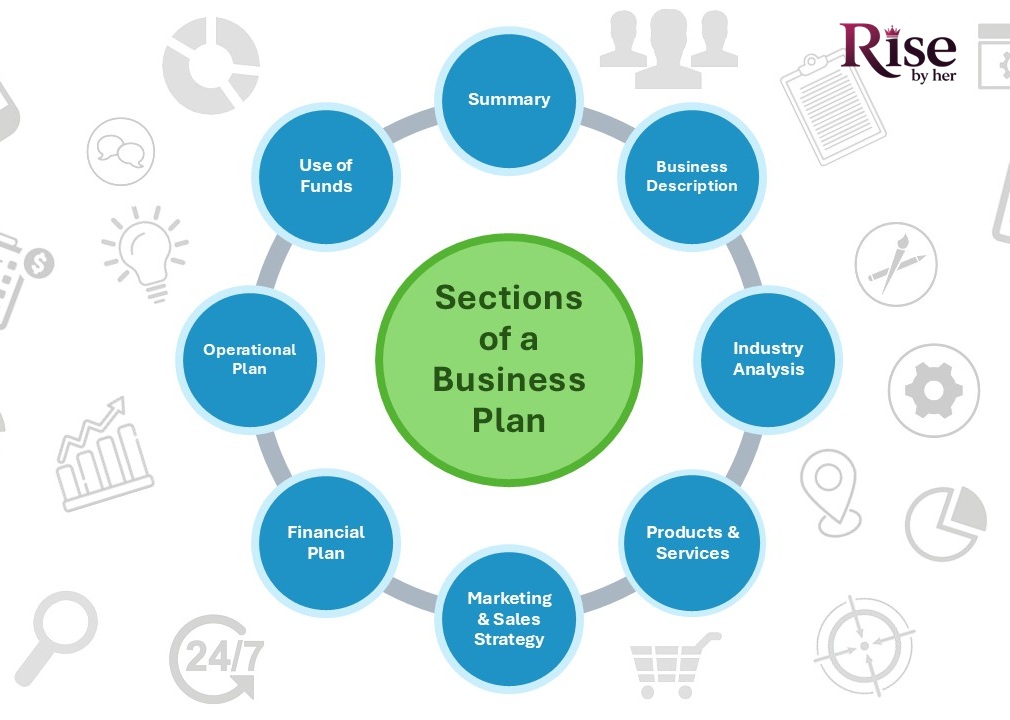
A well-structured business plan is crucial for securing funding and guiding business growth. Below are the key sections every business plan should include:
Executive Summary (How to Write It for Funding)
This is the first section but should be written last. It provides a high-level overview of your business, including:
- Business name and mission statement
- Products or services offered
- Target market and competitive advantage
- Funding requirements and expected return on investment (ROI)
Business Model and Revenue Streams
This section explains what your business does and why it exists. It includes:
- Your business model (e.g., e-commerce, service-based, retail)
- The problem your business solves
- Your company’s vision and long-term goals
Market Research and Competitive Analysis
Investors want data-backed evidence that your business can succeed. This section includes:
- Industry trends and market size
- Target audience demographics and customer needs
- Competitive analysis – Strengths and weaknesses of competitors
Product or Service Offering (Your Unique Value Proposition)
Describe your offerings in detail, including:
- Unique Selling Proposition (USP) – What makes your products/services stand out?
- Pricing strategy
- Development plans for future products/services
Marketing and Sales Strategy
Your plan for attracting and retaining customers should cover:
- Marketing channels (SEO, social media, paid ads, influencer partnerships)
- Sales strategy and customer acquisition model
- Branding and positioning strategies
Operations Plan and Business Structure
This section details how your business will function daily, covering:
- Business location and logistics
- Technology and tools needed for operations
- Team structure and hiring plans
Financial Plan and Projections
This section is critical for investors and lenders. It should include:
- Startup costs and funding requirements
- Revenue model and pricing strategy
- Projected income statement, balance sheet, and cash flow for 3–5 years
Funding Request and Use of Funds
If seeking funding, explain:
- How much capital is needed
- How the funds will be allocated (e.g., marketing, product development, staffing)
- Expected ROI for investors
A well-crafted business plan that includes these essential sections not only attracts investors but also provides a clear roadmap for success. In the next section, we’ll discuss how to tailor your plan for different types of funding sources.
Financial Projections That Help Women Entrepreneurs Get Funded
Financial projections are where your business plan becomes believable. They show funders that your idea is profitable, your costs are realistic, and your business can survive long enough to scale.
Investors and lenders don’t expect perfect numbers, but they do expect clear assumptions and strong logic. If your projections look sloppy or overly optimistic, your funding request will be rejected fast.
Startup Costs and Break-Even Point
This section explains exactly what it will cost to launch your business and how much funding you need upfront.
Include key startup expenses like:
- product development or inventory
- equipment and tools
- website, branding, and marketing
- legal setup and licenses
- software subscriptions
- rent, utilities, and payroll
To make your plan stronger, separate costs into:
- one-time startup costs
- monthly operating costs
Then calculate your break-even point, which is when your revenue finally covers your expenses. Funders want to see how quickly your business can become financially stable.
Profit and Loss Forecast (12–36 Months)
Your profit and loss forecast shows how your business will perform over time.
It should include:
- projected revenue
- cost of goods sold (COGS)
- operating expenses
- net profit or loss
For funding, you should forecast:
- 12 months minimum
- 24–36 months if you’re targeting investors
Use realistic assumptions based on pricing, customer demand, and growth capacity. A steady forecast looks more credible than aggressive “overnight success” projections.
Cash Flow Forecast (Most Important for Investors)
Cash flow is the #1 financial document investors check because profit doesn’t always mean you have cash.
A cash flow forecast shows:
- how money comes in
- how money goes out
- whether you can survive slow months
It should clearly include:
- monthly inflows (sales, contracts, subscriptions)
- monthly outflows (rent, payroll, suppliers, marketing)
- ending cash balance
- runway (how long funding lasts)
Strong cash flow projections prove you can manage funding responsibly.
Key Metrics Investors Look For (CAC, LTV, margins)
Investors fund businesses that can scale profitably, not just businesses that make sales.
Include key metrics like:
- CAC (Customer Acquisition Cost)
- LTV (Lifetime Value)
- Gross margin and net margin
- MRR (Monthly Recurring Revenue) for subscriptions
- Churn rate (customer drop-off)
- Burn rate (monthly spending)
- Runway (months before cash runs out)
A strong signal is simple:
LTV must be higher than CAC.
How to Tailor Your Business Plan for Investors, Grants, and Loans
What Investors Look for in Women-Led Businesses
Investors and lenders evaluate women-led businesses based on:
- Scalability & Market Potential – Can the business grow sustainably?
- Strong Financial Projections – Clear revenue models and realistic cash flow.
- Competitive Advantage – What makes the business unique?
- Founder’s Leadership & Vision – Experience, expertise, and business acumen.
- Social Impact & Sustainability – Investors increasingly favor businesses with positive societal impact.
What Grant Committees Want to See
Women entrepreneurs can access various funding sources, including:
- Grants: Non-repayable funds, such as the Cartier Women’s Initiative and Amber Grant.
- Loans: Low-interest options like SBA Women-Owned Business Loans and SheEO Loans.
- Venture Capital (VC): Women-focused investors like BBG Ventures and Astia fund high-growth startups.
What Banks Require Before Approving Loans
Banks fund businesses that look stable, predictable, and low-risk. Unlike investors, they are not betting on growth. They want proof that you can repay the loan on time.
To approve your application, banks typically look for:
- Strong personal and business credit history
- Consistent cash flow or realistic income projections
- Clear repayment plan based on revenue
- Detailed financial statements (P&L, cash flow, balance sheet)
- Collateral (equipment, property, or business assets)
- Proof of business registration and legal structure
- A solid market and competitor analysis
- A clear use of funds tied to business growth or operations
Banks also want to see that your numbers are conservative and realistic. Overestimating revenue or underestimating costs is one of the fastest ways to get rejected.
A strong business plan for a loan should feel structured, detailed, and financially safe.
How to Write a Strong Funding Request
A strong funding request is clear, specific, and easy to understand. It shows exactly how much money you need and what you will do with it.
To write a strong funding request, include:
- The exact amount you are asking for
- What the funding will be used for (inventory, marketing, hiring, equipment, product development)
- How the money will help your business grow (sales goals, customer growth, expansion plans)
- How long the funding will last (your runway)
- When you expect to break even or become profitable
Always connect your funding request to real business milestones. This makes investors and lenders trust that you have a clear plan and know how to manage capital.
Common Business Plan Mistakes That Stop Women From Getting Funded
Many women entrepreneurs don’t get rejected because their business idea is bad. They get rejected because their business plan lacks clarity, proof, or strong financial logic.
Investors, lenders, and grant committees read hundreds of business plans. If yours feels confusing, unrealistic, or incomplete, they move on fast.
Here are the most common mistakes that reduce your chances of getting funded.
Weak Executive Summary and Unclear Positioning
Your executive summary is the first thing funders read. If it’s vague, too long, or unclear, they may never read the rest of your plan.
Common problems include:
- not explaining what the business does quickly
- unclear target customer
- no clear problem and solution
- weak value proposition
- no mention of traction or results
- unclear funding request
Your executive summary should clearly answer:
What do you sell, who is it for, and why does it matter?
Unrealistic Financial Forecasts
Overly optimistic projections are a major red flag. Funders can instantly tell when the numbers are based on hope instead of logic.
Common financial mistakes include:
- revenue growing too fast without proof
- missing key expenses (marketing, payroll, taxes)
- unclear pricing strategy
- no cash flow forecast
- weak or missing break-even analysis
A realistic forecast builds trust. A fantasy forecast kills credibility.
Poor Market Research and Competitor Analysis
Many business plans fail because they don’t prove the market is real.
Common market research mistakes include:
- saying “everyone is my customer”
- using outdated statistics
- no customer pain points or buying behavior
- ignoring competitors
- claiming “no competition”
Investors want to see that you understand the market and know how to win in it.
A strong plan explains clearly:
Who your competitors are and what makes your business different.
Asking for Funding Without a Clear Plan
Funders don’t just want to know how much money you need. They want to know exactly how you will use it and what results it will create.
A weak funding request usually includes:
- unclear amount or range instead of one number
- vague spending categories like “growth” or “operations”
- no timeline for using the funds
- no milestones tied to the funding
- no explanation of expected ROI or results
A strong funding request is specific and tied to measurable business goals.
No Proof of Demand or Traction
Even the best business plan will struggle without evidence that customers actually want the product.
Traction does not need to be huge, but it must be real.
Examples of traction that increase funding chances include:
- early sales or pre-orders
- customer testimonials
- waitlist signups
- partnerships or contracts
- website traffic or social growth
- strong engagement or repeat buyers
- successful pilot programs
Traction reduces risk. The more proof you have, the easier it becomes to get funded.
Writing Tips to Make Your Business Plan Investor-Ready
A strong business plan is not just about good ideas. It is about clear communication. Investors and lenders review many business plans quickly, so your writing must be sharp, structured, and professional.
If your plan feels confusing, too long, or overly promotional, funders will assume you are not ready.
These writing tips will help your business plan look credible and investor-friendly.
Use Clear Language and Avoid Buzzwords
Avoid vague words that sound impressive but say nothing. Investors want clarity, not marketing phrases.
Common buzzwords to avoid:
- “revolutionary”
- “game-changing”
- “next big thing”
- “unique solution”
- “world-class”
Instead, use simple, specific language that explains:
- what you sell
- who you sell to
- why customers buy
- how you make money
Clear writing makes your business look organized and trustworthy.
Make Your Business Plan Easy to Scan
Most investors scan first before reading deeply. If your plan is hard to skim, it will be ignored.
Make it easy to scan by using:
- short paragraphs
- bullet points for key details
- clear headings and subheadings
- simple tables for financial numbers
- bold highlights for important figures
Also keep your sentences short. A business plan should feel direct, not academic.
Use Storytelling Without Sounding Emotional
Your story matters, especially as a woman entrepreneur, but it should support your business case, not replace it.
Good storytelling should explain:
- what problem you noticed
- why it matters in the market
- why your solution is better
- what makes you the right person to build it
Keep it professional. Focus on your mission, customer pain points, and the real opportunity.
The best storytelling connects emotion to logic and ends with proof.
Formatting Tips That Improve Credibility
Presentation matters more than most founders realize. A messy document makes your business look risky.
To improve credibility, use:
- a clean font and consistent styling
- professional spacing and margins
- a table of contents
- charts for key projections
- clear sections for funding request and use of funds
If possible, include a short appendix with:
- product images
- customer survey results
- testimonials
- supplier quotes or cost breakdowns
A well-formatted business plan feels serious, investor-ready, and easier to trust.
Business Plan Examples (What a Fundable Plan Looks Like)
Seeing real structure in action makes it much easier to write your own business plan. Investors don’t just look for ideas, they look for clarity, numbers that make sense, and a strong funding logic.
Below are simple examples of what fundable sections should look like.
Executive Summary Example (Simple Template)
A strong executive summary is short, clear, and focused on the business opportunity.
Example:
“This business is a direct-to-consumer skincare brand designed for women with sensitive skin. Our target market is women aged 25–40 who struggle to find affordable, natural skincare solutions that do not cause irritation.
We solve this problem by offering dermatologist-tested, plant-based products made with clean ingredients and transparent labeling.
We generate revenue through online sales and subscription-based skincare bundles, with an average order value of $45.
We are currently seeking $50,000 in funding to expand production, scale digital marketing, and increase inventory to meet growing demand.”
Financial Projections Example (Realistic Breakdown)
A fundable financial projection is simple, structured, and based on realistic growth.
Example (Year 1 Overview):
- Revenue: $60,000
- Cost of Goods Sold: $24,000
- Gross Profit: $36,000
- Operating Expenses: $30,000
- Net Profit: $6,000
Key assumptions behind this example:
- steady monthly sales growth
- controlled marketing spending
- consistent pricing strategy
- gradual customer acquisition increase
Investors don’t expect perfection, but they do expect logic behind every number.
Funding Request Example (Good vs Bad)
A funding request must be specific and clearly connected to business growth.
Weak Example:
“We are seeking funding to grow our business and support operations.”
This is too vague. It does not explain how the money will be used or what results it will create.
Strong Example:
“We are seeking $75,000 in funding to scale production, increase digital marketing, and expand inventory.
Funds will be allocated as follows:
- $30,000 for inventory and production
- $25,000 for marketing and customer acquisition
- $10,000 for hiring part-time support staff
- $10,000 for operations and software tools
This investment will allow us to increase monthly revenue from $5,000 to $15,000 within 12 months and reach break-even within the same period.”
Tools & Resources for Women Entrepreneurs
Women entrepreneurs have access to various free resources that can help with business planning, funding, and networking.
Free Business Plan Templates
Creating a business plan from scratch can be overwhelming. These free templates simplify the process:
- SBA (Small Business Administration) Business Plan Template – A structured template covering all essential sections.
- Bplans Free Templates – Industry-specific business plan samples for guidance.
- Score.org – Offers step-by-step business planning tools.
Government & Private Funding Sources
Funding is crucial for business success. Women entrepreneurs can explore:
- Government Grants:
- Women’s Business Centers (WBCs) – Provide funding and training.
- Grants.gov – Lists federal grants available for small businesses.
- Private Funding Sources:
- Cartier Women’s Initiative – Grants for impact-driven women entrepreneurs.
- SheEO – Peer-funded loans with zero-interest repayment.
- Tory Burch Foundation Capital Program – Provides affordable loans for women-led businesses.
- Venture Capital & Angel Investors:
- BBG Ventures – Invests in female-founded tech startups.
- Golden Seeds – A network of angel investors funding women entrepreneurs.
Online Communities & Mentorship Programs
Networking and mentorship are key to business success. Consider joining:
- Women’s Business Enterprise National Council (WBENC) – Provides certification and networking opportunities.
- Ellevate Network – A global community supporting women professionals.
- Ladies Who Launch – A nonprofit helping women scale their businesses through funding and mentorship.
- Facebook & LinkedIn Groups – Join business-focused communities like Women Entrepreneurs Network for peer support.
Conclusion & Next Steps
A business plan only becomes valuable when you actually use it to move toward funding. The goal is not just to write it, but to turn it into a clear roadmap that helps you secure money and grow your business.
If you follow the right structure and focus on clarity, your business plan can become one of your strongest tools for attracting investors, lenders, or grant opportunities.
Step-by-Step Action Plan (What to Do Next)
Now that you understand how a fundable business plan works, focus on execution.
Follow these steps:
- Start with a clear business idea and define your target customer
- Choose the right business plan format based on your funding goal (bank, investor, or lean startup)
- Build your core sections first: business model, market research, and value proposition
- Add realistic financial projections based on simple assumptions
- Write your funding request with a clear breakdown of how the money will be used
- Review your plan for clarity, structure, and consistency
- Get feedback from mentors, advisors, or experienced entrepreneurs
- Refine your plan before submitting it to funders
The key is progress, not perfection. A complete, clear plan is always better than an unfinished “perfect” one.
Final Encouragement for Women Entrepreneurs
Getting funded is not just about having a great idea. It is about presenting that idea in a way investors can trust.
As a woman entrepreneur, your advantage comes from preparation, clarity, and confidence in your numbers and strategy.
Start simple, build step by step, and improve as you go. Every strong business today started with a basic plan that evolved over time.
The most important step is to begin.
By Aveline Lowell
Founder & Editor-in-Chief, RiseByHer
Aveline Lowell writes research-driven content covering women’s finance, entrepreneurship, STEM, technology, and career growth. Her work focuses on practical, well-researched information that helps women make informed decisions.
Editorial & Disclaimer: RiseByHer aims to provide accurate, well-researched, and up-to-date information. Articles are reviewed and updated when necessary and are intended for general informational and educational purposes, not personalized financial, legal, tax, or professional advice.