
The old corporate playbook told us that a high-paying career in STEM required a toxic trade-off: six-figure salaries in exchange for 60-hour workweeks, chronic burnout, and zero personal time.
But in 2026, the landscape has radically shifted.
Driven by an explosion in asynchronous remote work, AI-augmented productivity, and a massive cultural push for psychological safety, women are no longer choosing between professional brilliance and personal autonomy. You can architect cutting-edge technology and still have time for your family, your passions, and your peace of mind.
If you are ready to stop trading your well-being for a paycheck, you are in the right place. Let’s dive into the top 10 high-paying, high-demand STEM career paths that offer the ultimate luxury in the modern workforce: true work-life balance.
Why STEM Is a Smart Choice for Women in 2026
For decades, entering a STEM field was framed as a purely academic triumph. In 2026, it is a strategic power move. As artificial intelligence, advanced data ecosystems, and green technologies redraw the boundaries of the global economy, STEM careers are no longer just tech-adjacent—they are the engines driving every major industry.
For women, this shift offers an unprecedented opportunity to secure financial autonomy, command executive influence, and architect lifestyle flexibility on their own terms. If you want a career that respects your time, values your cognitive input, and compensates you competitively, STEM is where you belong.
Here is why stepping into STEM right now is the smartest career decision you can make.
Closing the Gender Pay Gap in Tech and Science
The historical narrative surrounding the gender pay gap is undergoing a radical shift, driven heavily by transparent, skills-based hiring in technical sectors.
- The Reality of 2026: While an unadjusted pay gap still lingers in traditional fields, the controlled gender pay gap in tech and engineering has narrowed drastically. In progressive tech hubs and states with strict pay transparency laws (like California and New York), women in identical technical roles are earning 99 cents for every dollar earned by men.
- The Power of Leverage: STEM roles naturally hedge against pay discrimination because your output is highly quantifiable. Code compiles, data models optimize, and systems launch successfully—making value delivery undeniable.
- Wealth Generation: Beyond base salaries, STEM fields heavily utilize equity distribution, stock options, and performance-driven bonuses. Entering these fields gives women direct access to systemic wealth generation, not just a standard bi-weekly paycheck..
The Rise of Inclusive and Remote-First Work Cultures
The rigid, 9-to-5 desk-bound office model is quickly becoming a relic of the past, especially within tech and engineering industries that prioritize asynchronous productivity.
- Hybrid Dominance: Leading corporate data shows that over 52% of remote-capable STEM professionals now operate in hybrid models, while nearly 27% work entirely remotely.
- Autonomy over Attendance: For women, this flexibility is a massive equalizer. It allows for the integration of career growth with personal autonomy, minimizing the historical “caregiving penalty” that frequently derailed women’s careers in traditional corporate structures.
- Cultural Transformation: The modern STEM workplace heavily emphasizes “meeting equity” and psychological safety. Inclusive corporations are systematically moving away from legacy “bro cultures” by tying executive bonuses directly to diversity metrics and implementing structured, blind interview processes to dismantle unconscious bias.
Making a Tangible Societal Impact Through Innovation
If your career goal includes leaving a measurable mark on the world, STEM provides the most direct pipeline to systemic impact.
- Solving Real-World Problems: Women in STEM are not just writing arbitrary lines of code or staring at abstract metrics; they are leading the charge on issues that define human survival and progress.
- Diverse Teams, Better Tech: Inclusive innovation is a practical necessity. For example, AI algorithms and biomedical devices developed by gender-diverse teams show a 15% reduction in bias-related errors.
Whether you choose a career pathway in sustainability or machine learning, your technical expertise ensures your voice shapes the future:
The STEM Impact Matrix
- Climate & Sustainability: Engineering renewable grids and modeling carbon capture solutions to fight climate change.
- Healthcare & BioTech: Developing targeted, life-saving therapeutics and leveraging data science to close historical gaps in women’s healthcare diagnostics.
- Ethical AI & Ethics: Programming the foundational LLMs and autonomous systems of tomorrow to ensure they are equitable and free from toxic biases.
What Makes a STEM Career High-Paying & In-Demand?
Passion drives choices, but economics sustain them. In 2026, STEM careers command premium compensation and historic demand because they solve the market’s most expensive problems. When you possess skills that directly impact a company’s core technology, data assets, or infrastructure, you shift from being a corporate expense to a high-leverage asset.
Here is an insider look at the unique economic drivers that make a STEM career the most lucrative and secure professional path available today.
Strong Salary Potential & Equity Packages
The financial allure of STEM extends far beyond a generous base salary. The total compensation (TC) structure in these fields is uniquely designed to build long-term wealth.
- High Floor, No Ceiling: Entry-level technical roles routinely start at salaries that outpace the peak earnings of many non-technical fields.
- The Equity Multiplier: In tech, biotechnology, and clean energy, base pay is only part of the equation. Standard compensation packages frequently include Restricted Stock Units (RSUs), stock options, or performance bonuses. As the company grows, your net worth scales with it.
- Quantifiable Leverage: Because your work directly links to product deployment, cost reduction, or revenue generation, you have hard data to back up your value during annual reviews. This eliminates subjective biases and gives you immense leverage during salary negotiations.
Rapid Job Growth & AI-Proof Openings
While generative AI has automated routine administrative tasks, it has simultaneously created an insatiable demand for professionals who can build, secure, and manage these advanced ecosystems.
- The Skills Deficit: The market is facing an acute shortage of specialized talent. Bureau of Labor Statistics projections consistently show STEM occupations growing at over double the rate of non-STEM fields.
- AI-Proof Roles: The roles in highest demand are those requiring complex problem-solving, architectural design, and cross-functional leadership—areas where AI cannot replicate human capability.
- Job Security Through Scarcity: Companies cannot afford to lay off core technical talent without halting their entire product pipeline. This makes STEM professionals highly resilient during broader economic downturns.
True Flexibility & Async Remote Work Options
The nature of technical work naturally lends itself to modern, high-trust operational models that favor autonomy over arbitrary office hours.
- Asynchronous Productivity: Coding, data modeling, and system architecture are deeply focus-driven tasks. The industry has largely pivoted to asynchronous workflows, meaning you are measured by your output, not your time spent sitting in a specific time zone.
- Unrestricted Geography: High-demand STEM professionals frequently secure “work from anywhere” contracts, allowing them to earn tier-one tech salaries while living in lower-cost-of-living areas.
- Work-Life Integration: This built-in flexibility allows women to seamlessly integrate career progression with personal priorities, effectively dismantling the rigid structures that historically forced women to choose between professional growth and life milestones.
High Relevance and Portability Across Industries
One of the greatest hidden benefits of a STEM skill set is that it liberates you from being trapped in a single industry.
- Universal Utility: Every modern company is fundamentally a data and technology company. A cybersecurity expert, data scientist, or cloud architect can move seamlessly between healthcare, finance, entertainment, fashion, or aerospace.
- Future-Proof Career Pivots: If a specific sector experiences a slowdown, your technical core skills remain entirely portable. You can pivot your domain expertise without ever having to restart your career from scratch.
| Advantage Factor | Traditional Corporate Roles | Modern STEM Roles |
|---|---|---|
| Primary Compensation | Base Salary + Minor Bonus | Base Salary + RSUs/Equity + Performance Multipliers |
| Market Resilience | Highly susceptible to AI automation | AI-augmented; high demand for builders/architects |
| Work Model | Rigid, synchronous hours / hybrid mandates | Highly asynchronous, remote-first optionality |
| Skill Portability | Often locked into a specific industry vertical | Universally transferable across all sectors |
Top 10 Career Paths for Women in STEM (2026 List)
These high-paying STEM careers are not only in demand, but they also offer growth, flexibility, and the chance to make a real impact. Let’s break down each one:
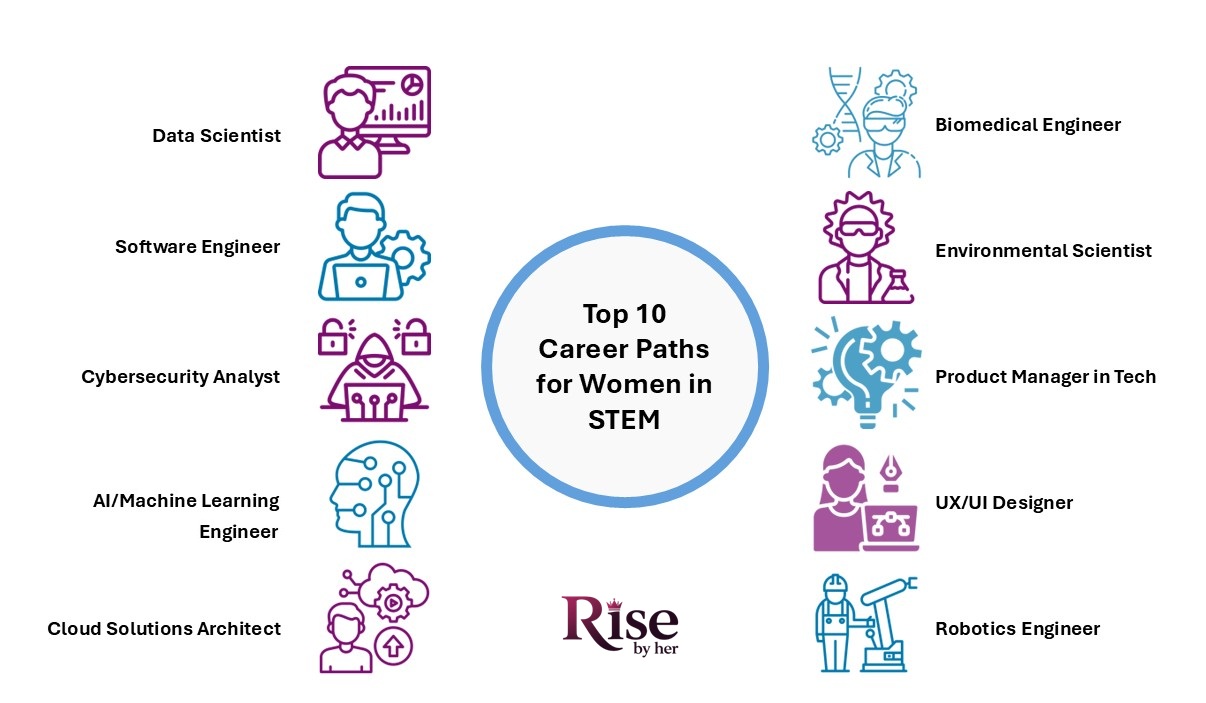
1. Data Scientist & Analytics Manager
AI and big data are transforming every industry, from healthcare to marketing. Companies need experts who can turn raw data into actionable insights.
- Average salary: $120K+
- Key industries: Tech, finance, healthcare, retail
- Top skills: Python, SQL, data visualization, machine learning
- Why it is great for women: Offers flexible remote work, strong upward mobility, and a huge demand for diverse perspectives in data interpretation.
2. Full-Stack Software Engineer
Every app, platform, and digital service needs skilled coders. The demand for software engineers continues to skyrocket.
- Average salary: $115K+
- Key industries: Technology, e-commerce, finance, education
- Top skills: JavaScript, Python, Git, Agile development
- Why it is great for women: Remote-friendly, high job security, and endless niches to specialize in (from mobile to AI).
3. Cybersecurity Analyst & Information Security Manager
With rising cyber threats, companies need professionals to protect sensitive data and secure digital systems.
- Average salary: $110K+
- Key industries: Government, banking, healthcare, defense
- Top skills: Network security, risk assessment, intrusion detection
- Why it is great for women: It is a growing field with urgent needs, plus many global companies are funding programs to bring more women into cybersecurity.
4. AI/Machine Learning Engineer
AI is now central to automation, smart tools, and predictive tech. Skilled engineers are shaping the future.
- Average salary: $130K+
- Key industries: Tech, robotics, automotive, research
- Top skills: Python, TensorFlow, neural networks, deep learning
- Why it is great for women: This field is still new and evolving, offering space for innovation, leadership, and early-career breakthroughs.
5. Cloud Solutions Architect
Companies are migrating to cloud platforms, needing experts to design and manage these infrastructures.
- Average salary: $135K+
- Key industries: IT, finance, SaaS, enterprise
- Top skills: AWS, Azure, DevOps, Kubernetes
- Why it is great for women: High pay, strong demand, and many certification pathways to break into the field (even from non-traditional backgrounds).
6. Biomedical Engineer & Healthtech Specialist
Blending healthcare with engineering, this field is innovating in medical devices, diagnostics, and treatment technologies.
- Average salary: $100K+
- Key industries: Healthcare, biotech, pharmaceuticals
- Top skills: CAD software, biology, materials science, clinical research
- Why it is great for women: Impactful work with real-world outcomes, and a growing number of women leaders in biomedical innovation.
7. Environmental Scientist & Sustainability Officer
Climate change, sustainability, and green energy are major global priorities. Environmental scientists are key players.
- Average salary: $85K+
- Key industries: Government, energy, consulting, NGOs
- Top skills: GIS mapping, environmental policy, data analysis
- Why it is great for women: Purpose-driven work, rising visibility in sustainability leadership, and opportunities in both public and private sectors.
8. Technical Product Manager (TPM)
As tech products grow more complex, companies need skilled PMs to align business goals with technical teams.
- Average salary: $120K+
- Key industries: SaaS, fintech, e-commerce, AI
- Top skills: Agile methodologies, UX design, stakeholder management
- Why it is great for women: A powerful leadership role that values communication, organization, and strategic thinking (skills where women shine).
9. UX/UI Designer & Product Researcher
Every digital product needs great user experience. This field is crucial in making tech more human-centric.
- Average salary: $95K+
- Key industries: Tech, e-commerce, education, mobile apps
- Top skills: Figma, Adobe XD, user research, prototyping
- Why it is great for women: Combines creativity and tech, offers freelance and full-time options, and is ideal for empathetic thinkers.
10. Robotics & Automation Engineer
Robotics is booming in industries like manufacturing, logistics, and healthcare, especially with automation taking over manual tasks.
- Average salary: $110K+
- Key industries: Aerospace, automotive, healthcare, industrial
- Top skills: C++, mechatronics, AI, control systems
- Why it is great for women: Hands-on innovation meets high-tech creativity, and global initiatives are pushing for gender balance in robotics.
How to Spot a Women-Inclusive STEM Workplace
Landing a high-paying STEM role is only half the battle; landing it at a company where you can actually thrive is the real win. Corporate marketing departments are excellent at drafting diversity statements, but the day-to-day reality on the engineering floor or in the data lab can be vastly different. To protect your career trajectory and mental well-being, you need to look past the glossy recruitment brochures and evaluate a company’s structural DNA.
Here is how to decode the real culture of a STEM workplace before you sign an offer letter.
Green Flags: Pay Transparency, Mentorship, and “Returnships”
A truly inclusive workplace leaves clues throughout its operational structure, hiring practices, and career development pipelines. Look for these undeniable green flags:
- Active and Funded “Returnship” Programs: Life happens. Whether due to caregiving, health, or a career pivot, taking a break shouldn’t derail your career. Top-tier STEM employers offer structured returnships—paid, mid-career internships with dedicated upskilling and mentorship designed specifically to smoothly reintegrate professionals back into high-level technical roles.
- Radical Pay Transparency: A company committed to equity doesn’t hide its numbers. Green-flag organizations publish clear, structured salary bands for every role and tier. During the hiring process, they provide the compensation range upfront without making you jump through hoops, indicating they pay for the value of the role, not your past negotiation skills.
- Formalized, Metric-Backed Mentorship: Look for established employee resource groups (ERGs) like a “Women in Tech” chapter that has executive sponsorship and a real budget. True mentorship isn’t just an informal coffee chat; it’s a structured program where senior leaders actively sponsor junior and mid-level women, clearing paths for their promotion into engineering architecture and executive leadership.
Red Flags to Avoid During the Interview Process
The interview is a two-way street—it is your best window into a company’s unvarnished culture. Watch out for these subtle but telling warning signs:
- The “Token Interviewer” Trap: If you are interviewing for a technical role, pay close attention to who evaluates your skills. If a company suddenly pulls a woman from a completely different department (like HR or marketing) just so a woman is on the panel, but the actual engineering team is entirely homogeneous, it’s a major red flag. You want to see women in the technical trenches and leadership roles evaluating your technical merit.
- The “Always On” Hustle Culture: During the interview, ask questions about deployment cycles and communication boundaries. If panels brag about “late-night coding breakthroughs” or look visibly burnt out, it indicates an asynchronous nightmare. This type of culture disproportionately impacts women who balance career growth with personal autonomy, leading to rapid burnout.
- Vague Answers on Career Progression: When you ask, “What does the promotion track look like for a Senior Developer here?” the answer should be algorithmic and clear—based on quantifiable skill milestones. If the response is vague, relying on phrases like “We just know when someone is ready” or “It’s about cultural fit,” the promotion track is highly vulnerable to subjective, unconscious bias.
How to Launch or Pivot Your STEM Career with Confidence
Breaking into STEM doesn’t require a lifetime of coding experience or an elite Ivy League pedigree. In 2026, the tech and science sectors care about one thing above all else: can you solve the problem in front of you? Whether you are a recent graduate mapping out your first move or a seasoned professional executing a mid-career pivot, the barrier to entry has evolved from where you went to school to what you can build.
Landing your target role requires a deliberate, tactical approach. Here is your expert-backed playbook to entering the STEM arena with maximum leverage and total confidence.

Choosing the Right Path: Degree vs. Skills-Based Hiring
The educational landscape has fractured, and for the first time, traditional degrees are no longer the exclusive gatekeepers to a high-paying STEM career.
- The Skills-Based Revolution: A staggering number of enterprise tech companies and startups have completely dropped four-year degree requirements. They rely on technical assessments, portfolio reviews, and practical code challenges to evaluate talent. If you can prove execution, you can get hired.
- When a Degree Matters: Formal degrees (B.S., M.S., or Ph.D.) remain highly valuable and often non-negotiable in deeply academic or regulated sub-sectors. If your dream is to work in Biomedical Engineering, Deep Tech Research, or Hardware Robotics, a structured academic foundation is still your strongest play.
- The Verdict: For software engineering, cloud computing, cybersecurity, and data analytics, your portfolio and verified skills trump a diploma. For physical engineering and life sciences, formal credentials still rule.
Top Industry-Recognized Certifications to Jumpstart Your Career
If you choose to bypass or complement a traditional degree, specialized certifications act as highly visible trust signals on your resume. In 2026, the most high-leverage certifications include:
- Cloud & Infrastructure: AWS Certified Solutions Architect or Google Cloud Professional Cloud Architect. These are gold standards for cloud infrastructure roles.
- Data & Artificial Intelligence: Microsoft Certified: Azure AI Engineer Associate or Google Data Analytics Professional Certificate. Perfect for signaling foundational mastery of data pipelines and machine learning deployments.
- Cybersecurity: CompTIA Security+ (for entry-level exposure) scaling into the CISSP (Certified Information Systems Security Professional) as you gain experience.
If you are planning to advance your career in tech, explore this guide on Top Tech Certifications Women in STEM Need for Jobs to identify the most in-demand skills employers are looking for.
Navigating the Career Pivot: Mid-Career Transitions into STEM
Pivoting into STEM from a non-technical background (like marketing, finance, or teaching) is not a restart—it’s an upgrade. Your edge lies in your domain expertise.
- Identify Your Bridge: Do not try to learn everything at once. Find the intersection of your current field and technology. If you have a background in healthcare, pivot toward HealthTech product management or clinical data analytics. If you come from finance, target FinTech or blockchain data analysis.
- Highlight Transferable Power Skills: Non-technical professionals often possess superior communication, stakeholder management, and cross-functional leadership skills. In a room full of brilliant but introverted engineers, a technical professional who can articulate complex ideas to stakeholders is incredibly rare and highly compensated.
If you are considering a career change, this guide on How to Transition Into a Tech Career as a Woman (Step-by-Step 2026 Guide) will walk you through the essential steps to get started in tech.
Gaining Real-World Experience via Internships & Open-Source Projects
The classic paradox—need experience to get a job, need a job to get experience—is easily solved in STEM if you know where to look.
- The Open-Source Pipeline: Contributing to open-source projects on platforms like GitHub is a public, verifiable way to prove you can write clean code and collaborate with global engineering teams. It acts as a living, breathing resume that hiring managers deeply respect.
- Build public portfolios: If you are a data scientist, publish clean, documented notebooks on Kaggle. If you are a UX/UI designer, build detailed case studies on Behance.
- Target “Returnships”: If you are returning to the workforce after a hiatus, specifically target companies offering mid-career internships designed to upskill and integrate experienced professionals back into technical tracks.
Tapping into Global Mentorship & Women-Led Support Networks
You do not have to build your career in a silo. Isolation is the fastest route to imposter syndrome, but a powerful network acts as an accelerant.
- Join Active Ecosystems: Immerse yourself in organizations like Girls Who Code, the Society of Women Engineers (SWE), Women in AI, and Elpha. These are not just social clubs—they are active job boards, mentorship hubs, and funding networks.
- The Power of Sponsorship: A mentor gives you advice, but a sponsor gives you opportunities. Look for senior leaders within your target network who have the organizational capital to drop your resume directly onto a hiring manager’s desk or advocate for you in closed-door talent reviews.
Mastering the Art of Salary Negotiation in Tech
The final step to launching with confidence is ensuring you do not leave money on the table. Women historically negotiate less frequently than men, compounding the wage gap over a career.
- Never Give a Number First: When a recruiter asks about your salary expectations, deflect professionally. Use phrases like: “I’m highly competitive and flexible. I’d love to learn more about the scope of the role and the total compensation package before discussing specific figures.”
- Leverage Total Compensation (TC): Remember that in STEM, your base salary is just one lever. If a company hits a hard ceiling on base pay, negotiate for a higher sign-on bonus, more Restricted Stock Units (RSUs/equity), an accelerated review schedule, or extra remote stipends.
- Use Market Data Assets: Go into the conversation armed with objective data from platforms like Levels.fyi or Glassdoor. Present your target number as a reflection of current market realities for your specific skill set, removing emotion from the transaction entirely.
If you want to improve your compensation outcomes, check out Salary Negotiation Tips for Women Leaders: How to Advocate for Your Worth to learn how to confidently negotiate your salary and advocate for your value.
Essential Resources & Communities for Women Pursuing STEM
You do not have to navigate the complex world of science, technology, engineering, and mathematics in isolation. In fact, trying to do it alone is one of the fastest routes to burnout. The global STEM ecosystem is packed with powerful, highly funded networks explicitly designed to lift women up, provide financial safety nets, and open closed doors.
Whether you need a community of peers who understand the unique dynamics of a data lab, a senior executive sponsor to greenlight your resume, or the capital to fund your transition, these resources are your competitive advantage.
Professional Organizations (e.g., Girls Who Code, Society of Women Engineers)
Joining a dedicated professional organization transforms your career from a solo journey into a collective movement. These entities act as decentralized talent networks, massive job boards, and advocacy powerhouses.
- Society of Women Engineers (SWE): For over seven decades, SWE has been the gold standard for global engineering support. Beyond local chapters, SWE hosts the world’s largest conference for women engineers, giving you direct, face-to-face hiring access to fortune 500 tech giants, aerospace firms, and deep-tech startups.
- Girls Who Code & Women Who Code Networks: While highly focused on closing the gender gap for younger developers, these ecosystems feature thriving adult alumni networks. They offer structured technical loops, interview prep channels, and a pipeline to tech companies actively seeking female engineering talent.
- Specialized Elite Ecosystems: * Elpha: Often described as the “LinkedIn for women in tech,” Elpha is a highly private, incredibly candid online community where senior software engineers, product managers, and founders share insider salary data, review company interview loops, and share unlisted job opportunities.
Scholarships, Grants, and Boot Camp Fellowships
The financial barrier to entry in STEM has never been lower, thanks to a massive influx of corporate and institutional capital specifically designated to support female-identifying talent.
- Global Fully Funded Masters Scholarships: Institutional programs are actively funding diverse cohorts. For example, the British Council Scholarships for Women in STEM completely covers tuition, stipends, and travel for women pursuing clean energy, AI, or advanced electronic engineering master’s degrees. Similarly, programs like the Pioneering Women in STEM fellowship offer full-ride paths to elite European universities.
- Private and Corporate STEM Grants: Organizations like MPOWER Financing run dedicated annual Women in STEM Scholarships targeting international and DACA students in North America, while life sciences giants run focused diversity grants to support women entering biotechnology.
- Boot Camp Fellowships & Tech Accelerators: If you are bypassing academia for an intensive skills-based transition, look for non-dilutive grant paths or corporate-backed fellowships. Tech boot camps regularly partner with organizations to offer partial or full-tuition fellowships to female applicants. For founders or mid-career leaders, regional programs like the BDC Women in Technology (WIT) Bootcamp and global schemes like the Women TechEU initiative provide substantial equity-free grants alongside mentorship to put women at the forefront of deep tech.
If you are looking for funding opportunities, explore Top Grants for Women in STEM in 2026 (How to Apply & Get Funded) to learn how to apply and increase your chances of securing financial support.
Conclusion: Empowering the Next Generation of Women in STEM
The true measure of closing the gender gap in tech and science isn’t just about how many women enter the room today—it’s about how wide we leave the door open for those following behind us. Empowering the next generation of women in STEM is a continuous cycle of representation, access, and community. When a woman secures a high-paying, flexible technical role, she changes her own economic trajectory; when she reaches back to mentor a student, sponsor an intern, or advocate for an inclusive hiring policy, she changes the trajectory of the entire industry.
As we look toward the future, rewriting the narrative around women in innovation requires three critical commitments from all of us:
- Visible Representation: You cannot be what you cannot see. Normalizing women in technical leadership, architecture, and scientific research dismantles the unconscious bias that technical spaces are inherently male domains. Every time a female data scientist, engineer, or founder shares her journey, she provides a real-world blueprint for a young girl or mid-career professional doubting their place in tech.
- Early and Equitable Access: Bridging the digital divide starts early. True empowerment means funding community coding workshops, supporting local robotics teams, and ensuring young girls have access to hands-on science and technology programs before systemic biases steer them away from quantitative tracks.
- Cultivating Active Sponsorship: Mentorship gives a young woman advice, but sponsorship gives her an opportunity. Elevating the next generation means actively using our organizational capital to drop resumes on hiring managers’ desks, advocate for promotions behind closed doors, and build supportive networks where emerging talent can safely ask questions, iterate, and grow.
The future of innovation requires diverse perspectives. By building, thriving, and pulling others up as we climb, we ensure that the next generation of women won’t just participate in the STEM economy—they will run it.
Your Next Move
What is one tactical action you can take today to move your STEM career forward? Whether it’s researching a certification, connecting with a local women-led network, or updating your portfolio, start before you are ready. The industry is waiting for your perspective.
View the complete guide of 25 High-Paying STEM Careers for Women in 2026 (Salaries, Degrees & Growth Outlook)

By Aveline Lowell
Founder & Editor-in-Chief, RisebyHer
Aveline Lowell is the Founder and Editor-in-Chief of Rise by Her, where she publishes research-driven content focused on women’s entrepreneurship, financial independence, and scalable income strategies. Her work covers profitable business models, grant opportunities, digital income growth, and strategic career advancement for modern women building sustainable wealth.
She is committed to providing structured, practical guidance that helps women make informed financial and business decisions.