

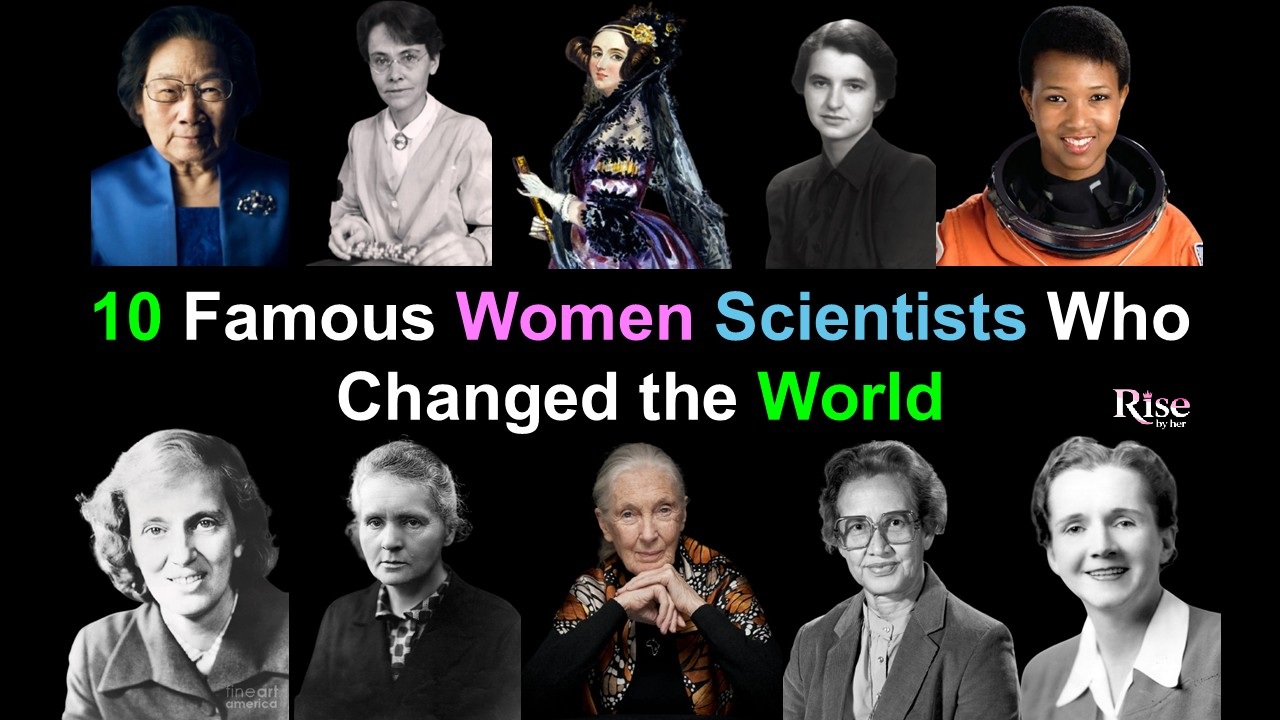
Throughout history, famous women scientists have reshaped our understanding of the universe—often while battling immense systemic barriers. From unlocking the secrets of DNA to launching astronauts into orbit and discovering life-saving medical treatments, these visionaries fundamentally altered the trajectory of modern science.
Yet, many of their groundbreaking contributions were overlooked, delayed, or attributed to others.
In this guide, we highlight 10 incredible women in STEM history whose pioneering breakthroughs changed the world forever, how their work impacts our lives today, and the lasting legacy they left behind.
Quick Summary: Famous Female Scientists at a Glance
When analyzing famous female scientists in history, their impact spans physics, genetics, space exploration, and life-saving medicine. Below is a quick-reference summary of these 10 pioneers, highlighting their field of study, core scientific breakthrough, and major global recognition.
These 10 scientists account for multiple Nobel Prizes, key discoveries behind the structure of life (DNA), and critical breakthroughs in computer science and modern spaceflight.
| Scientist | Field of Research | Key Breakthrough / Discovery | Major Award & Recognition |
|---|---|---|---|
| Marie Curie | Physics & Chemistry | Discovered Radium and Polonium; pioneered radioactivity research | First 2x Nobel Laureate (Physics 1903, Chemistry 1911) |
| Rosalind Franklin | Biophysics & X-Ray Crystallography | Captured Photo 51, revealing the DNA double-helix structure | Posthumous global recognition as a DNA co-discoverer |
| Ada Lovelace | Applied Mathematics | Wrote the first machine algorithm for the Analytical Engine | Recognized as the world’s first computer programmer |
| Katherine Johnson | Orbital Mathematics | Calculated key trajectories for NASA’s Mercury and Apollo 11 flights | Presidential Medal of Freedom (2015) |
| Jane Goodall | Primatology & Ethology | Revealed that wild chimpanzees make and use tools | UN Messenger of Peace & Dame Commander (DBE) |
| Dorothy Hodgkin | X-Ray Crystallography | Determined the 3D structures of penicillin, vitamin B12, and insulin | Nobel Prize in Chemistry (1964) |
| Barbara McClintock | Cytogenetics | Discovered genetic transposition (“jumping genes”) | Nobel Prize in Physiology or Medicine (1983) |
| Rachel Carson | Marine Biology & Ecology | Uncovered the dangers of synthetic pesticides (DDT); sparked modern environmentalism | Posthumous Presidential Medal of Freedom |
| Mae Jemison | Aerospace Engineering & Medicine | Conducted bone cell research in orbit aboard STS-47 | First Black woman in space |
| Tu Youyou | Phytochemistry & Pharmacology | Extracted artemisinin from sweet wormwood to revolutionize malaria therapy | Nobel Prize in Physiology or Medicine (2015) |
10 Pioneering Women Scientists and Their Breakthroughs
While systemic barriers historically kept many female researchers out of formal academic records, these ten extraordinary trailblazers defied the status quo. Below, we examine their scientific discoveries, historical context, and how their breakthroughs continue to drive modern innovation today.
1. Marie Curie: Pioneer of Radioactivity and First Dual-Nobel Winner
Impact at a Glance
- Core Breakthrough: Coined the term “radioactivity,” isolated radium and polonium, and developed mobile X-ray units during WWI.
- Modern Relevance: Laid the groundwork for modern oncology, nuclear physics, and radiation therapy..
Few figures in scientific history command as much reverence as Marie Skłodowska Curie. Working in a makeshift laboratory alongside her husband Pierre, Curie investigated the invisible rays emitted by uranium salts—a phenomenon she famously named radioactivity.
Her painstaking chemical isolation of pitchblende led to the discovery of two new elements: polonium and radium.
Curie made history in 1903 as the first woman to win a Nobel Prize (Physics), and again in 1911 (Chemistry), making her the only person in history to win Nobel Prizes in two distinct scientific fields. Beyond her laboratory discoveries, her creation of “Little Curies”—vehicle-mounted radiological units—saved thousands of soldiers’ lives during World War I by allowing surgeons to locate bullets and shrapnel in real-time.
2. Rosalind Franklin: The Unsung Hero Behind the DNA Double Helix
Impact at a Glance
- Core Breakthrough: Captured “Photo 51” using X-ray crystallography, proving the double-helix structure of DNA.
- Modern Relevance: Essential to modern genomics, CRISPR gene editing, and molecular biology.
The story of biophysicist Rosalind Franklin remains one of the most prominent examples of the Matilda Effect in scientific history. While working at King’s College London, Franklin perfected X-ray diffraction techniques to capture high-resolution images of biological molecules.
In May 1952, Franklin and her student Raymond Gosling captured Photo 51—the critical image providing undeniable physical proof that DNA exists as a double helix.
Unbeknownst to Franklin, her colleague Maurice Wilkins shared Photo 51 with James Watson and Francis Crick, providing the crucial missing piece for their famous 1953 DNA model. Franklin died of ovarian cancer in 1958 at age 37. Four years later, Watson, Crick, and Wilkins received the Nobel Prize in Medicine—an award Franklin was ineligible to receive posthumously, though her central role is now globally recognized.
3. Ada Lovelace: Visionary of the World’s First Computer Algorithm
Impact at a Glance
- Core Breakthrough: Wrote the first complex algorithm intended for implementation on a machine.
- Modern Relevance: Considered the foundational pioneer of computer programming and software engineering.
Daughter of the famed poet Lord Byron, Ada Lovelace possessed a rare combination of poetic imagination and rigorous mathematical talent. In 1842, while translating an Italian article on Charles Babbage’s proposed mechanical computer (the Analytical Engine), Lovelace added extensive “Notes” that were three times longer than the original text.
In these notes, she published Note G—a detailed step-by-step method for calculating Bernoulli numbers using the machine.
This is widely celebrated as the world’s first true computer algorithm. Crucially, Lovelace was the first to realize that computing devices could manipulate symbols beyond basic numbers, predicting modern digital technology over a century before electronic computers were built.
4. Katherine Johnson: The NASA Mathematician Who Calculated Moon Landings
Impact at a Glance
- Core Breakthrough: Calculated complex orbital mechanics, launch windows, and emergency return trajectories for NASA space missions.
- Modern Relevance: Enabled human space exploration, satellite orbital paths, and modern aerospace navigation.
Before electronic supercomputers powered space travel, NASA relied on human “computers”—talented mathematicians like Katherine Johnson. Joining the National Advisory Committee for Aeronautics (NACA, later NASA) in 1953, Johnson overcame double discrimination as a Black woman working in the segregated Jim Crow era.
Her mathematical genius proved indispensible. Johnson calculated the precise trajectory for Alan Shepard’s 1961 flight (making him the first American in space) and verified the computerized flight equations for John Glenn’s 1962 orbit around Earth by hand.
Later, her work on backup navigation charts helped calculate the emergency return trajectory that brought the crew of Apollo 13 home safely in 1970.
5. Jane Goodall: Primatologist Who Redefined Human-Animal Connections
Impact at a Glance
- Core Breakthrough: Documented toolmaking, social structures, and meat-eating habits in wild chimpanzees.
- Modern Relevance: Transformed primatology, ethology, and wildlife conservation frameworks worldwide.
When 26-year-old Jane Goodall arrived at Gombe Stream National Park in Tanzania in 1960 without a formal university degree, traditional scientists viewed animal behavior strictly through cold, quantitative lenses. Goodall’s unconventional approach—naming the chimpanzees rather than numbering them—unlocked groundbreaking behavioral insights.
Her most significant discovery occurred when she observed a chimpanzee named David Greybeard stripping leaves off a twig to “fish” for termites.
At the time, scientific consensus held that humans were the only species capable of making and using tools. Her mentor, anthropologist Louis Leakey, famously responded: “Now we must redefine tool, redefine Man, or accept chimpanzees as humans.” Goodall’s work permanently dismantled the rigid scientific boundary between humans and animals.
6. Dorothy Hodgkin: Nobel Chemist Who Unlocked the Structure of Insulin
Impact at a Glance
- Core Breakthrough: Used X-ray crystallography to map the 3D atomic structures of complex biological molecules like penicillin, vitamin B12, and insulin.
- Modern Relevance: Revolutionized structural biology and rational drug design in pharmacology.
British chemist Dorothy Crowfoot Hodgkin was a pioneer in using X-ray crystallography to solve complex biochemical puzzles that other researchers deemed impossible.
In 1945, Hodgkin successfully mapped the three-dimensional atomic structure of penicillin, settling a fierce debate among organic chemists and enabling mass production of the life-saving antibiotic. She went on to map vitamin B12 in 1956 (earning the 1964 Nobel Prize in Chemistry) and spent 34 years perfecting the spatial structure of insulin in 1969. Her structural breakthroughs directly enabled pharmaceutical scientists to produce synthetic insulin and targeted antibiotics at a global scale.
7. Barbara McClintock: Geneticist Who Discovered “Jumping Genes”
Impact at a Glance
- Core Breakthrough: Identified mobile genetic elements (transposons) in Indian corn (maize).
- Modern Relevance: Transformed our understanding of genome fluidity, epigenetics, and viral integration.
Cytogeneticist Barbara McClintock spent decades studying the inheritance patterns of color traits in maize kernels. In the late 1940s, her microscopic observations revealed something that completely contradicted classical genetics: segments of DNA could physically change positions on a chromosome.
She called these mobile elements transposons (popularly known as “jumping genes”).
Because the scientific establishment firmly believed that genes were fixed in rigid locations on chromosomes, her work was initially met with skepticism and outright dismissal. McClintock stopped publishing her maize research in 1953. It took 30 years for molecular biologists to rediscover transposition in bacteria and viruses, validating her research and awarding her the unshared 1983 Nobel Prize in Physiology or Medicine.
8. Rachel Carson: Ecologist Who Sparked the Global Environmental Movement
Impact at a Glance
- Core Breakthrough: Documented the bioaccumulation and ecological damage caused by synthetic chemical pesticides like DDT.
- Modern Relevance: Led to the banning of DDT, creation of the US EPA, and established modern environmental law.
A marine biologist with the U.S. Fish and Wildlife Service, Rachel Carson possessed both scientific rigor and a poetic writing style. In 1962, she published her landmark book, Silent Spring, exposing the indiscriminate use of synthetic pesticides—specifically DDT—and how these toxins bioaccumulated through food chains, threatening bird populations and human health.
The chemical industry launched aggressive personal and professional attacks against Carson, attempting to label her an “hysterical woman.”
However, her meticulous research stood up to federal scrutiny. Silent Spring catalyzed a worldwide shift in ecological consciousness, leading directly to a U.S. ban on agricultural DDT and the establishment of the U.S. Environmental Protection Agency (EPA).
9. Mae Jemison: First Black Woman in Space & Multidisciplinary Physician
Impact at a Glance
- Core Breakthrough: Conducted microgravity life-science experiments aboard Space Shuttle Endeavour (STS-47).
- Modern Relevance: Champion of science education, technological integration, and health equity.
Dr. Mae Jemison built an extraordinary career at the intersection of medicine, engineering, and space exploration. Holding degrees in chemical engineering and African-American studies from Stanford, followed by a Doctorate in Medicine from Cornell, Jemison worked as a Peace Corps medical officer in West Africa before joining NASA’s astronaut corps in 1987.
On September 12, 1992, aboard STS-47, Jemison made history as the first African American woman to enter space.
During her eight-day mission, she logged 190 hours in orbit, acting as a co-investigator on experiments evaluating bone cell research and space motion sickness. After leaving NASA, Jemison founded The 100 Year Starship project, an initiative working to ensure human interstellar space travel becomes a reality within the next century.
10. Tu Youyou: Nobel Laureate Who Saved Millions with Malaria Therapy
Impact at a Glance
- Core Breakthrough: Isolated artemisinin (qinhaosu) from traditional Chinese medical texts to create the most effective modern antimalarial drug.
- Modern Relevance: Reduced global malaria mortality rates by over 50%, saving millions of lives worldwide.
During the height of the Vietnam War, malaria was decimating soldiers on both sides. In 1969, pharmaceutical chemist Tu Youyou was appointed to head “Project 523,” a secret military research team tasked with finding a cure for chloroquine-resistant malaria.
Tu turned to ancient traditional Chinese medicine literature, sifting through over 2,000 potential herbal recipes. She discovered a reference in a 4th-century text to Artemisia annua (sweet wormwood).
By refining a low-temperature extraction technique, Tu successfully isolated artemisinin, a compound that rapidly neutralized the malaria parasite in human blood. Tu even volunteered as the first human subject to test the extract’s safety. Her discovery became the global standard for antimalarial therapy, earning her the 2015 Nobel Prize in Medicine.
Overcoming the “Matilda Effect”: Overlooked Women in STEM History
While celebrated figures like Marie Curie broke through institutional barriers, countless other women in STEM history saw their discoveries co-opted, minimized, or attributed entirely to male colleagues. In science history, this systemic bias is known as the Matilda Effect.
What is the Matilda Effect?
Coined in 1993 by science historian Margaret W. Rossiter, the Matilda Effect describes the historical bias where female scientists receive significantly less credit for their research than their male counterparts. Rossiter named the phenomenon after 19th-century suffragist and abolitionist Matilda Joslyn Gage, who first observed that male peers routinely claimed credit for women’s intellectual achievements.
Key Concept: The Matilda Effect is the scientific counterpart to the Matthew Effect (where famous scientists get disproportionate credit). Under the Matilda Effect, women’s contributions are systematically attributed to male supervisors, husbands, or lab colleagues.
3 Prominent Historical Examples of the Matilda Effect
| Lise Meitner & Nuclear Fission 1938–1944 | Austrian physicist Lise Meitner led the team that discovered nuclear fission. However, when her long-time collaborator Otto Hahn published the findings, he omitted her name due to political pressure in Nazi Germany. In 1944, Hahn was awarded the Nobel Prize in Chemistry alone, while Meitner received no official recognition despite explaining the theoretical physics behind the reaction. |
| Rosalind Franklin & the DNA Structure 1952–1962 | Biophysicist Rosalind Franklin captured Photo 51, the definitive X-ray diffraction image showing DNA’s helical structure. Her data was shared without her knowledge with James Watson and Francis Crick, who used it to build their famous 1953 DNA model. Watson, Crick, and Maurice Wilkins won the 1962 Nobel Prize, omitting credit for Franklin’s central role. |
| Jocelyn Bell Burnell & Pulsars 1967–1974 | As a postgraduate student at Cambridge, Jocelyn Bell Burnell discovered the first radio pulsars (rapidly rotating neutron stars). When the discovery was awarded the 1974 Nobel Prize in Physics, it went exclusively to her thesis advisor, Antony Hewish, and colleague Martin Ryle—ignoring Bell Burnell, who originally detected the signal. |
Why Reclaiming This History Matters Today
Recognizing these historical oversights isn’t just about correcting the archival record—it directly impacts modern STEM retention and gender equality:
- Restoring Accurate Citation: Modern scientific institutions are actively reviewing past awards and textbook citations to properly attribute intellectual property.
- Providing Visible Role Models: Highlighting overlooked researchers counters the false narrative that women were absent from early scientific breakthroughs.
- Combating Unconscious Bias: Understanding how peer-review systems and award committees historically marginalized women helps scientific journals implement double-blind review processes today.
Frequently Asked Questions About Women in Science
Who was the first recognized female scientist?
The earliest historically documented female scientist is Enheduanna, an Akkadian high priestess from around 2300 BCE who created detailed astronomical tracking systems and calendar observations in ancient Mesopotamia. In classical antiquity, Hypatia of Alexandria is celebrated as the first prominent female mathematician and astronomer, famous for editing foundational mathematical texts and designing scientific instruments like the hydrometer.
What percentage of Nobel Prizes in science have gone to women?
Roughly four to five percent of all scientific Nobel Prizes in Physics, Chemistry, and Medicine have been awarded to women. While representation in Medicine is slightly higher at around five percent, Physics remains the lowest at around two percent. However, momentum is shifting, as more than half of all female scientific Nobel laureates received their awards within the last twenty-five years.
Why were female scientists historically underrepresented in records?
Female researchers faced systemic barriers that restricted their access to higher education, research funding, and academic institutions for centuries. University policies frequently barred women from obtaining formal degrees, and male lab directors often published findings under their own names, systematically burying the contributions of their female assistants.
Who was the first woman to win a Nobel Prize?
Marie Curie became the first woman to win a Nobel Prize in 1903, earning the award in Physics for her pioneering research on radiation. She made history again in 1911 by winning a second Nobel Prize in Chemistry, making her the first person to ever receive Nobel Prizes in two different scientific fields.
What is the “Matilda Effect” in science?
The Matilda Effect is a term coined by science historian Margaret Rossiter to describe the historical bias where female scientists receive less recognition and citation for their research than male colleagues. Under this phenomenon, groundbreaking work done by women was routinely credited to their male supervisors, husbands, or lab partners instead.
How can we encourage more women and girls to pursue STEM careers?
Increasing female participation in science requires providing strong mentorship networks, ensuring early exposure to STEM subjects in school, and establishing transparent, bias-free hiring and grant review systems. Highlighting historical and contemporary female role models in educational curricula also helps break down persistent stereotypes about who belongs in scientific fields.
Conclusion: The Legacy and Future of Women in STEM
The contributions of famous women scientists demonstrate that groundbreaking discoveries rely on diverse perspectives. From early pioneers who conducted research in isolation to modern teams leading global collaborations, female scientists have consistently expanded the boundaries of physics, medicine, computing, and environmental science.
While historical biases like the Matilda Effect delayed recognition for many, their discoveries laid the foundation for modern life-saving therapies, space exploration, and sustainable technologies. Recognizing these achievements reshapes our understanding of scientific history and ensures that intellectual property is attributed accurately.
Building an equitable future in STEM requires active structural support. Establishing mentorship programs, ensuring transparent grant review processes, and providing early access to STEM education are critical steps toward closing the persistent gender gap. By dismantling historical barriers, the global scientific community ensures that future innovations draw from the full potential of global talent.
By Aveline Lowell
Founder & Editor-in-Chief, RiseByHer
Aveline Lowell writes research-driven content covering women’s finance, entrepreneurship, STEM, technology, and career growth. Her work focuses on practical, well-researched information that helps women make informed decisions.
Editorial & Disclaimer: RiseByHer aims to provide accurate, well-researched, and up-to-date information. Articles are reviewed and updated when necessary and are intended for general informational and educational purposes, not personalized financial, legal, tax, or professional advice.